
Short-term volatility is still a factor, but the market is clearly thinking long-term. All eyes are on the end of the first half of the year, when much of the uncertainty around cryptocurrencies, such as macro signals and Fed policy, should dissipate.
Take the CLARITY Act, for example. If adopted, it could give digital assets a serious legitimacy boost. Meanwhile, lingering questions surrounding the Fed chairman may finally disappear as markets have already priced in rate cuts.
In this mix Ripple [XRP] stands up.
Since it is an L1 that attracts ETF inflows, it is clear that investors are betting on the long term, even after the recent FUD. And now that more regulations are on the horizon, there is a real chance that this will happen XRP could gain even more steam in the second half of the year.

Source: SoSoValue
But here’s the question: What exactly are investors betting on?
Ripple has undoubtedly started 2026 with some strategic moves. From setting up a Ripple Treasury to obtaining regulatory licenses in multiple countries, the company is strengthening RLUSD’s use case across Europe.
Meanwhile, XRP is showing strong tokenization. Are RWA TVL is up 11% over the past 30 days, reaching a record high of $235 million. This is another signal that the network foundations continue to attract institutional capital.
That said, the price doesn’t really reflect this growth. With a 9% decline so far in 2026, XRP has fallen to $1.60 for the first time in nine months, effectively wiping out any gains it made post-election cycle.
Naturally, the question arises: is Ripple simply undervalued?
Bitcoin dictates the market, XRP feels the pressure
Altcoins closely follow Bitcoin [BTC] now.
The current one correlation between BTC and the altcoin market is 87%, which basically means Bitcoin dictates the market. If the price falls, the market bleeds. When BTC pumps, the rally usually drags everything up.
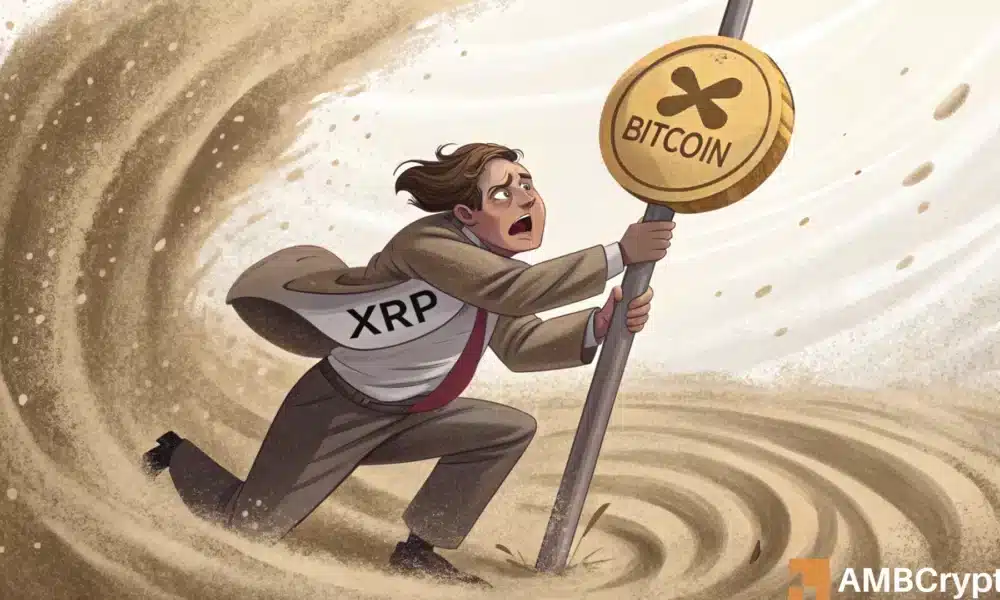
Ripple is a good example of this. Despite solid inflows, the price largely follows BTC’s movements. In fact, as the chart shows, XRP tops the table with a value of 0.998, making it the most BTC-dependent altcoin.

Source: Alpharactal
This is where Ripple’s recent collapse starts to make sense.
Even as ETF flows, strategic partnerships, and licensing point to a long-term growth strategy, the current FUD around a government shutdown and other pressures are weighing on BTC, and, by extension, XRP.
Unsurprisingly, this puts a dent in Ripple’s long-term play.
XRP just broke the $1.80 support level, shaking belief. Meanwhile, as long as BTC volatility continues to exceed fundamentalsthe impact of the recent inflows will remain muted, leaving the token exposed to deeper corrections.
Final thoughts
- ETF inflows, strategic partnerships, regulatory progress and record RWA TVL indicate continued institutional interest despite near-term FUD.
- Ripple’s correlation with Bitcoin of 0.998 represents a drop in BTC pressure on XRP, preventing the recent inflows from fully impacting the price and exposing it to deeper corrections.