
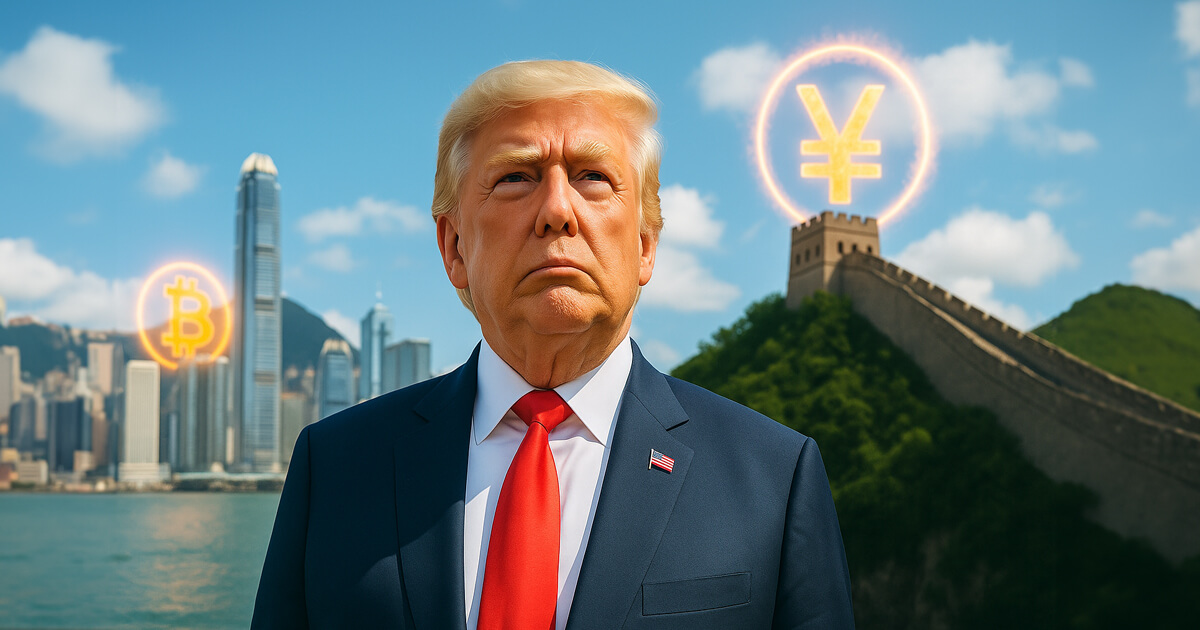

President Donald Trump told 60 Minutes on November 2 that China is a competitive threat in crypto, warning that “China is very much into it right now.”
The statement reveals a paradox. Beijing banned crypto trading and mining in 2021, yet Trump sees the country as America’s main rival in digital assets.
The decoupling is likely not about secret intelligence or a policy reversal that went unnoticed, but rather about merging Hong Kong’s licensed market, Beijing’s central bank’s digital currency ambitions and stable gray market currency flows into one “China” story.
The timing is significant as Hong Kong’s Securities and Futures Commission announced during Hong Kong FinTech Week that it will relax rules allowing licensed virtual asset platforms to tap into global order books and liquidity pools one day later.
The move deepens Hong Kong’s integration with international crypto markets, while the mainland maintains its ban.
Trump’s statement, whether intentional or not, captures a real dynamic: “China” is operating on multiple crypto fronts simultaneously, but not on the ones most people assume.
The ban on the mainland remains in effect
The People’s Bank of China declared all cryptocurrency transactions illegal on September 24, 2021, covering both peer-to-peer trading and mining activities.
The ban bans domestic exchanges, criminalizes facility services and blocks foreign platforms from serving mainland users. No major outlet or legal tracker is reporting a reversal of that framework at the time of writing.
The ban achieved its immediate goals of boosting foreign exchanges, collapsing domestic mining operations, and limiting retail access to speculative tokens.
What it didn’t take away were the reasons people wanted crypto in the first place: capital mobility, cross-border settlement speed, and distrust of intermediaries.
These forces moved into Hong Kong’s licensed regime, moved into over-the-counter stablecoin channels, or found expression in Beijing’s own digital currency project.
Hong Kong as the tolerant exceptional position
Hong Kong’s regulatory approach goes in the opposite direction. The SFC launched a licensing framework for virtual asset trading platforms in June 2023, allowing retail access to approved tokens on compliant exchanges.
In April 2024, Hong Kong had approved spot Bitcoin and Ethereum ETFs, products previously unavailable on the mainland, giving institutional investors a regulated entry point.
The November 3 announcement further expands this tolerant stance. Licensed platforms can now connect to global liquidity sources instead of operating siled order books from Hong Kong.
The change removes a structural disadvantage that Hong Kong’s domestic market alone cannot generate the depth or spreads competitive with Binance or Coinbase.
Connecting to international liquidity turns Hong Kong licensed platforms into viable alternatives for sophisticated traders looking for regulatory coverage without compromising execution quality.
This is the mechanism that makes Trump’s framework coherent, even if it is technically inaccurate. When he says “China,” he is probably lumping a Special Administrative Region with de facto policy autonomy into the same mental category as the mainland.
Hong Kong’s moves, retail entry, ETFs, and now global liquidity are creating the appearance that “China” is making progress in crypto while Beijing’s trading ban remains in place.
The CBDC layer: digital money, not crypto
Beijing’s e-CNY pilot represents the world’s largest central bank digital currency implementation by transaction volume.
According to reports, cumulative transactions exceeded 7 trillion yen by mid-2024, covering retail payments, government payments and corporate settlements.
Hong Kong began accepting e-CNY at local merchants in May 2024, linking the mainland’s digital currency infrastructure with an international financial center.
The e-CNY functions as programmable state money, centralized, monitored and designed to strengthen rather than challenge Beijing’s monetary control.
It shares no philosophical DNA with Bitcoin or decentralized finance. Yet its scale and cross-border expansion into Hong Kong contribute to the perception that ‘China’ is operating at the digital asset frontier.
Trump’s comments confuse this state-issued digital currency with permissionless crypto, but the confusion reflects a real reality. China has the most advanced retail CBDC in production, giving it credibility in claiming leadership in digital finance even as it bans decentralized alternatives.
According to reports last year, Chinese regulators are studying offshore yuan-backed stablecoins issued through Hong Kong, with the aim of tapping into cross-border settlement flows currently dominated by dollar-pegged tokens.
The proposal would allow Beijing to enforce capital controls on the mainland while providing exporters abroad with a compliant digital settlement tool.
adoption of stablecoins and gray market hashrate
Gaps in enforcement and economic incentives created a parallel system. Chinese exporters are increasingly accepting USDT for cross-border payments, bypassing the slow process of bank transfers and capital controls.
The adoption is not centrally coordinated, but is so widespread that Beijing cannot ignore it.
The flow of stablecoins also increased in trade channels between Russia and China as Western sanctions complicated traditional bank rails, turning digital dollars into a clearing layer for transactions that the formal financial system struggles to process.
This over-the-counter activity explains why the statement “China is big in crypto” holds true for traders and businesses, even as retail sales remain banned on the mainland.
The distinction between prohibited speculation and tolerated commercial use creates room for stablecoins to function as infrastructure rather than as an investment asset.
Beijing has not legalized this activity, but neither has it eradicated it, creating a calculated ambiguity that allows cross-border trade. At the same time, the state is investigating how these flows can be channeled into manageable instruments.
Furthermore, China’s hashrate did not drop to zero following the 2021 mining crackdown. Cambridge’s mining map shows continued activity, likely due to operations moving to remote provinces or transferring hardware abroad while maintaining Chinese ownership.
More importantly, Chinese companies continue to manufacture the equipment that secures global cryptocurrency networks.
Bitmain, the dominant ASIC manufacturer, operates from Beijing and continues to expand its production capacity in Southeast Asia and North America.
Even if there were no Bitcoin mining in China, the country would remain deeply entrenched in crypto infrastructure through its hardware supply chains.
Trump says ‘China is big in crypto’: what it probably means
Trump’s statement (probably) does not reflect a reversal in mainland policy or classified intelligence. It reflects a strategic reality that is more complex than binary narratives allow.
The comment ‘China is big in crypto’ collapses a number of separate phenomena. Hong Kong’s licensed market is now linked to global liquidity as Beijing’s over 7 trillion yen CBDC program extends to Hong Kong.
Exporters control the USDT trade despite capital controls, and Chinese hardware manufacturers provide the global mining infrastructure.
The liquidity announcement in Hong Kong is important because it expands the channel through which Chinese capital can legally access the crypto markets.
Licensed platforms that connect to Binance or Kraken order books offer land-based investors offshore pathways that look less like evasion and more like regulatory arbitrage.
The perception that “China” competes in the crypto space is reinforced not because Beijing has lifted its ban, but because Hong Kong has built a compliant alternative that achieves comparable market access through a different legal architecture.
Trump campaigned on making America the crypto capital, framing the issue as a binary battle for primacy.
His comments treat China as a unitary player, when in reality the country faces jurisdictional divisions, state versus private initiatives and retail bans that go hand in hand with institutional access.
Yet the core concern remains: China maintains multiple positions in crypto despite its domestic ban.
The competitive landscape Trump describes exists, but it doesn’t take the form most people take.
The ban on the mainland remains intact. The threat comes from Hong Kong’s licensed alternative, Beijing’s CBDC infrastructure, and from exporters using stablecoins, rather than a sudden Chinese adoption of decentralized finance.
What Trump called “going big on it” is less a policy shift than an acknowledgment that China has found ways to participate in the crypto markets without legalizing the activity that regulators fear most, namely uncontrolled retail speculation in unauthorized assets.