
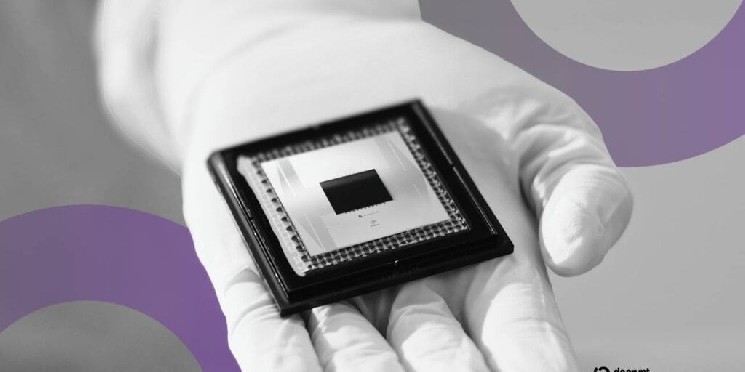
For more than a decade, the world of digital currencies has been built on a single foundation: the blockchain.
This complex, code-based system of distributed ledgers was a revolutionary approach to creating digital scarcity and preventing counterfeiting.
But now researchers at Google are exploring a concept that could sidestep this entirely, securing money not through a series of codes, but through the fundamental laws of physics.
This new research into ‘quantum money’ offers an alternative to cryptocurrencies such as Bitcoin and addresses exactly the problem that a blockchain was designed to solve.
If this succeeds – a big one if it assumes advanced quantum computing – it would essentially eliminate the need for the core technology of a blockchain, representing a fundamentally different path to a secure digital future.
In a new study called “Anonymous Quantum Tokens with Classic Authentication,“ researchers from Google Quantum AI, the University of Texas at Austin and the Czech Academy of Sciences have advanced a decades-old idea for a theoretical currency secured by the immutable laws of quantum mechanics.
The article outlines a system in which money is not just data in a ledger, but a unique quantum object whose integrity is guaranteed by the structure of reality itself.
The uncopyable dollar
The concept is based on one of the strangest and most powerful principles in physics: the ‘non-cloning theorem’.
This law states that it is impossible to create a perfect, independent copy of an unknown quantum state. While a series of data can be copied endlessly on a computer, a quantum state cannot.
“If you had a one-dollar bill that was actually a quantum state, you could prove, based on the properties of quantum mechanics, that copying such a state is impossible,” Dar Gilboa, a Google Quantum AI researcher and co-author of the study, told me. Declutter. “You could only succeed with a very small chance.”
In this system, counterfeiting is not only computationally difficult, as with Bitcoin; it is physically forbidden.
Replacing the ledger with physics
This is where the technology becomes a direct threat to the blockchain model.
The primary function of a blockchain is to prevent ‘double spending’ without a central authority. It does this by creating a huge, public and immutable accounting ledger – the distributed ledger – that everyone looks at.
Quantum money solves the same problem much more directly. You don’t need a global ledger to track the token’s ownership history yourself is not physically copyable and can only be issued once.
- Blockchain secures transaction history in a ledger.
- Quantum Money ensures security sign yourself.
If every digital dollar has its own inherent physical security, the whole energy-intensive device of a proof-of-work blockchain becomes redundant. Verification is a direct physical process, not a global consensus event.
Another philosophy: the centralized compromise
Although quantum money could replace blockchain technology, it does not share the decentralized philosophy. Gilboa is quick to make this distinction.
“We are not solving the same problem,” he emphasized. “What we do is not decentralized, so it’s not really an analogue of cryptocurrencies in any strong sense.”
The Google model assumes that a trusted central issuer, such as a bank, creates quantum tokens. However, it uses physics brilliantly to keep that problem honest.
The system is designed to provide a strong privacy guarantee, preventing the bank from tracking its own currency. Users can work together to perform a ‘swap test’ on their quantum tokens.
“If they’re not…identical, that means the bank could be tracking you,” Gilboa said. Any attempt by the bank to secretly label its money would be immediately exposed.
A glimpse of a distant future
This financial revolution will not happen tomorrow.
Gilboa emphasizes that the research is completely theoretical and far exceeds current capabilities.
“It presupposes not only having a large, fault-tolerant quantum computer, but also the ability to do quantum communications… a whole set of very difficult technical challenges,” he said.
Yet the research is of great importance.
It shows that the defining technological solution of the past decade – the blockchain – is not the only answer to securing digital value. The brutal accounting of a distributed ledger could one day be replaced by the elegant and absolute laws of the quantum realm.
“It’s a crazy tool,” Gilboa concluded. “You can do all these wild things. It’s high risk, high reward, but that’s what makes it exciting.”