

Crypto’s latest drop hit the big ones in magnitude: Bitcoin was down about 8.1% in the last 24 hours and down about 29.5% in the last 30 days, while Ether was down about 9.4% in one day and down about 41.4% in the past month; XRP fell about 10.3% in 24 hours and about 42.7% over 30 days, and Solana fell about 12.3% on the day and about 42.8% for the month.
While many point to the appointment of Kevin Warsh as the next chairman of the US Federal Reserve, noted macro analyst Alex Krüger argued on Friday on
What Went Wrong with Crypto?
Krüger described this move as a momentum break that turned into a seller’s market. In his story, the “10/10 massacre” – a nod to the sharpness of the denouement, with a pointed caveat about whether he would “get sued” for mentioning Binance – was less a mystery than a cascade of factors that steadily reduced risk appetite and then snatched away any last hope of a liquidity tailwind.
Related reading
He first pointed to the hangover of Digital Asset Treasuries (DATs) and then to a reversal in flows linked to criminal networks. Krüger said “major flows reversed following the DoJ’s indictment against Cambodia’s Prince Group last October,” describing this as a material shift in demand that may have undervalued the market while the price was still holding up.
What went wrong with crypto?
1. 10/10 carnage (will I get sued if I mention Binance?).
2. The Hangover of Digital Asset Treasuries (DATs).
3. Reverse flows from crime syndicates: Large flows returned after the DoJ’s indictment of the Cambodian Prince Group last October.
4. Quantum…
— Alex Kruger (@krugermacro) February 6, 2026
Two other themes in his post leaned explicitly on fear and opportunity costs. Krüger flagged “quantum fears (real)” as a psychological overhang, then argued that the AI boom has become a direct competitor for both capital and talent. He said the pivot isn’t subtle: “capital is about AI,” “talent is about AI,” and even “miners are about AI,” all of which close the loop around crypto’s ability to reaccelerate.
At the same time, he suggested that the global market bid has narrowed. Krüger cited a “perception of Bitcoin as American,” adding that there are “few Chinese buyers,” a contrast to participation that he said was “in large numbers behind the metal’s upward trend.”
He also described a structural shift in who “owns” the trade. “The Swamp & Institutions are taking over,” he wrote, arguing that the market has moved from “Cypherpunk/Rebel technology to ETF technology.” In his view, crypto used to be “for mavericks and geniuses,” but now “it’s a line item in a 401k” — a change that, in his view, is displacing the volatility-driven momentum that historically attracted OGs and the retail industry.
Other pressure points were more well-known: the political risk surrounding the association with Trump (“what happens when the Democrats are back?”), “minimal innovation (since Hyperliquid)” and the brutal reflexivity of the Solana memecoin cycle – “Solana casino massacre (thanks Pump Fun & the Memecoin Supercycle).”
He paired that with a supply critique: “There are 29.91 million cryptocurrencies tracked by CoinMarketCap,” he wrote, warning that “almost every coin in the top 200 is grossly overvalued,” in addition to “never-ending” launches that “pump and then dump into oblivion that only benefits insiders.” He even called the “dead digital gold story” a new barrier for marginal buyers.
Related reading
The mechanical result, Krüger said, was simple: “sellers are dumping more aggressively than usual at each pump,” while “buyers are no longer showing up to buy the dips.”
Then came what he described as the macro trigger that hardened the selloff. “And then came the Warsh nomination (which defeated Hassett and Rieder), and the market suddenly became deeply aware that Warsh is a big believer in small balance sheet: goodbye Quantitative Easing (QE) and Yield Curve Control (YCC) dreams, hello Quantitative Tightening (QT). That’s what happened.”
Krüger emphasized that he was describing the past and not predicting the next step, arguing that the damage has already been done. Still, he noted that “volume, liquidations, implied volatility and options skew indicate a local bottom has likely arrived.”
In the answers, the conversation turned to what crypto could still be used for in an AI-led cycle. One user said the rotation “makes sense” but argued that the bigger benefit is in “agent stacks” that could ultimately “manage crypto liquidity,” positioning crypto rails as infrastructure for machine-to-machine value transfer.
Krüger largely agreed on the asymmetry. “I don’t know. I was hoping for momentum. Momentum can create magic,” he wrote. “I am very concerned about points #3 and #4. Saylor just started a new initiative on #4, maybe that will help. The reality is that crypto cannot compete with AI. It’s impossible. But it can be used by AI. That is high quality hopium. Agent-to-agent payments would be better done on crypto rails.”
At the time of writing, BTC was trading at $66,029.
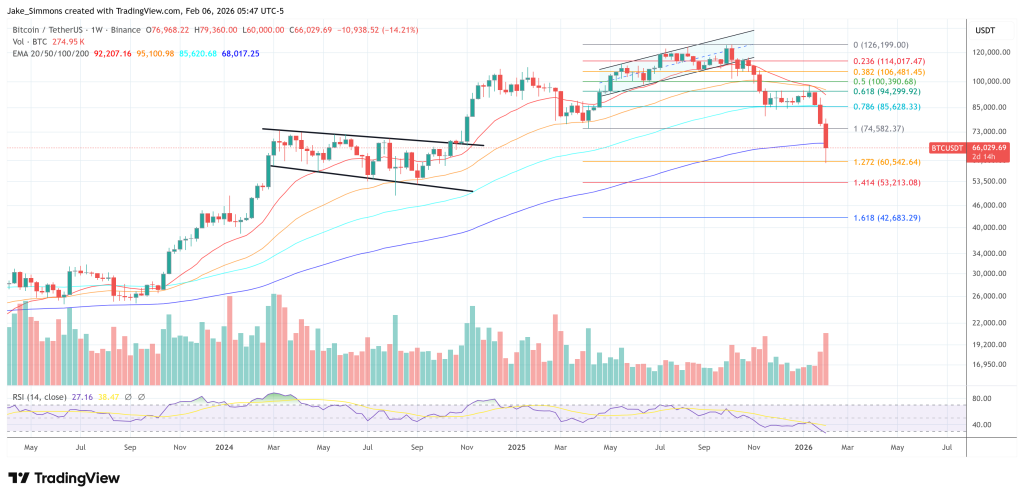
Featured image created with DALL.E, chart from TradingView.com