
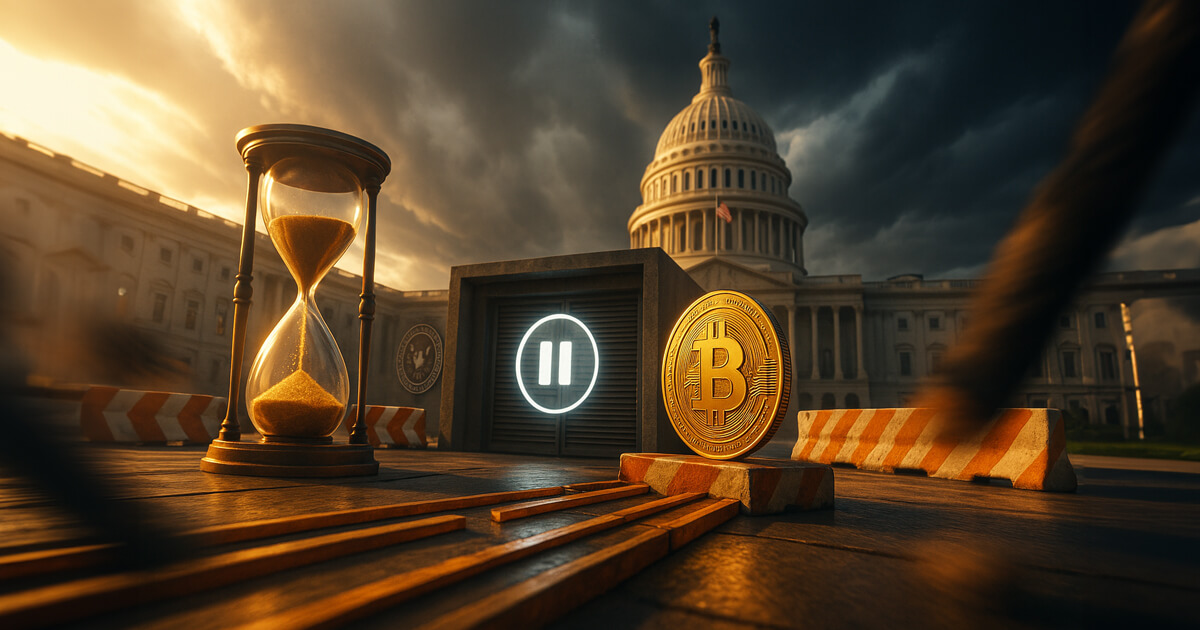

During the U.S. federal government shutdown that began on October 1, 2025, the Securities and Exchange Commission (SEC) transitioned to emergency staffing. As a result, nearly a hundred crypto ETF decisions were left stuck in the approval zone and key economic data from agencies like the Bureau of Labor Statistics and the US Census Bureau were halted.
For crypto, that blackout became an unscripted stress test, as the industry suddenly lost its usual supportive elements of regulation. And since the crypto market often prides itself on being decentralized and self-sufficient, this is a moment of truth where this claim can be proven.
How do crypto traders, exchanges and issuers perform if supervision suddenly disappears? Let’s see.
What actually pauses during a US shutdown:
- ETF and Token Submission Ratings: Routine processing of ETF and token registration documents has been largely suspended, as reflected in the SEC announcement.
- Communication with the publisher: Many channels of correspondence between the SEC and registrants are inactive during the shutdown.
- Federal data releases: Reports on jobs, inflation and trade data are delayed, according to notices from the Census Bureau and the Bureau of Labor Statistics ahead of the shutdown.
A pause in surveillance, not in action
The shutdown didn’t just put an end to new rules; it stopped everything that gives the market structure and visibility. And as enforcement activity continues to slow, crypto issuers, exchanges, and traders continue to navigate the silence on their own terms.
For issuers, it’s an exercise in patience. There is nothing to do but wait. Projects with outstanding ETF or token applications simply cannot move forward, no matter how ready they are. Bureaucratic timeouts don’t discriminate; they hit all momentum equally.
In the meantime, exchanges remain stable. The more experienced understand that smooth handling during a regulatory blackout is the best insurance policy. If something goes wrong now, it will probably be checked later. So the smart players do their best to stay compliant and avoid anything that seems questionable when the lights come back on.
However, traders appear to be getting caught up in the chaos and are viewing the shutdown as an opportunity rather than a reason to slow down. Take Bitcoin as an example: during the first two weeks since the shutdown began (October 1-14), BTC briefly traded above the $120,000 mark, with 24-hour volume of $60-70 billion, as reported by CoinMarketCap.
With no new macro data or regulatory headlines to anchor expectations, market participants are relying on the only signal left: price action. In normal times, traders ask ‘why’ something is moving. In a vacuum they only respond to ‘what’. It becomes a feedback loop: price drives sentiment, sentiment drives price. The result is a market that feels alive and unpredictable, but also disconnected from fundamentals. Whatever the market does becomes the message.
A sign of strength? Or immaturity?
That’s fascinating to watch, but also very risky. At first glance, the market seems mature. Prices have risen, liquidity is high and the stock markets are showing no signs of stress. Given the lack of active oversight, this suggests that crypto infrastructure has become more resilient than before.
But if we look beneath the surface, we can see that the shutdown also exposes weaknesses. Some traders behave as if the lack of supervision means the freedom to take greater risks. It’s the financial equivalent of kids testing their limits while their parents are away. But make no mistake: When regulators return, they will check every corner.
Periods of regulatory absence tend to lead to increased leverage and lax disclosure discipline. In the credit markets, analysts have noted that when companies operate out of full view of regulators and public disclosure, they behave with unprecedented discretion, shielded from the discipline and scrutiny usually imposed by the watchdogs.
And from what we’ve observed so far, the same implications apply to the crypto market: when oversight is minimal, boundary testing accelerates. But when the SEC’s full workforce returns, these actions won’t simply disappear – they will simply become visible for retrospective review.
So yes, the market is holding up, but it is being tested. True adulthood is not about how you act when someone is watching; it’s about what you do when no one is looking.
When the data stops flowing
For all its independence, the crypto market does not operate in a vacuum. As more traditional players enter the space, digital assets move increasingly in sync with macro signals: interest rates, inflation reports and regulatory updates. These signals determine sentiment, liquidity and strategy. When they suddenly disappear, the entire decision-making framework changes.
In their absence, other signals become increasingly important. Traders pay more attention to on-chain metrics such as portfolio flows or gas costs. Social sentiment and news chatter become substitutes for economic data. As traditional data streams have gone dark, background noise has taken center stage and become the new compass.
But this substitution has limits. While on-chain data can reveal activity, it does not always reflect intent. And so there is not always a risk. Without reliable macro context, even experienced traders can misread the tone of the market.
ETF Delays: The Silent Momentum Killer
Perhaps the most visible casualty of the shutdown is the pipeline of spot and futures ETFs that have had their ratings halted by the SEC.
These are not just financial products; they represent institutional validation and investor confidence. When approvals freeze, builders lose momentum and investors lose patience. People don’t care why the approvals are missing, just that they are there. And the entire sector is starting to feel like it’s waiting for permission again.
It’s important to remember that the postponement doesn’t mean a ‘no’ – it’s a ‘not yet’. A simple bureaucratic freeze instead of the supervisor issuing a negative judgment. But perception matters, and in a fast-changing market like crypto, even silence can feel like rejection.
Shutdowns are rarely good for everyone, but can be especially devastating for industries where timing, trust and momentum are everything.
Quick Takeaways:
- Bitcoin’s rise during the shutdown indicates confidence, but also a speculative reflex when supervision is gone.
- Delays in ETF reviews reflect bureaucracy and personnel issues, not the official position of the SEC. It is important not to let this affect overall market sentiment.
- With macro data on hold, on-chain signals and sentiment are gaining influence, but they can be misleading. These tools reflect the activity, but not always the intention.
The bigger picture
What does this stress test ultimately tell us? First, that the days when regulatory uncertainty froze all activity are largely behind us: the crypto infrastructure is now stronger and more resilient.
But it also shows that the absence of supervision does not mean that there is no risk. The market may be stable now, but when normal regulatory operations resume, it remains to be seen who has overextended themselves in the silence.
The current shutdown may be temporary, but the lessons learned about the discipline and maturity of this market will have far-reaching consequences.