

Polygon, previously known as Matic network, is a well-established cryptocurrency that is recognized among crypto investors and enthusiasts. However, not as many people know that it is actually a layer-2 solution for another digital asset — Ethereum.
Why is that important, you may ask? Well, for one, it makes this cryptocurrency more future-proof. According to the creator of Ethereum, Vitalik Buterin, many post-Merge improvements to the main network will be done using layer 2 solutions like Polygon.
Polygon does more than just make the Ethereum ecosystem more efficient — it enables cross-chain communications for different blockchains in the network. It is also one of the best platforms for creating interconnected blockchain networks. Polygon’s team refers to their project as “Ethereum’s Internet of blockchains.”
Who Сreated Polygon?
Polygon was created in October 2017 by India’s first crypto billionaires: Jaynti Kanani, Sandeep Nailwal, and Anurag Arjun. Back then, it was known as the “Matic network.”
The Polygon ecosystem has always been envisioned as an “assistant” to the Ethereum network, aiming to solve and address its key issues, such as high gas fees and lack of proper scalability solutions. Despite that, it does have its own independent proof-of-stake (PoS) blockchain.

What is Polygon Crypto? Polygon’s Rebranding
In 2021, the team behind Polygon decided to rebrand the project in order to better reflect their vision of a polychain scaling platform that supports multiple blockchains. The new name, Polygon, was chosen because it channels the idea of a “network of many different chains.”
In addition to changing the network’s name, new features also got introduced, elevating Polygon above its previous status as a simple scaling solution that could only offer plasma chains.
This rebranding has been an immense help in increasing awareness of Polygon and its native token, MATIC. The new name clarified what the network intended to do and brought much attention to this cryptocurrency.
What is the MATIC Token?
The native token of the Polygon network, MATIC is used to pay transaction fees and can also be staked in order to earn rewards for helping to secure the network. In addition, developers who build on Polygon can use MATIC tokens to access features like gas-free withdrawals and fast transactions.
You can buy MATIC token on Changelly.
How Does Polygon Work?
The Ethereum blockchain undeniably has a lot of issues that gravely impede its growth. Slow transaction speeds and high gas fees make it impossible to use ETH for everyday payments. Polygon allows users to carry out those same Ether transactions but in a faster, cheaper, and overall much more efficient way.
To do this, Polygon uses a modified proof-of-stake algorithm to secure its network, thus making it possible for consensus to be reached with every single block. The Polygon network is made up of a series of sidechains connected to the Ethereum mainnet. These sidechains are used to process transactions off-chain, which helps improve the network’s scalability.
Let’s take a look at some of the principal characteristics of the Polygon network.
Layer 2 Solution
Polygon acts as a critical Ethereum layer-2 solution, contributing to the scalability and efficiency of the Ethereum network by handling transactions off the main chain. It does this by using sidechains connected to the main Ethereum blockchain. This allows for off-chain transactions that are then settled on-chain.
Developers who build on Polygon can use MATIC tokens to pay transaction fees. Thanks to this, Polygon has lower transaction fees than Ethereum. In addition, Polygon has implemented a number of features to reduce gas costs, such as gas-free withdrawals and fast transactions.
Layer-2 solutions like Polygon are expected to be pivotal in addressing Ethereum scalability post-Merge, shaping the future of the Ethereum layer as it evolves. As a result, more and more people will likely become aware of this amazingly innovative technology and, by extension, Polygon.
Proof of Stake (PoS)
Having a PoS blockchain allows Polygon to take advantage of features like smart contracts, which enables the creation and deployment of decentralized applications (dApps). Additionally, it lets users who hold MATIC tokens stake them to earn rewards. This makes the network attractive to developers and investors alike.
Polygon’s team also used the proof-of-stake nature of its consensus mechanism to implement a number of security features, such as fraud proofs.
Polygon Bridge
The “Polygon Bridge” is the solution that allows Polygon to connect to the Ethereum network. It also enables the transfer of NFTs and ERC-20 tokens from the MATIC blockchain to the ETH one.
Polygon has two main bridges: the Proof-of-Stake and the Plasma Bridge. Although both of them have the same purpose — transferring digital assets from one blockchain to another — they employ different security methods.
Just like the name suggests, the proof-of-stake bridge uses the PoS consensus mechanism as its primary security measure. It is what helps most investors and dApp users to transfer tokens and ETH between the two chains. The Plasma bridge is more popular with developers as it is generally more secure. However, plasma chains that the Plasma bridge operates on are less user-friendly and can be less convenient to use.
Polygon Protocol
The Polygon network is powered by the Polygon Protocol, which consists of a set of smart contracts deployed on the Ethereum blockchain. The protocol is designed to offer a wide range of features to users, including but not limited to:
- Gas-free withdrawals. This feature allows users to withdraw their tokens from the Polygon network without having to pay gas fees.
- Fast transactions. Transactions on the Polygon network are confirmed in just a few seconds.
- Low transaction fees. Users only have to pay a small fee when they make a transaction on the network.
- Compatibility with multiple programming languages. This makes it much easier for developers to create and deploy dApps on the Polygon network.
How Does Polygon Differ from Other Blockchains?
Polygon has quite a few features that make it stand out from the crowd of many other cryptocurrencies and/or layer 2 solutions. Some of them we have already mentioned above — namely, its unprecedented interoperability with the Ethereum blockchain, low fees, high transaction speeds, support of multiple programming languages, and so on. However, that’s not all that makes it unique.
Most importantly, the combination of scaling solutions offered by Polygon is possibly complete like no other: in addition to the plasma chains and sidechains mentioned above, it also has zk (zero-knowledge) and optimistic rollups. Developers can pick whichever solution fits their project best, which makes the Polygon network incredibly flexible.
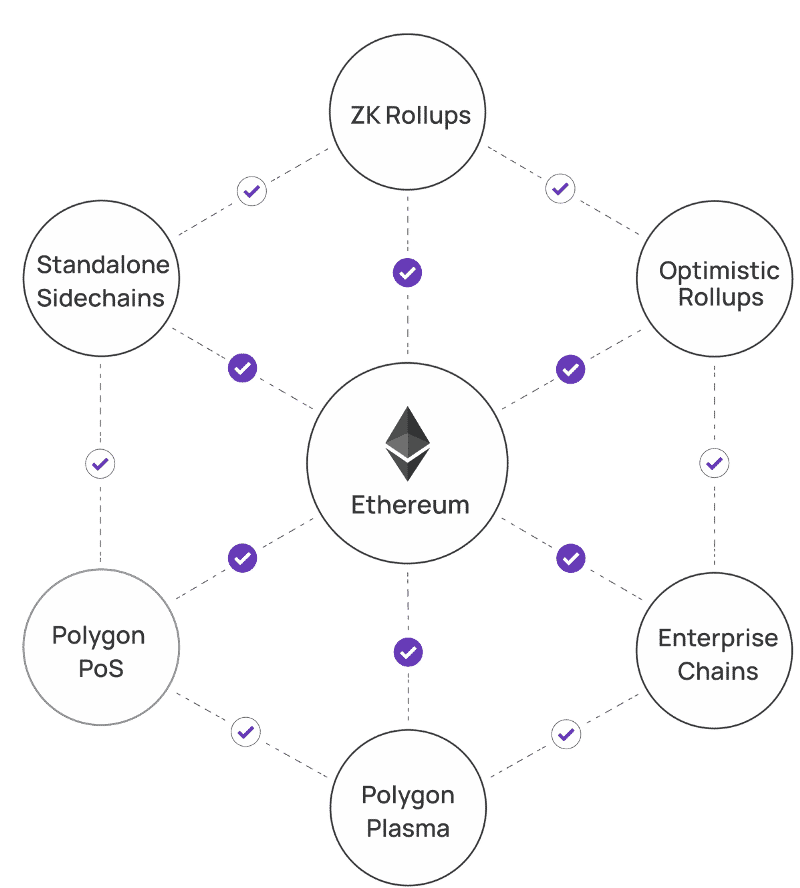
Polygon is also an EVM (Ethereum Virtual Machine) sidechain, but that doesn’t make the project unique in itself. However, it actually commits checkpoints to Ethereum, which significantly boosts the security of the whole network. That’s where the difference between Polygon and other EVM-compatible projects lies.
Polygon vs. Ethereum
The relationship between Polygon and Ethereum is foundational yet distinct. While Polygon operates as a scaling solution for the Ethereum blockchain, enhancing its efficiency, Ethereum serves as the value layer that anchors the security and integrity of networks built upon it. Polygon was conceived to address scalability issues that have long challenged the Ethereum network—high transaction fees and slower block production times.
By leveraging Polygon’s MATIC token, users enjoy reduced transaction costs and improved transaction speed, which directly combats network congestion and network load issues prevalent on Ethereum. Polygon operates a separate blockchain that runs alongside Ethereum, using a modified Proof-of-Stake mechanism to validate Polygon network transactions swiftly and with finality. Meanwhile, Ethereum continues to evolve, with its layer as the fundamental settlement layer, maintaining robustness and decentralization.
Polygon’s innovative approach and its compatibility with Ethereum have positioned it as a significant player in blockchain technology, allowing network participants to engage in network transactions with greater efficiency and at a fraction of the cost, all while benefiting from the security and reliability that Ethereum provides.
What Is Polygon 2.0?
Polygon 2.0 represents the evolution of the Polygon ecosystem, striving to create a seamless user experience akin to operating on a single blockchain network. It is designed as a network of ZK-powered L2 chains, where ZK technology refers to “zero-knowledge proofs,” a method that allows one party to prove to another that a statement is true without conveying any additional information apart from the fact that the statement is indeed true. This tech is central to ensuring privacy and scalability in blockchain systems.
The aim of Polygon 2.0 is to resolve some of the inherent blockchain constraints by combining all Polygon protocols into a unified framework of continuous blockspace, enhanced by ZK technology. This proposed upgrade is not just a simple patch but a comprehensive overhaul of the system, addressing aspects such as protocol architecture, tokenomics, and governance to streamline liquidity.
Behind Polygon 2.0 is a collaborative effort that spans over a year, bringing together the expertise of developers, researchers, and the wider communities from both Polygon and Ethereum. Community discussions, which are integral to the development and refinement of Polygon 2.0, are open and can be accessed on the community forum, reflecting the project’s commitment to transparency and collective progress.
Which DApps Use Polygon?
Polygon currently supports over 7,000 dApps, with more emerging every week. Some of the most popular Polygon-based decentralized applications include:
- Sunflower land, a game
- QuickSwap, an exchange
- Arc8, a game
- 1inch Network, a DeFi project
- Uniswap V3, an exchange
According to the website DappRadar, while games make up most projects with a high number of unique addresses, they still bring in a relatively small amount of profit and trading volume. Exchanges and DeFi projects are typically not as popular yet have a much higher amount of crypto being passed through the network’s smart contracts.
The Future of Polygon
Looking ahead, the trajectory of MATIC is one of growth and significant potential. The Polygon network aims to position itself as a primary scalability solution that not only addresses current scalability issues but also anticipates future needs, including the integration with emerging technologies such as the Internet of Things. Its market capitalization and position as Polygon’s native cryptocurrency serve as a testament to its widespread adoption and potential for mass adoption.
As blockchain projects proliferate, Polygon’s scaling solutions, including Polygon 2.0, are poised to play a crucial role in facilitating the transition to a blockchain-centric world. Apart from scaling, the focus is on ensuring that the solutions are sustainable and can handle the anticipated increase in network transactions as blockchain technology becomes more entrenched in various sectors.
How to Buy Polygon (MATIC)
To buy the Polygon MATIC token, you will first need to get a crypto wallet that supports ERC-20 tokens and then find cryptocurrency exchanges that list MATIC, like Chagelly, which lets you purchase MATIC directly with fiat currency. The process generally involves creating an account on the exchange, depositing funds or a cryptocurrency like Ethereum, and then trading it for MATIC tokens. The specifics can vary from one exchange to another, and it’s always recommended to ensure the chosen platform’s reliability and security.
After purchasing, MATIC tokens can be stored in a private wallet or kept on the exchange for trading purposes.
FAQ
Is Polygon a good investment?
Polygon has a lot going for it and seems to be relatively future-proof. Ultimately, however, what defines it as a good investment or not is how it fits your portfolio.
What is the Polygon crypto used for?
Polygon is a layer 2 solution that increases scalability and reduces fees on the Ethereum network. It can also be used to deploy dApps and stake MATIC tokens.
Does the Polygon crypto have potential?
The crypto market is extremely unpredictable, but Polygon has a lot of things that can help a crypto asset book a one-way ticket to the moon: a big market cap, innovative functionality, prospects, and a great community.
Is Polygon the same as Ethereum?
While the two naturally have their similarities, Polygon and Ethereum are two different cryptocurrencies.
How many Polygon coins are there?
Polygon’s MATIC token has a fixed supply, which introduces a scarcity factor much like Bitcoin. The total supply of MATIC tokens is capped, meaning that there is a finite number of this cryptocurrency that can ever exist. This fixed supply helps to preserve the value layer of the network and forms a part of Polygon’s tokenomics. The precise number of MATIC tokens in circulation and the total supply can usually be tracked through various market data providers or the Polygon network’s own documentation and analytics services.
Disclaimer: Please note that the contents of this article are not financial or investing advice. The information provided in this article is the author’s opinion only and should not be considered as offering trading or investing recommendations. We do not make any warranties about the completeness, reliability and accuracy of this information. The cryptocurrency market suffers from high volatility and occasional arbitrary movements. Any investor, trader, or regular crypto users should research multiple viewpoints and be familiar with all local regulations before committing to an investment.