

The total value of Unichain (TVL) has fallen 86% from its all-time high (ATH), with observers attributing the decline to the end of the stimulus program and the lack of a moat to soften the impact of ending such a program.
Tom Wan, head of data at Entropy Advisors, who shared the information Defillama Chart showing the decline also revealed that Unichain’s TVL crash is not an isolated incident, with other networks such as Linea falling 83% and Berachain experiencing a 91% decline from their respective peaks.
Unichain, the Layer 2 blockchain developed by decentralized exchange giant Uniswap, spent more than $21 million on a campaign that started in April 2025 and was managed by Glovewhich distributed approximately 3.5 million UNI tokens.
During the campaign, Unichain’s TVL increased astronomically. A significant part of that growth has now evaporated.
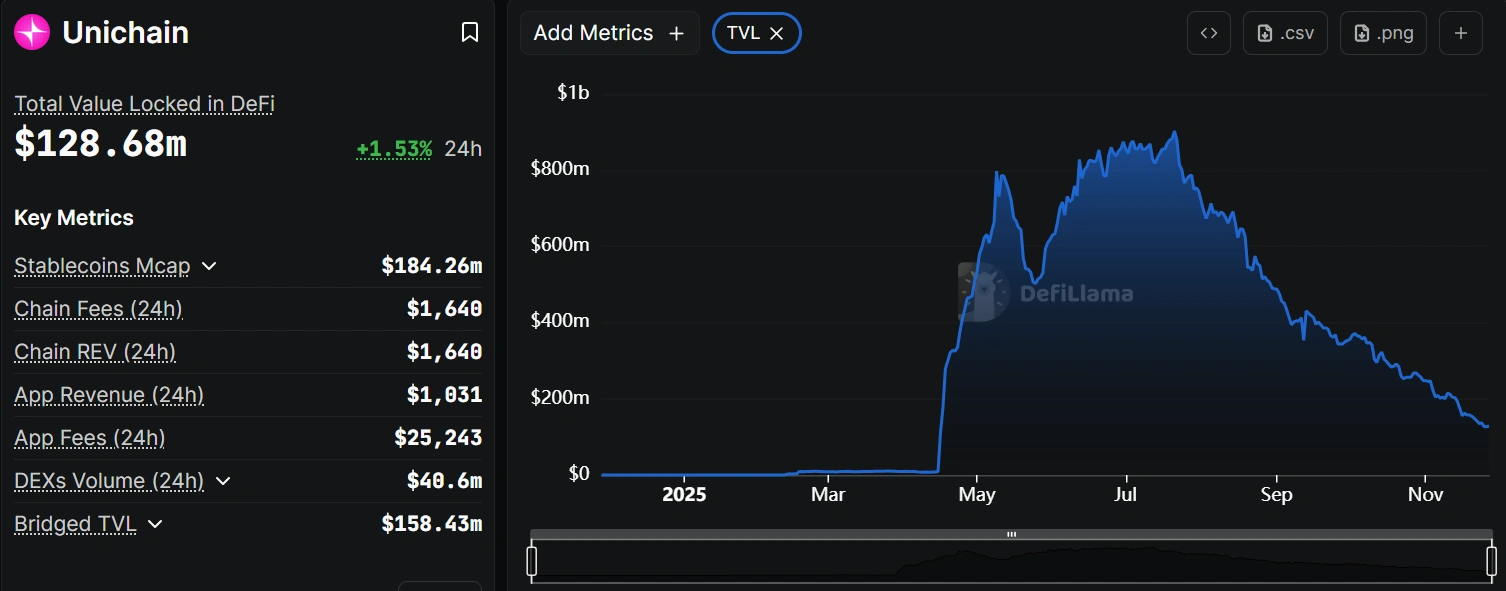
Unichain TVL is down almost 90% from its all-time high. Source: DefiLlama
Sustainable returns versus temporary incentives
Erik PinosHead of Ecosystem at Nibiru Chain, noted that “incentives are very difficult to get right” in response to Wan’s initial post.
Wan responded to Pinos, who writes: “100%, I like how we at Entropy Advisors design DRIP on Arbitrum, which supports the program to be highly reflexive to market conditions, dynamics and performance of participating protocols and assets.”
A X user under the name Soleil also assessed Unichain’s predicament, writing: “Killer apps and sustainable returns are the only two elements that TVLs can keep. For Unichain, the app is essentially Uniswap. When the incentives end, LPs have alternative choices in different DeFi protocols to maximize their ROI, the moat just isn’t there.”
Unlike established Layer 2 networks that have cultivated diverse ecosystems of applications, Unichain’s main appeal remains its connection to Uniswap itself. Without compelling reasons to maintain capital on the network beyond incentive farming, liquidity providers have simply deployed their assets toward more lucrative opportunities elsewhere.
Eliezer Ndinga, global head of research and founder of venture partner, 21shares, writes in his reply to Wan’s postalso echoed this sentiment: “Crypto actually has a product-market fit problem without those incentives. Those become table stakes. Protocols can learn so much from the founders of Web 2 bootstrapping.”
What’s next for Unichain and the blockchain market?
Unichain is not technically missing, as it still offers fast finality and low costs, features that should in principle support sustainable use and make it attractive to builders. However, the data shows that this is not happening on a large scale, and the challenge, according to observers, lies in converting transient reward seekers into regular users of on-chain applications.
On other chainsBerachain, whose platform suffered an exploit earlier this month, has been the hardest hit in terms of TVL decline. It went from a record high of over $3.3 billion to $273.67 milliona decrease of 91.7%.
LineaOn the other hand, there has been a slight recovery, from the 83% decline Wan reported to around 78.9% at the time of writing.
The reasons for these declines are not unrelated to the bear market that hit the market, with Bitcoin falling nearly $80,000 last week. However, the market has seen some progress, with Bitcoin gaining some momentum and it is now doing so priced at over $91,000. Historically, these types of events impact other blockchains, whether Layer 1 or Layer 2, and recovery can be slow and difficult.