
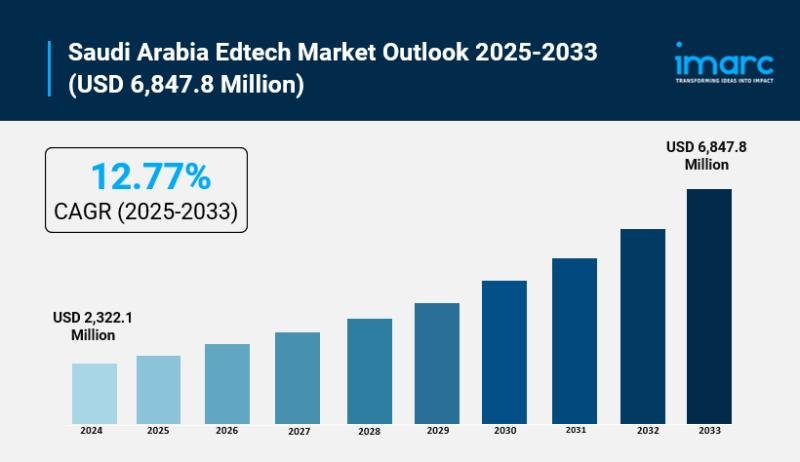
Saudi Arabia Edtech Market Overview
Market size in 2024: $2,322.1 million
Market forecast in 2033: $6,847.8 million
Market growth rate 2025-2033: 12.77%
According to IMARC Group’s latest research publication, “Saudi Arabia Edtech Market Report by Sector (Preschool, K-12, Higher Education, and Others), Type (Hardware, Software, Content), Deployment Mode (Cloud-based, On-premises), End User (Individual Learners, Institutes, Enterprises) and Region 2025-2033,” the Saudi Arabian edtech market reached $2,322.1 million in 2024. The market is expected to reach $6,847.8 million by 2033, with a growth rate (CAGR) of 12.77% over the period 2025-2033.
Evaluate market opportunities with the sample business report: https://www.imarcgroup.com/saudi-arabia-edtech-market/requestsample
How AI and digital transformation are reshaping the future of Saudi Arabia’s Edtech market
● The SAMAI initiative has trained more than a million Saudis in practical AI skills, giving students and professionals the confidence they need to succeed in an increasingly digital and innovative economy.
● Alef Education’s AI platforms create personalized learning experiences for Saudi students and improve academic performance by up to 25% in just one semester.
● The Madrasati platform uses AI analytics to track student progress in real-time, helping teachers provide targeted support and vastly increasing engagement between schools in the Kingdom.
● AI tools reduce the administrative workload of teachers in Saudi institutions by more than 35%, allowing teachers to spend more meaningful time inspiring their students every day.
● Through Saudi Vision 2030 and SDAIA programs, universities are using AI to deliver customized learning paths that help students build the advanced skills needed for tomorrow’s innovative jobs.
How Vision 2030 is transforming the Edtech industry in Saudi Arabia
Saudi Arabia’s Vision 2030 fundamentally reshapes the EdTech landscape by modernizing education infrastructure and aligning learning outcomes with the future demands of the workforce. Initiatives such as the National Transformation Program and expanded e-learning mandates are driving strong demand for digital learning platforms, adaptive learning tools and virtual classrooms. The push to increase youth employability and develop Saudi talent through upskilling and reskilling programs is accelerating the adoption of EdTech in schools, universities and corporate training. Growing smartphone penetration and government-backed digital literacy campaigns are further fueling widespread demand for innovative education technology solutions.
Edtech Market Trends and Drivers in Saudi Arabia:
The edtech market in Saudi Arabia is experiencing tremendous growth, fueled by Vision 2030’s heavy investments in digital platforms such as Madrasati, which now reaches more than 7 million primary and secondary education students with live classes and interactive tools across the Kingdom. This national e-learning center has trained more than 300,000 teachers in digital skills, making classrooms in places like Riyadh and Jeddah much more attractive and effective. With smartphone usage above 95% and 36.8 million internet users, children and parents are turning to apps for personalized lessons, especially in STEM subjects. The government’s SAMAI initiative has trained more than 1 million Saudis in the basics of AI, with women making up 52% of participants, pushing local startups to create Arabic-focused content. Real-world examples shine in rural schools, where cloud-based systems are closing gaps and noticeably increasing attendance and test scores. It is a game-changer, making education accessible and fun for everyone.
AI-powered personalization is another huge driver, with more than 210 edtech startups rolling out smart tutoring systems every year that analyze learning patterns for customized feedback, helping students master tough concepts faster. Platforms integrated into universities such as King Saud use predictive analytics to identify problems early, improving outcomes in higher education, where enrollments top 1.7 million. Vision 2030 supports this through the National eLearning Center, which certifies AI proctoring for more than 1 million digital learners and ensures secure online exams. Business news is abuzz with local companies partnering with global giants like Coursera to offer VR classrooms, cut costs and increase engagement in real-world classes. Statistics show that hardware such as tablets improves interactivity in 90% of schools, especially for individual students who prefer mobile apps. This technology makes learning feel customized, keeping Saudi youth ahead in a competitive world.
The government’s push for smart infrastructure and online accreditation is leading to new trends such as results-based digital learning, scaled up by the Ministry of Education to connect 90% of schools to national LMS platforms with real-time dashboards. High-speed internet and smart classrooms equipped with digital signage are now reaching both urban and rural areas, supporting more than 500 edtech companies focusing on pre-school to higher education content. Recent expansions accredit business platforms, combining job skills training with academic education for companies serving thousands of businesses. In action, NEOM’s edtech pilots use gamified apps to teach children coding, in line with the goals of a knowledge economy. With increasing digital literacy, end users from institutions to individuals are embracing cloud deployments, dominating with a 60% share. These steps make education seamless and future-proof, which makes everyone involved enthusiastic.
Ask analyst for custom report: https://www.imarcgroup.com/request?type=report&id=20715&flag=E
Segmentation of Edtech Industry in Saudi Arabia:
The report has segmented the market into the following categories:
Sector insights:
● Kindergarten
● Primary-12
● Higher education
● Others
Type of insights:
● Hardware
● Software
● Content
Deployment mode insights:
● Cloud-based
● On location
End-user insights:
● Individual students
● Institutes
● Enterprises
Breakdown by region:
● Eastern region
● Central region
● Western region
● Southern region
Competitive landscape:
The competitive landscape of the industry has also been examined, along with the profiles of key players.
Recent news and developments in the Edtech market in Saudi Arabia
● March 2026: Alef Education introduces advanced AI adaptive learning platforms in Saudi schools, achieving up to 25 percent improvement in students’ academic performance through customized learning paths.
● February 2026: The Madrasati platform introduces advanced AI analytics features, reducing administrative workload for teachers by 35 percent and increasing student engagement across the Kingdom.
● January 2026: The SAMAI initiative trained more than one million Saudis in practical AI skills, increasing Edtech adoption and preparing students for innovative careers.
Please note: If you require specific details, data or insights that are not currently within the scope of this report, we are happy to accommodate your request. As part of our tailor-made service, we collect and provide the additional information you need, tailored to your specific requirements. Let us know your exact needs and we will ensure the report is updated accordingly to meet your expectations.
About us:
IMARC Group is a global management consultancy helping the world’s most ambitious changemakers create lasting impact. The company offers a comprehensive suite of market entry and expansion services. IMARC’s offerings include in-depth market assessment, feasibility studies, business incorporation assistance, plant setup support, regulatory approvals and licensing navigation, branding, marketing and sales strategies, competitive landscape analysis and benchmarking, price and cost research and sourcing research.
Contact us:
IMARC group
134 N 4th St. Brooklyn, NY 11249, USA
Email: sales@imarcgroup.com
Tel. no.:(D) +91 120 433 0800
United States: +1-201971-6302
This release was published on openPR.