

Arthur Hayes argues that Bitcoin’s oft-quoted four-year halving cycle has failed and that macro liquidity – not protocol mechanisms – will dictate the market’s next phase. In a new essay titled “Long Live the King!” Published on October 9, 2025, the co-founder of BitMEX claims that policy choices in Washington and Beijing are setting up a structurally simpler money regime that should continue to push BTC higher even as many traders look for a by-the-book cycle peak. “The four-year anniversary of this fourth cycle is upon us,” he writes, but those who practice the old pattern “miss why it will fail this time.”
The four-year Bitcoin cycle is dead
Hayes’ frame is explicit: the price of money and its quantity are the dominant variables for risky assets, and the value of Bitcoin in USD rises and falls with the liquidity of the dollar. “Bitcoin is the best form of money ever created in the current state of human civilization,” he says, but the dollar price “will ebb and fall because of the price and supply of dollars.” He expands the lens to China, arguing that the yuan credit boost has historically strengthened or dampened crypto cycles, in addition to US conditions.
To make the point that the timing anchored by the halving is outdated, Hayes revisits four eras and links each era to turning points in dollar and yuan liquidity. The ‘Genesis Cycle’ (2009-2013) saw quantitative easing after the financial crisis and a surge in Chinese lending, until both slowed in 2013.[ing] the Bitcoin bubble.”
Related reading
The “ICO cycle” (2013-2017) was driven less by dollars than by “a ton of yuan sloshing around global money markets,” when China’s credit impulse peaked in 2015 amid a yuan devaluation, before tightening and higher U.S. interest rates ended the run. The “COVID Hoax” period (2017-2021) – Hayes’ label for the pandemic-era policy response – saw “helicopter money” under President Donald Trump and a rapid doubling of dollar supply, with interest rates set to zero, propelling all risky assets, including crypto, until inflation tightened in late 2021 forced.
In the current phase of the “New World Order” (2021–?) Hayes argues that liquidity levels, not halvings, explain Bitcoin’s resilience. He points to the U.S. Treasury’s tendency to issue short-term notes, which drained the Fed’s reverse repo facility and released “~$2.5 trillion of liquidity into the markets,” and characterizes this as a political choice to “spark the economy.”
Related reading
He links the macroeconomic pivot directly to today’s situation: “The Fed resumed cutting rates in September even as inflation is above its own target,” as the government seeks to “lower the cost of housing” and relax banking regulation to boost lending to “critical industries.” According to Hayes, the policy signals are unequivocal: “money will be cheaper and more abundant.”
He says China won’t repeat the extreme credit increases of 2009 or 2015, but it won’t be a headwind either. As Beijing grapples with deflationary pressures and a real estate reckoning, Hayes expects pragmatism to prevail: “If economic pressures prove too great… Chinese policymakers will print money.” The result, he says, is that China may not drive global fiat creation, “but it won’t hinder it either.”
The unifying thesis is that cycles have always been monetary cycles with different masks. Bitcoin’s previous peaks coincided with declining dollar and yuan liquidity; the latest progress reflects a realignment of political priorities toward easier money, regardless of the halving calendar.
Hayes puts it bluntly: “Listen to our monetary masters in Washington and Beijing. They clearly state that money will be cheaper and more abundant. That’s why Bitcoin continues to rise in anticipation of this very likely future.” His final line distills the claim to a coronation metaphor: “The king is dead, long live the king!”
At the time of writing, BTC was trading at $122,147.
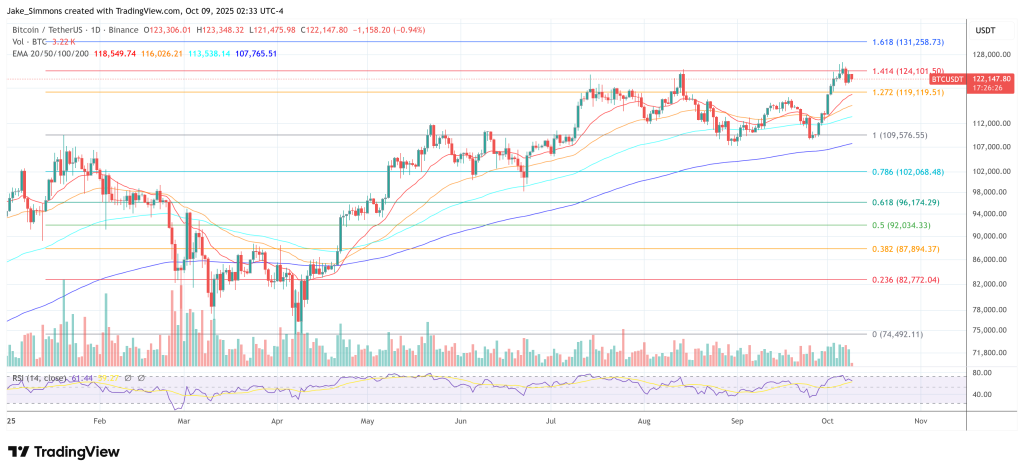
Featured image created with DALL.E, chart from TradingView.com