
Global economies experienced significant uncertainty following the imposition of trade restrictions by the United States in mid-2025.
Uncertainty in the global market continued into 2026, especially against the backdrop of increased geopolitical tensions.
As the idea of free trade weakened, investors, both individuals and central banks, turned to more established assets, especially gold.
Is gold a safer bet amid uncertainty in the global market?
Gold has been trading within an ascending channel since November 2024, rising from $2,572 to an ATH of $5,595 before retreating.
At the time of writing it is Gold [XAU] traded at $5133, extending the month-long consolidation. Amid this strong price trend, gold has gone more than 1,200 days without losing 20%.

Source: Checkonchain
With crypto seeing a stellar performance, market analysts have differing opinions on what’s behind the rally.
According to Ray DalioGold made huge gains, not only because it is seen as more established, but also because of renewed demand.
“Central banks, individuals and others are acquiring gold as an alternative because money is mechanically seen as debt.”
While central banks can print fiat money, which can cause inflation, they cannot print gold.
Furthermore, gold saw huge demand from central banks and individual investors in 2022, causing a massive surge in accumulation.
While other assets saw liquidity decline due to rising trade tensions, investors saw gold as a safer bet. More importantly, Dalio noted that gold has acted as a diversifier, performing where others have not.
He expressed:
“Gold also serves as a diversifier in a portfolio and performs well when other assets do not.”
Why Bitcoin is lagging behind
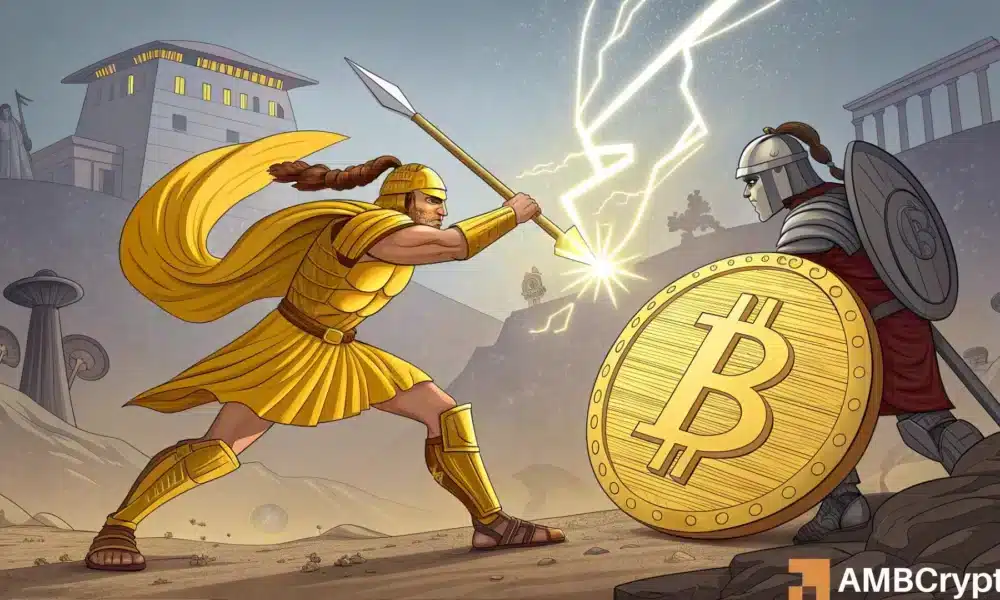
While Gold saw demand through a period of uncertainty, the markets saw Bitcoin [BTC] otherwise. Ray Dalio stated that Bitcoin could not keep pace with gold due to the nature of BTC-related transactions.
He said,
“Bitcoin has no privacy and all transactions can be monitored and indirectly controlled. Central banks will not want to buy Bitcoin and be able to hold it.”
Because transactions involving BTC are traceable, central banks are discouraged from holding them. As such, central banks have shown no interest in holding Bitcoin, starving the king coin of potential sustained demand.
Furthermore, Dalio added that,
“Bitcoin ownership tends to have a high correlation with technology stocks.”
This is evident from the recent performance of MSFT, AAPL, META, GOOG, the S&P 500 and NDQ as they have all fallen along with BTC. During this period, only NVDA and TSLA have shown more strength than Bitcoin.

Source: Checkonchain
Likewise, BTC is small compared to gold, and the market, especially traditional markets, perceives them differently.
When things get tight, investors are likely to liquidate their BTC holdings, putting downward pressure on the asset.
Therefore, Dalio argues that given the prevailing conditions, investors consider gold as a better option than Bitcoin.
Can BTC reverse the prevailing dynamics?
Bitcoin underperformed against metals through 2025, with both silver and gold remaining above the market’s baseline.
On the other hand, BTC has fallen along with SPX, SPX total return, and TILT, indicating a high correlation with stocks.

Source: Checkonchain
The performance of these assets showed that investors have reduced exposure to assets perceived as risky. As such, capital flowed into metals for preservation while also realizing profits.
Currently, global markets are more focused on assets seen as hedges against uncertain policies. Therefore, BTC remains at the mercy of global liquidity.
Under such circumstances, the likelihood that BTC can compete with gold requires a shift in demand and a restoration of liquidity. Until markets feel safe enough to flow capital into SPX and other stocks, gold is positioned to outperform BTC.
Final summary
- Gold continued to rise amid renewed demand from central banks and individual investors, Ray Dalio said
- Bitcoin failed to keep pace amid reduced liquidity and risk sentiment among investors.