
Startup VeryAI has raised $10 million in a seed funding round led by Polychain Capital to launch a palm-scan identity verification system designed to distinguish real users from AI-generated accounts.
The platform records identity attestations on Solana and aims to help crypto exchanges, fintech companies and online platforms tackle the growing risks of bots, deepfakes and synthetic identities. The company said zero-knowledge proofs allow users to verify their status across platforms without revealing any personal information.
The system captures palm images using a smartphone camera and converts them into encrypted biometric signatures used to confirm that a user is human without storing any identifying data.
According to the company, palm biometrics are highly distinctive and less publicly visible than facial features commonly used in identity checks. The scans are converted into irreversible feature representations rather than stored images, preventing the original biometric data from being reconstructed.
“We are entering a period where the internet can no longer assume that every account, post or video was created by a real person,” Zach Meltzer, founder and CEO of VeryAI, told Cointelegraph. “AI is powerful, but it also breaks many of the trust assumptions on which the internet is built.”
He said crypto platforms are vulnerable to these risks, citing examples such as sybil attacks during onboarding, fake accounts generating token incentives, and impersonation scams targeting users and project communities.
The goal isn’t just to prove that a human exists somewhere; it is also to help platforms verify that a real person is present and acting authentically.
The company is already working with organizations like MEXC, Colosseum, Clique and Talus, while other centralized exchanges and wallets are preparing to integrate the palm verification system, Meltzer said.
Investors in the round included the Berggruen Institute and Anagram. Anatoly Yakovenko, co-founder of the Solana blockchain, also joined as an angel investor.
Related: Crypto ATM Losses to Rise 33% by 2025 as AI Superpowers Scams: CertiK
AI-generated identities are driving demand for proof-of-human systems
As artificial intelligence continues to blur the line between human and automated activities on the internet, some developers say blockchain-based identity systems can help restore trust in digital interactions.
Chris Dixon, general partner at Andreessen Horowitz and founder of the venture capital firm’s crypto investment arm a16z, warned last year that an “ocean of AI-powered deepfakes and bots” could erode trust on the internet and suggested that blockchain systems could help address the problem through cryptographic verification of identity and digital content.
One company trying to tackle the problem is World, co-founded by Sam Altman, which uses biometric iris scans to generate a digital identity that allows users to prove they are human without revealing any personal data. The system records proof of a user’s uniqueness on a blockchain network, while the Orb device scans a person’s face and iris to verify identity, although the biometric approach has drawn criticism from privacy advocates.
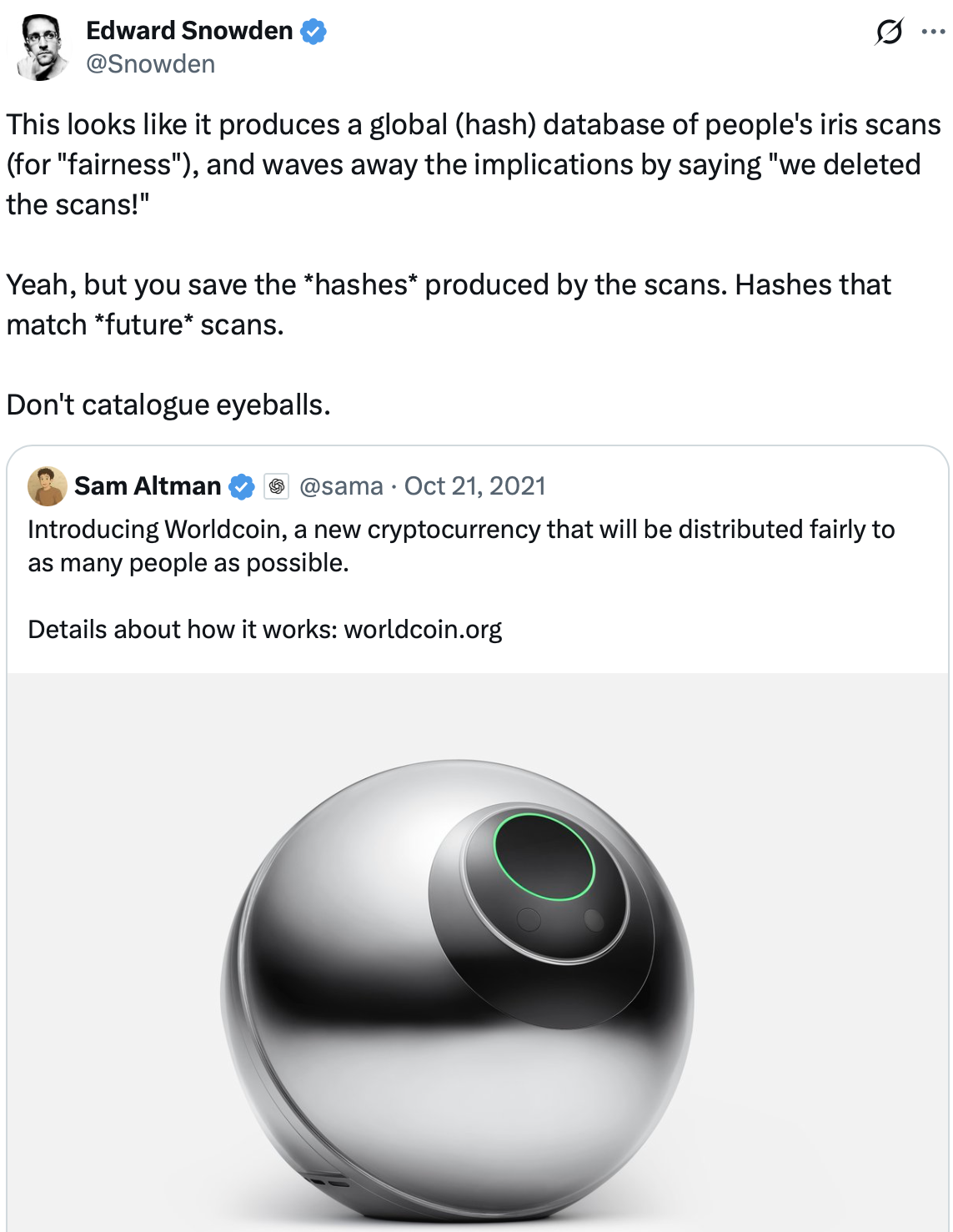
Source: Edward Snowden
As AI advances, interest in these systems appears to be growing. In January, the token tied to World (WLD) rose about 40% after reports that OpenAI was exploring a bot-free social media platform that would require users to verify they are human before participating.
Some developers argue that identity verification must strike a balance between authentication and privacy protection. Ethereum co-founder Vitalik Buterin has advocated models that allow users to prove specific attributes, such as uniqueness or eligibility, without revealing their full identity, using technologies such as zero-knowledge proofs.
Magazine: Fly’s mind ‘uploaded’, wetware from human brain cells plays Doom: AI Eye