
As blockchain technology matures, the industry faces a crucial challenge: balancing transparency with privacy. Most public blockchains make all transaction data public, which poses risks for companies and individuals. This tension has led to debate over whether decentralization must sacrifice confidentiality.
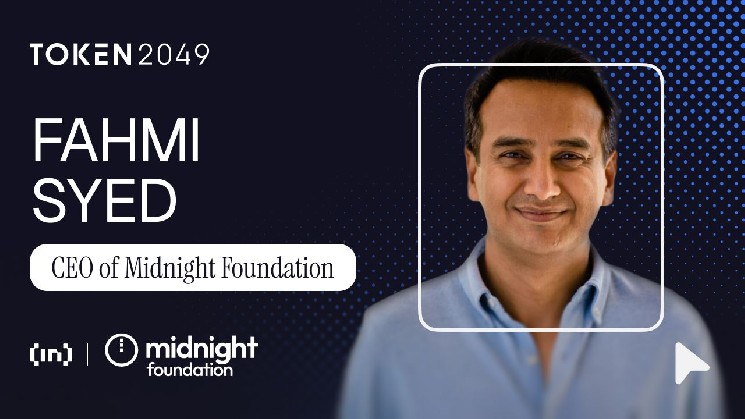
Fahmi Syed, chairman of the Midnight Foundation, believes there is a better way forward. During Token2049 Singapore at the main event venue, he outlined BeInCrypto Midnight’s vision for ‘rational privacy’. Midnight’s approach uses zero-knowledge proof-based smart contracts to unlock selective disclosure: the ability to control what you share, when and with whom.
Briefly explain Midnight Network and how it differs from other privacy-focused blockchains.
Midnight is a new layer one blockchain, built on advances in zero-knowledge proofs. We built a dual-state, public and private ledger architecture that allows applications to validate sensitive data using cryptographic proofs.
Through zero-knowledge proofs and purpose-built smart contract disclosure mechanisms, individuals, companies, and machines can decide what to share, when to share it, and with whom to share it. This is what we call “rational privacy”: selective, programmable privacy that protects sensitive data by default while still enabling compliance and auditability when necessary.
Today, most public blockchains are transparent or pseudo-anonymous, but pseudo-anonymity is not privacy; over time, identities and wallets can be exposed, tracked, or compromised.
How does your approach differ from previous attempts to add privacy to public blockchains?
Public ZK chains started with Monero and Zcash, among others. These privacy-focused networks showed how zero-knowledge proofs could protect sensitive data, but because their tokens acted as a store of value, they raised compliance concerns for not only regulators, but also companies that must adhere to KYC/KYB procedures.
The next evolution was the rise of ZK rollups or ZK chains, which mainly focused on scaling blockchain transactions and later included some privacy features. But when you try to adjust privacy, there is always a risk of exposure.
At Midnight, we’ve built privacy into the core of the network, allowing you to protect sensitive data and metadata while remaining auditable on-chain. This essentially allows you to build technology and applications that preserve privacy without sacrificing compliance.
What is Midnight’s mechanism that enables both privacy and compliance?
Private data should not be on a blockchain. The most valuable uses of private data occur when value can be derived from it while the underlying information remains under the exclusive control of the owner. One way this can happen is through evidence and certificates. For example, identity cards, property deeds or accreditation. These proofs function as keys that enable your access to deeper levels of a product, service or network.
Today, valuable data is siloed and completely underutilized. What Midnight can do is bring such silos together to unlock shared value, without risk of exposure. Instead of sharing raw data over networks, you can provide attestations, or evidence that allows untrusted parties to collaborate in a trusted way. In this way I see Midnight as a layer of truth, through our smart contracts you can allow disclosures or enable different parties to validate information without risk.
With Midnight you can choose who, when and to whom you disclose information. People often think of privacy as trying to obscure or shield. We believe that privacy is a starting point for compliance. Privacy with selective disclosure will enable better compliance.
Midnight uses a two-component tokenomics system with NIGHT and DUST. What motivated this design choice and how does it address the economic challenges faced by other Layer-1 blockchains?
The current economic model for most blockchains is not only confusing, it’s broken. For example, you may have a Samsung phone, but you are not paying for your Samsung phone with your Samsung shares. Why? Because your shares are an investment, your phone is just a product that you use or ‘consume’.
Today, the tokens you select for investment purposes in Ethereum, Cardano, Solana, and other L1s are the same assets you use to pay transaction fees or “gas.” This is counter-intuitive: for example, what happens if the token price increases in value? Transaction fees rise, especially during periods of network congestion, meaning you cannibalize your investment just to make a transaction, effectively bringing the network to a standstill.
We parted ways at midnight property and utility by consumption. NIGHT is our proprietary utility token that gives you ownership and control of Midnight. NIGHT generates DUST, a renewable, shielded resource. DUST does not function as a store of value as it decays within seven days. Instead of paying for transactions with NIGHT, you pay with DUST, and if you own NIGHT, your supply of DUST will keep replenishing. This model ensures that you don’t cannibalize your primary asset just to pay for using the network.
The Glacier Drop has attracted a lot of attention in the community. Can you share its key objectives and how it supports Midnight’s vision?
We are so confident in our technology and its capabilities that we are giving away 100 percent of NIGHT’s token supply through a multi-phase distribution process, starting with the Glacier Drop, which is open to users from eight major blockchain ecosystems. If you had at least $100 worth of BTC, ETH, ADA, SOL, AVAX, BNB, XRP, or BAT tokens in a self-custodial wallet on the snapshot date, you are eligible to come and claim. The number of NIGHT you can claim corresponds to your ownership in the other eligible chains. The more you have, the more NIGHT you receive. Participants from each of these ecosystems will have the opportunity to come and claim before we open this up to everyone during the Scavenger Mine phase.
Scavenger Mine allows anyone, from any ecosystem or background, to claim a share of Glacier Drop’s unclaimed tokens. Only after the end of Scavenger Mine will a distribution be made to the Midnight Foundation, the on-chain treasury and the on-chain reserves.
You recently announced a partnership with Google Cloud. How does this partnership advance Midnight’s business adoption goals, and what does it mean for bringing traditional Web2 companies into the blockchain space?
That’s right, our partnership with Google Cloud provides enterprise-grade infrastructure support for our network, giving institutions and others more confidence to use Midnight’s privacy-enhancing infrastructure. Through this partnership and others, millions of users and thousands of business customers are welcome to use Midnight’s technology to add enhanced privacy functionality to their products and services.
Can you explain this collaboration with a practical example?
A healthcare company in Turkey with three million patients is currently working with us to explore how they can use blockchain infrastructure to generate evidence of their patients’ medical histories. Our strategy is to start with partners with slightly lower regulatory hurdles for proof of concept. Once we can demonstrate viability in one area, we can expand it to another area. For example, we are now in discussions with a large hospital in California that wants to use Midnight for cross-clinical studies with other external partners. They want to protect sensitive patient data, so they’re exploring how Midnight can bring together disparate silos of medical history and records to achieve better outcomes for their patients and the medical industry as a whole, without ever exposing the data in the chain.
Can you walk us through Midnight’s roadmap from testnet to mainnet launch? What are the key milestones and goals for the rest of 2025 and beyond?
Our primary goal for this year is to successfully complete Glacier Drop, launch our token, and prepare for the mainnet launch. From there, our focus will be on how we bring our technology to market while maintaining our path towards decentralization. To build institutional trust, our strategy is to launch with a consortium of federated nodes, consisting of ten trusted partners running validators, to provide the robustness, speed, and scalability needed for businesses to operate securely and confidently.
As we scale, through feature releases, upgrades, and with partners bringing in more transaction volume, Midnight will gradually evolve into a decentralized ecosystem. To support this, when we launch on the mainnet, we will run a boosted testnet in parallel with the federated mainnet. Ultimately, the two will converge and we will end up with a fully decentralized blockchain where validation is done not just by trusted partners, but by a broader group of 100 to 200 validators.
The post Midnight Redefines Blockchain Privacy with Zero Knowledge and Rational Design appeared first on BeInCrypto.