
Ethereum and Bitcoin, two of the largest blockchains in the world, face significant challenges in scaling their networks. As more users and transactions move to layer two (L2) solutions, these systems can undermine the security and sustainability of the base layer (L1), reducing fees and rewards for miners and validators.
The growing adoption of L2 raises concerns for base layers
Both Ethereum and Bitcoin are grappling with a fundamental problem: how to scale their networks to accommodate growing numbers of users without sacrificing security or decentralization. Recently, Cybercapital founder Justin Bons presented his theory that Layer 2 (L2) platforms are ‘parasitic’ to Ethereum. Bons has long warned about the growing influence of Ethereum L2 solutions on the main chain, as well as other blockchains that use L2 scaling methods. The following is an overview of the dilemma faced by Layer 1 (L1) blockchains such as Bitcoin and Ethereum.
In their current state, neither blockchain can process transactions at speeds comparable to centralized systems like Visa or Mastercard, and the cost of using the base layer can be prohibitively high. Since 2015, tweaking Bitcoin’s consensus layer to improve scalability has sparked ongoing debate, with proponents increasingly favoring L2 solutions like the Lightning Network. Ethereum core developers have also strived to help L2s such as Arbitrum, Optimism, Base, and Linea flourish.
These L2s promise faster transactions and lower fees, but also introduce a new set of challenges. Layer two solutions, by design, move transactions from the base layer, or L1, to a secondary layer. For Ethereum, L2s such as Arbitrum and Optimism bundle multiple transactions into a single L1 transaction, reducing costs and increasing throughput. For Bitcoin, the Lightning Network allows users to conduct off-chain transactions, only settling on the main blockchain when absolutely necessary. While these solutions are praised for improving transaction speed and reducing costs, they pose a potential threat to the security and economic model of L1 blockchains.
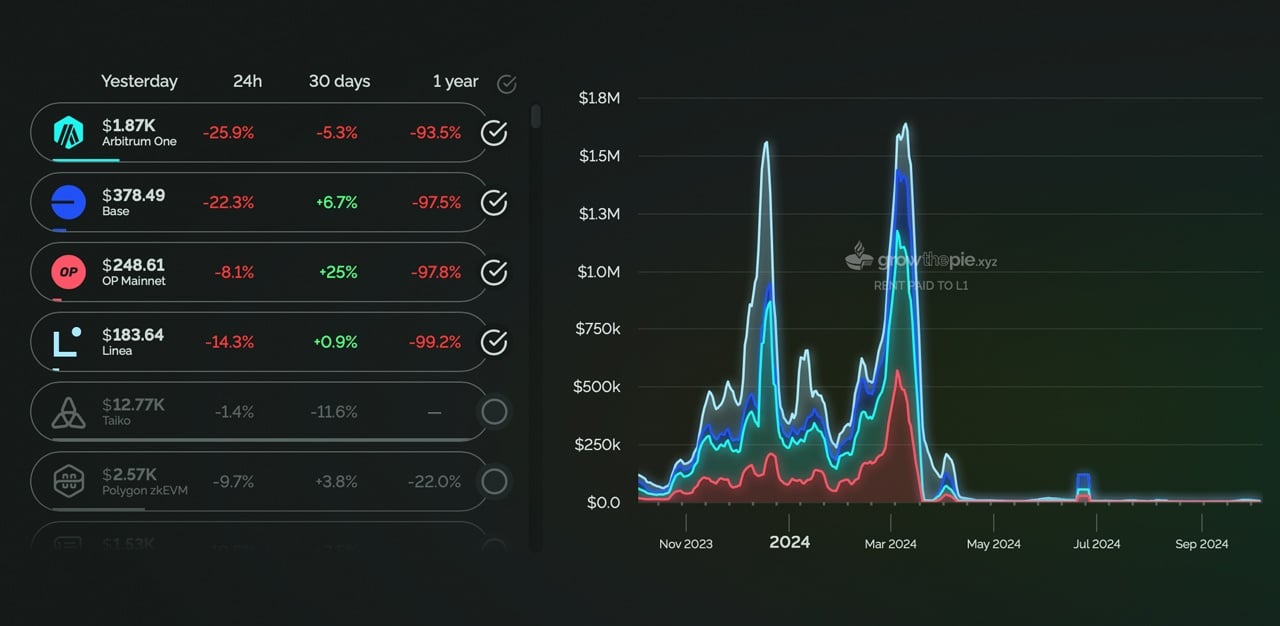
Rent paid to L1 (Ethereum) according to growthepie.xyz.
Ethereum’s first layer once benefited significantly from activity on these L2s. As of November 2023, L2 solutions such as Arbitrum, Base, Optimism, and Linea contributed an estimated $200,000 in daily rents to Ethereum’s L1. By December, these fees had risen to as much as $1.5 million per day. However, financial support has declined since then. From December 2023 to March 2024, L2 payments to Ethereum fell to less than $250,000 per day, before peaking at around $1.7 million in early March. By the end of April 2024, these fees had dropped dramatically, with less than $10,000 per day being paid to the Ethereum mainnet. This decline raises questions about the long-term sustainability of Ethereum’s L1 infrastructure if most activity shifts to L2s permanently.
Bitcoin faces a similar problem. Once Bitcoin (BTC) is moved to the Lightning Network or other Bitcoin sidechains, transactions bypass the main chain, freeing miners from the fees they would traditionally earn from processing transactions. Bitcoin’s economic security depends on the incentives given to miners, both through transaction fees and the block reward, which halves approximately every four years. As fees move off-chain, concerns are growing that Bitcoin miners may no longer have sufficient economic motivation to continue securing the network, potentially making it less secure over time.
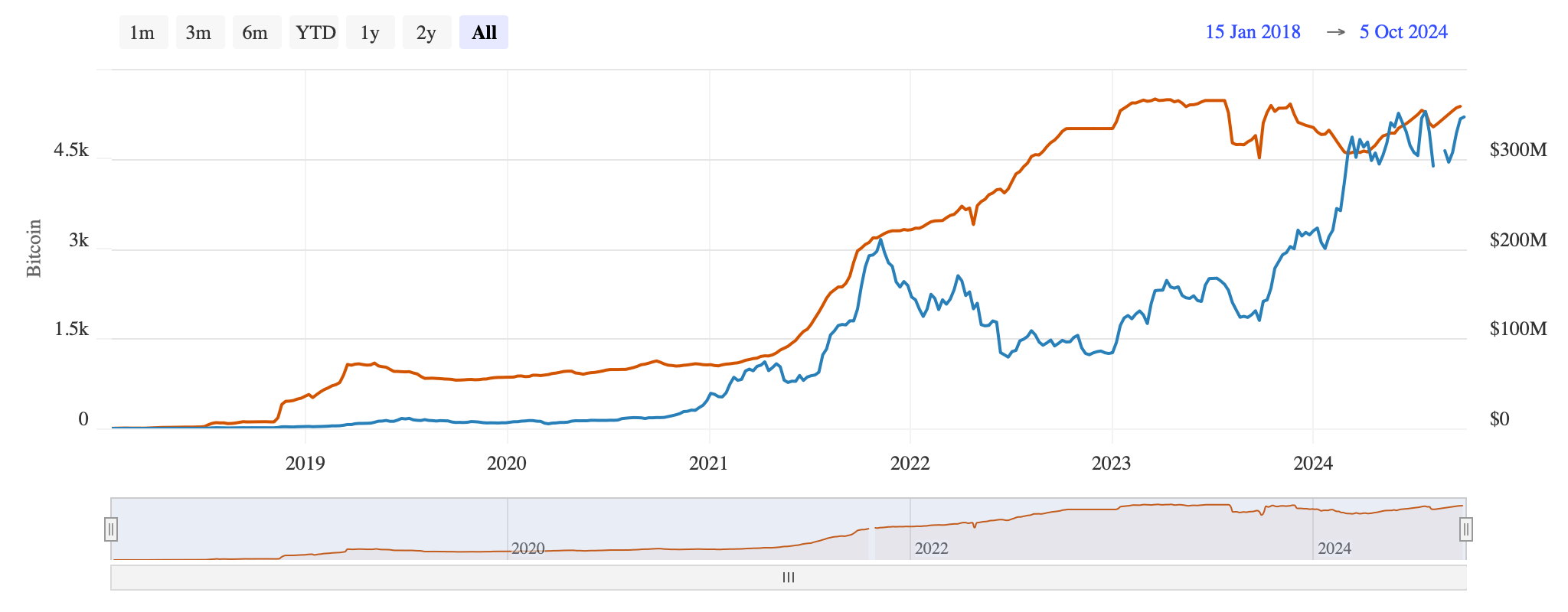
According to data from bitcoinvisuals.com, the capacity of Bitcoin’s Lightning Network (LN) is approximately 5,360 BTC as of October 6, 2024. Miners only receive fees when bitcoin (BTC) is moved into or out of Lightning Channels, meaning no fees are paid to them while transactions occur off-chain on LN. Similarly, wrapped bitcoin (WBTC) and other tokenized forms of bitcoin do not contribute significant fees to the L1 once converted.
In addition to Bons, Blockchair’s lead developer Nikita Zhavoronkov has expressed concerns about Bitcoin’s shrinking security budget. The fundamental problem lies in the fact that both Ethereum and Bitcoin were designed with the expectation that users would pay to use the base layer. These fees are a crucial part of maintaining the security of the blockchain, especially as block rewards diminish over time. If too many transactions occur on L2s, the L1 may suffer from insufficient fees, reducing the incentives for validators and miners to secure the network.
L2 solutions such as Arbitrum and Optimism, while providing immediate benefits in terms of scalability and cost-efficiency, could undermine the long-term viability of Ethereum’s L1 if they are not designed to contribute sufficiently to the base layer. Similarly, Bitcoin’s Lightning Network, while addressing some of Bitcoin’s scalability issues, removes miners from the transaction loop entirely, making BTC’s security model solely dependent on diminishing block rewards.
While there is no doubt that L2 solutions provide a temporary solution to the scalability problems of both Ethereum and Bitcoin, they raise important questions about the long-term health of these networks. If L1 blockchains rely on a steady stream of fees to incentivize miners and validators, and if those fees are increasingly captured by L2 solutions, the economic model of these blockchains could become unbalanced.
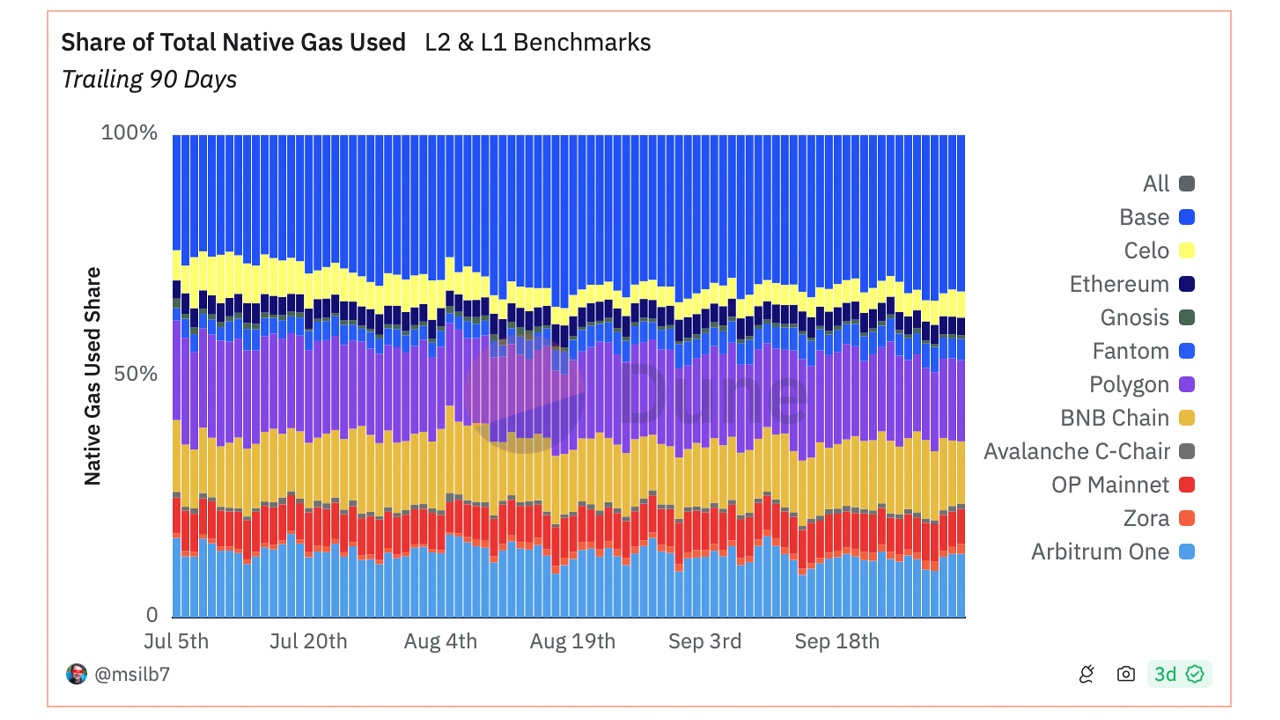
Dune.com statistics on share of total indigenous gas used – L2 and L1 benchmarks as of October 6, 2024.
The ultimate goal for both Ethereum and Bitcoin has always been to create decentralized, secure networks that can handle global demand. However, if L2 solutions continue to move transactions away from L1 without providing sufficient compensation to the base layer, the security and decentralization of these networks could be compromised. Finding a balance between L1 and L2 activity is crucial for the future of blockchain scalability. The issue of rewards also does not address criticisms of T2 concepts, which are often seen as significantly more centralized than the main chain, making them more vulnerable to attack and theft.
In conclusion, while L2 solutions offer clear benefits in terms of transaction speed and costs, they also pose significant risks to the long-term sustainability of Ethereum and Bitcoin. Without a mechanism to ensure that L2s contribute meaningfully to the security and infrastructure of the base layer, these solutions may prove to be a workaround rather than a permanent solution. Both the Ethereum and Bitcoin communities will need to carefully consider how to scale their networks without compromising the fundamental principles that make them unique in the world of decentralized finance.
As mainstream adoption approaches, the urgency for Ethereum and Bitcoin communities to address these scaling issues increases. If a sustainable balance between L1 and L2 is not achieved soon, the security and decentralization of these blockchains could be at risk in the coming years. Resolving these challenges is critical to maintaining the integrity of the networks and ensuring their long-term viability.
What are your thoughts on the L2 issues facing the Bitcoin network and Ethereum protocol? Tell us in the comments below.