
XRP approaches mid-February, caught between technical stress and renewed accumulation. After one of the sharpest sell-offs in months, the token has recovered from recent lows but remains below a key resistance zone around $1.50.
Related reading
The conflicting signals, extreme oversold indicators, heavy capitulation volume and steady institutional inflows are fueling the debate on whether XRP is stabilizing or simply pausing before falling again.
The latest recession unfolded quickly. XRP fell more than 30% from early January highs and briefly reached the $1.11 level during the February 5 market-wide sell-off. That drop coincided with the spike in fear in the crypto markets, as Bitcoin fell to $60,000 and broad liquidations wiped out hundreds of billions in market value.
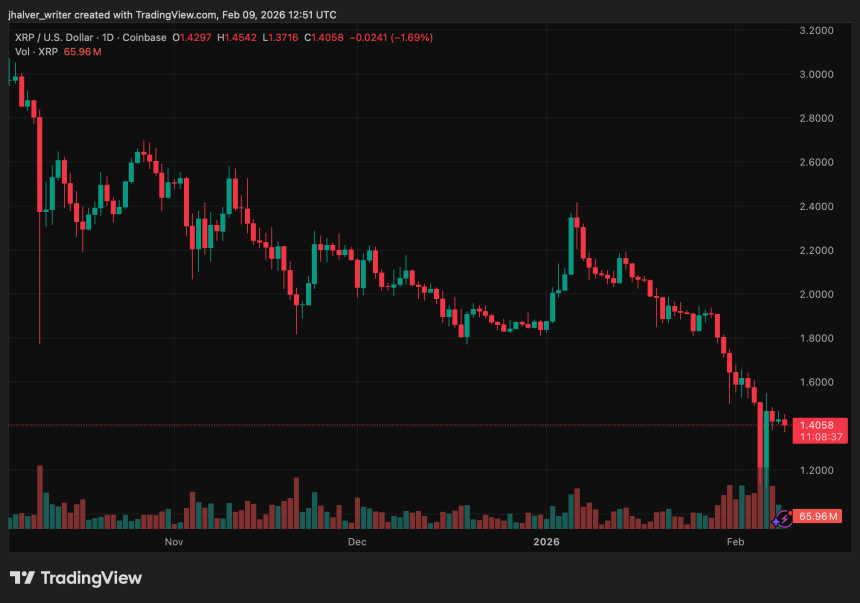
XRP's price trends to the downside on the daily chart. Source: XRPUSD on Tradingview
Oversold signals and capitulation volumes
Technical analysts point to unusual momentum conditions. On the weekly chart, XRP’s Relative Strength Index fell to levels historically associated with market bottoms rather than routine declines.
Analysts like STEF IS CRYPTO Note that these measurements often reflect a depletion of sales, although they do not guarantee an immediate reversal.
Volume data adds weight to that image. During the February 5 crash, XRP recorded the highest single-day trading volume on Coinbase in almost a year, a pattern that some analysts associate with capitulation.
Blockchain Backer, who had previously warned of a downturn in January, said such spikes often mark the later stages of a decline, even if prices still consolidate or bottom out again afterward.
XRP dip buyers are stepping in because institutions are interested
As retail sentiment weakened during the decline, several leading investors publicly announced dip buying.
Media personality Patrick Bet-David confirmed that he had increased his XRP position during the sell-off, following similar revelations from market commentator Coach JV. Both viewed their purchases as long-term accumulation rather than short-term transactions.
Institutional data tell a similar story. XRP was the only major crypto asset to post positive ETF flows last week, bringing in about $45 million in net inflows, while Bitcoin, Ethereum and Solana products saw outflows.
Most of that demand came from Franklin Templeton and Bitwise XRP ETFs, suggesting some institutions are maintaining exposure despite continued price weakness.
The $1.50 level remains the line to watch
Despite the recovery, technical resistance remains strong. XRP continues to trade below former support zones between $1.50 and $1.65, which now act as supply. Analysts caution that the recent gains should be viewed as corrective until the price regains these levels and starts forming higher lows.
Related reading
For now, XRP is at a crossroads. Oversold conditions and steady inflows suggest selling pressure is easing, but the market has yet to confirm a broader trend change. Whether XRP can turn the stabilization into a sustainable recovery will likely depend on how it behaves around the $1.50 resistance in the coming days.
Cover image of ChatGPT, XRPUSD chart on Tradingview