
At the time of writing, Bitcoin [BTC] hovered around the key level of $70,000, attracting significant attention in the US Congress.
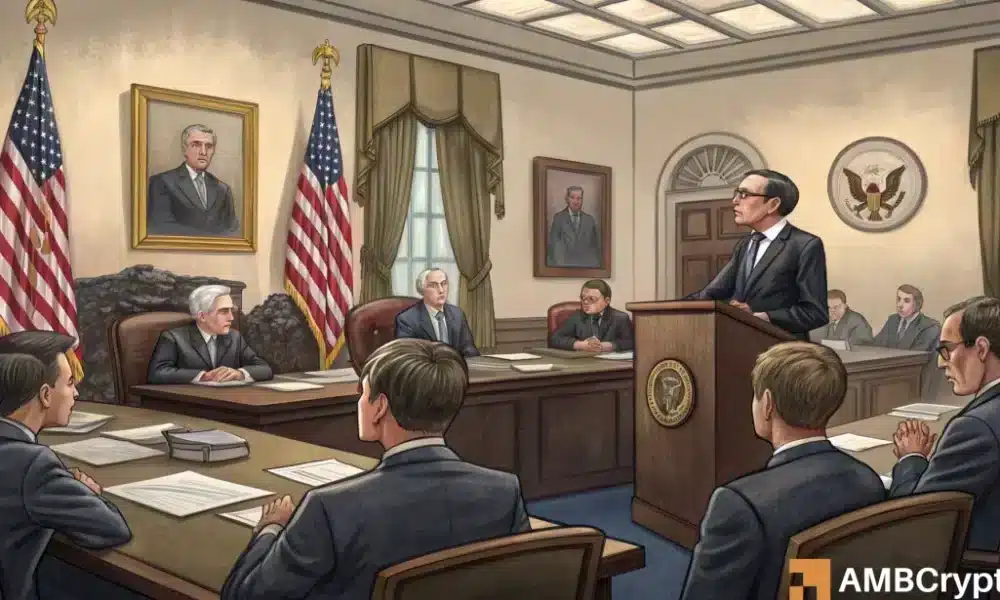
During a review of the 2025 FSOC report, Treasury Secretary Scott Bessent faced pointed questions about crypto and its impact on financial stability.
While testifying before the House Financial Services Committee, Secretary Bessent came under pressure from Representative Brad Sherman, a well-known critic of crypto. Sherman asked him whether the government would be able or willing to step in to “save” Bitcoin if the price were to collapse.
This tense exchange underscored a broader debate: Should Bitcoin be left entirely to the free market, or should it be treated as a strategic asset that the U.S. government may need to protect?
What was said?
Representative Sherman asked,
“Can you order the banks of this country to buy more Bitcoin or change the banking rules so that they are incentivized to do so in terms of the reserves they would otherwise have to have?”
To which Bessent replied:
“I am the Minister of Finance. I do not have the authority to do that and as chairman of the FSOC I do not have that authority either.”
Tensions escalated when Sherman pushed for a straight yes-or-no answer to the question of whether taxpayer money would ever be used to support a shrinking crypto market.
Instead of responding directly, Minister Bessent shifted the discussion to the government’s broader strategy.
He defended the Strategic Bitcoin Reserve, emphasizing that it is not a financial burden but a national security asset designed to strengthen America’s role in the digital economy.
Bessent replied:
“We are holding the seized Bitcoin. That’s not exactly taxpayer money. That is an asset of the US. It is an asset of the US.”
In doing so, Bessent made clear that the Treasury Department sees Bitcoin as an important part of the U.S. financial system, one that it plans to support through policy, not bailouts.
Bessent confirmed during the hearing that the seized Bitcoin had increased in value.
He said,
“Of the $1 billion worth of Bitcoin that was seized, $500 million was retained, and that $500 million has become over $15 billion.”
Trump’s pro-crypto stance is front and center
For the administration and its supporters, including Chairman French Hill and Representative Andy Barr, the growth of crypto-related assets shows that their pro-growth policies are working. However, Democrats ended the session with heavy criticism.
Senior member Maxine Waters said the administration’s policies favor Wall Street over ordinary Americans. Overall, Democrats accused Treasury Secretary Bessent of dismissing dire warnings about potential market risks.
Republicans, on the other hand, defended the government.
Chairman French Hill praised the deregulation and strong economic data, while Bessent said lighter regulations would support innovation and small banks.
Overall, Republicans supported “tailor-made” regulations, arguing that smaller banks should not be treated the same as large global institutions and emphasizing the need to strengthen the commercial banking sector.
Final thoughts
- Finance Minister Bessent’s defense of the seized Bitcoin signals a shift toward treating digital assets as strategic reserves.
- Democrats’ warnings reflect continued fears of a repeat of past financial crises.