

Internet of Things (IoT) market
Market outlook and forecasts
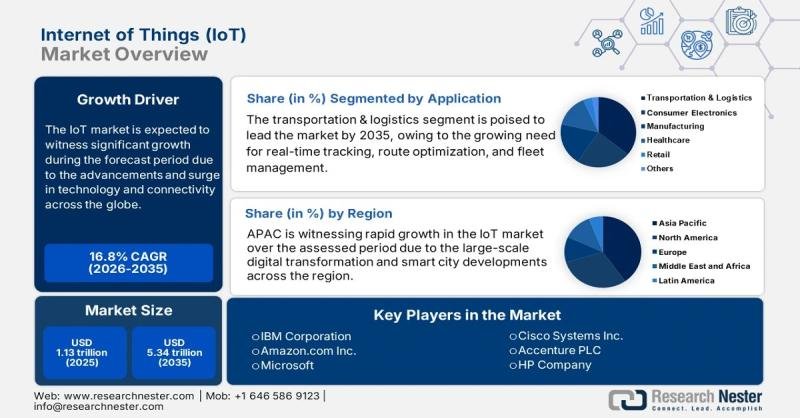
The Internet of Things (IoT) market continues to evolve as interconnected devices reshape operations across industries, governments and consumer environments. By 2025, the IoT market will reach $1.13 trillion, reflecting widespread adoption in industrial automation, smart infrastructure and asset tracking ecosystems. The market is expected to grow significantly to $5.34 trillion by 2035, supported by robust modernization initiatives, extensive cloud integration and maturing edge computing capabilities. The forecast period 2026-2035 expects a CAGR of 16.8%, underscoring the strong long-term growth momentum of the IoT market.
➤ Request a free sample PDF report @ https://www.researchnester.com/sample-request-1189
Highlights of regional achievements
North America remains one of the early adopters of IoT technology, driven by enterprise digital transformation, intelligent transportation programs and high adoption of connected consumer electronics. The region’s advanced cloud landscape and strong cybersecurity frameworks continue to support IoT innovation.
Europe is showing steady growth, fueled by smart manufacturing, the development of EV infrastructure and strict energy efficiency policies. Countries such as Germany, France, the Netherlands and the Nordic countries are accelerating the creation of interconnected industrial ecosystems, increasing demand for IoT in the public and private sectors.
The Asia Pacific region is expected to capture the largest market share by 2035, driven by the large-scale deployment of IoT in smart cities, expanding 5G deployment and rapid industrial automation in China, India, Japan and South Korea. Government-backed digitalization initiatives and increasing consumer adoption of connected devices are further boosting regional dominance.
➤ Access comprehensive insights on competitive strategies, market sizing and regional analyses. Overview of the Internet of Things (IoT) Market Report Here: https://www.researchnester.com/reports/internet-of-things-iot-market/1189
Market segmentation
The IoT market includes diverse segments, each experiencing different growth patterns based on emerging use cases and technology maturity.
Transport & Logistics is poised to have a 35.8% share by 2035 as real-time fleet visibility, connected supply chain networks, predictive maintenance and autonomous mobility become mainstream. Advanced telematics and sensor-based monitoring are transforming the way goods move across borders.
The component segment, which includes devices, sensors, platforms and connectivity solutions, continues to experience strong demand. Miniaturization, cost-efficient chipsets and improved interoperability enable new deployment models in healthcare IoT, smart utilities, industrial IoT (IIoT) and commercial buildings.
➤ Discover how the Internet of Things (IoT) market is developing globally – view your free sample report → https://www.researchnester.com/sample-request-1189
Key market trends
1. Edge Computing Redefining real-time data processing
One of the most transformative shifts within the IoT landscape is the mainstream adoption of edge computing, which minimizes latency by processing data closer to connected devices. This trend is particularly relevant for industries that require immediate decision-making, such as manufacturing automation, autonomous vehicles and smart healthcare systems.
Recent deployments of edge AI chips, distributed computing architectures, and containerized applications illustrate enterprises’ accelerating shift from cloud-only to hybrid edge-cloud environments. As a result, organizations realize lower data transfer costs, improved security, and faster operational responsiveness.
2. Increase in AI-powered IoT ecosystems
AI-powered IoT platforms are increasingly playing a central role in enabling predictive analytics, autonomous workflows and decentralized systems. Innovations in machine learning, neural networks and generative AI are upgrading IoT capabilities from simple monitoring to dynamic, self-optimizing environments.
Examples include AI-enabled predictive maintenance in industrial facilities, intelligent routing in logistics and adaptive building management systems in commercial real estate. Over the past year, organizations have invested heavily in AI-IoT integration to enable higher efficiency and more resilient operations.
3. Growing attention to sustainability and energy efficiency
Sustainability initiatives are driving companies and governments to adopt IoT solutions that optimize energy consumption, reduce waste and promote environmental compliance. Smart meters, automated network systems, connected agricultural instruments and sensor-driven water management platforms highlight the growing role of IoT in managing the environment.
Recent collaborations between utilities, smart city developers and IoT solutions providers illustrate how connected technologies are being used to monitor carbon emissions, track resource efficiency and support circular economy models.
➤ Unlock detailed analysis of the key market trends transforming hybrid mobility. Get your sample report → https://www.researchnester.com/sample-request-1189
Recent business developments driving the IoT market
A broad ecosystem of established companies and emerging innovators continues to push the IoT market to new levels of technological maturity. Over the past twelve months, numerous developments, including acquisitions, product launches, financing rounds and strategic partnerships, have shaped the competitive landscape.
1. Amazon Web Services (AWS) – AWS has expanded its IoT Core and IoT Greengrass capabilities with enhanced edge-processing frameworks and AI model integration. The company also launched new security features aimed at industrial IoT users.
2. Cisco Systems – Cisco has announced strategic updates to its IoT networking portfolio, including rugged routers and expanded software-defined networking (SD-WAN) capabilities for enterprise IoT. Cisco also strengthened cybersecurity offerings focused on connected industrial assets.
3. Siemens AG-Siemens introduced advanced industrial IoT modules within its MindSphere ecosystem, allowing manufacturers to deploy deeper analytics and predictive maintenance tools. Several acquisitions in the field of automation and digital twin software strengthened Siemens’ position.
4. IBM- IBM continued to expand its hybrid cloud and AI-IoT integration and release new automation capabilities within the IBM Maximo suite. Partnerships with telecom operators strengthened IoT deployments in utilities and infrastructure.
5. Samsung Electronics – Samsung has continued to evolve its connected device strategy with new smart-home IoT platforms and ecosystem partnerships. Recent investments in semiconductor innovation are supporting the next generation of IoT chipsets.
➤ Request a free sample PDF report @ https://www.researchnester.com/sample-request-1189
Together, these companies illustrate the diverse innovations taking place in the Internet of Things (IoT) market, strengthening the long-term potential of the sector.
Related news:
https://www.linkedin.com/pulse/why-businesses-prioritizing-infrastructure-asset-management-svzwf/
https://www.linkedin.com/pulse/how-custom-virtual-routers-transforming-network-infrastructure-mmgtf/
Contact details
AJ Daniel
Corporate Sales, USA
Research Nester
77 Water Street 8th Floor, New York, 10005
Email: info@researchnester.com
US Phone: +1 646 586 9123
Europe Phone: +44 203 608 5919
About Nester Research
Research Nester is a one-stop service provider with a client base in over 50 countries, a leader in strategic market research and consulting with an unbiased and unparalleled approach to helping global industry players, conglomerates and executives with their future investments, while avoiding future uncertainties. With an out-of-the-box mentality to produce statistical and analytical market research reports, we provide strategic advice so that our clients can make wise business decisions with clarity, while strategizing and planning for their future needs and succeeding in achieving their future endeavors. We believe that every company can explore its new horizons, provided the right guidance is available at the right time through strategic minds.
This release is published on openPR.