
Decentralized applications (DApps), including apps for gaming, have gained traction due to their transparency, security, and ownership of user assets. However, delivering high-quality AAA gaming experiences through DApps comes with challenges.
Existing 2D gaming DApps operate on blockchain networks using smart contracts for asset management. Although they are favored for their simple mechanics and efficient use of resources, their limitations become apparent as the complexity of the gaming experience increases.
Scalability is a primary hurdle for traditional blockchains like Ethereum, impacting real-time interactive gaming due to limitations around transaction throughput and latency.
Performance is also an issue. AAA games require powerful computers and superior graphics. Yet existing DApps struggle to meet these demands, resulting in subpar visual experiences.
Furthermore, developing AAA gaming DApps is costly due to blockchain resource-intensive tasks and execution costs. Balancing immersive experiences with user-friendly releases complicates the use of traditional DApp frameworks for AAA games.
What is the actor model?
The ‘actor model’ is a communications model that enables parallel computing and asynchronous messaging within a blockchain protocol, making it possible for developers to build complex DApps with less effort.
The actor model is used within the Gear Protocol and development was led by Nikolay Volf, founder of the Gear Protocol and Vara and one of the key developers of Polkadot and the Substrate framework.
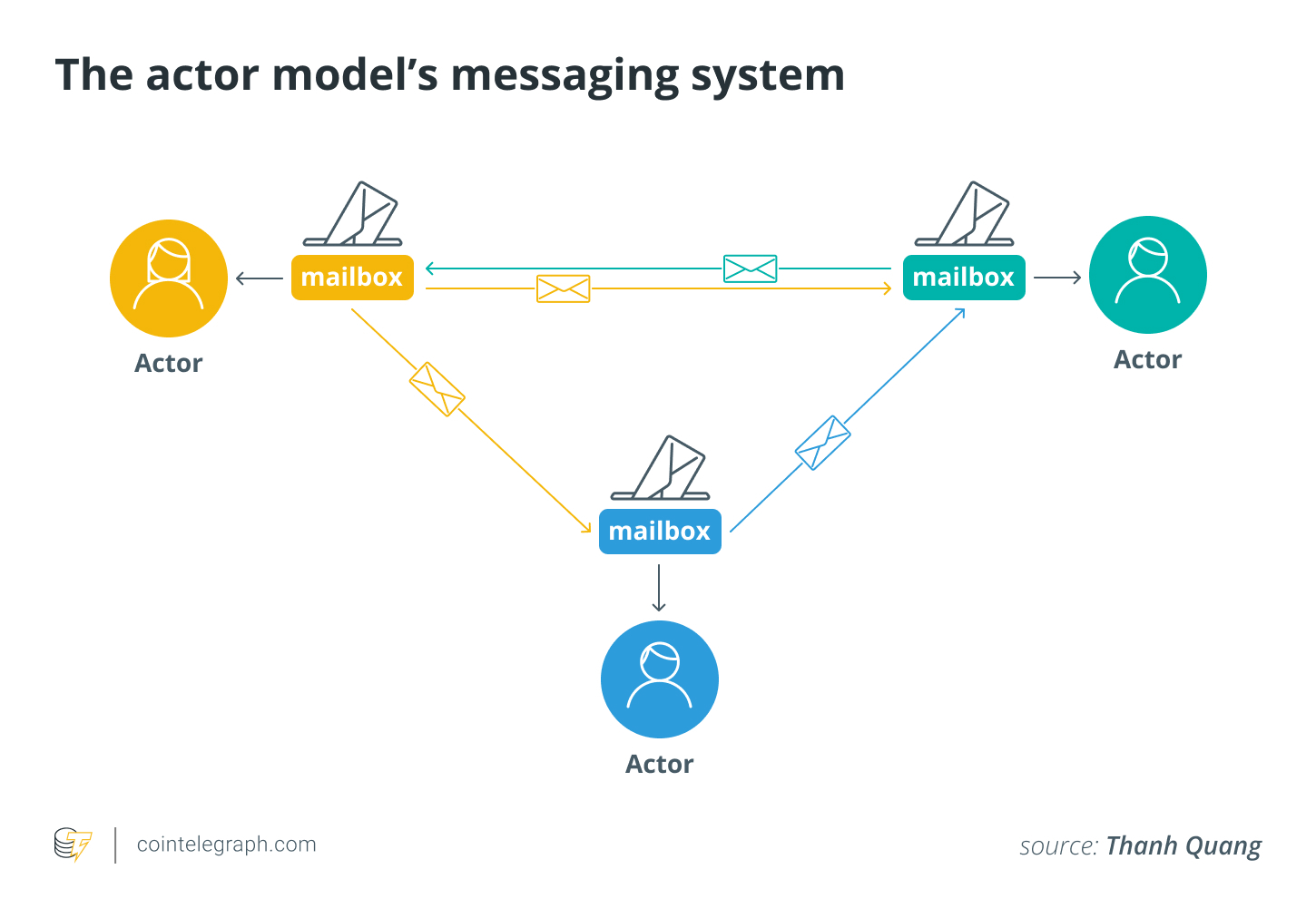
Within the model are actors: programs or users that send messages to other programs in the protocol. Each actor has a mailbox and a private status that cannot be changed directly by another actor. Instead, they can only change status by receiving a message from another actor.
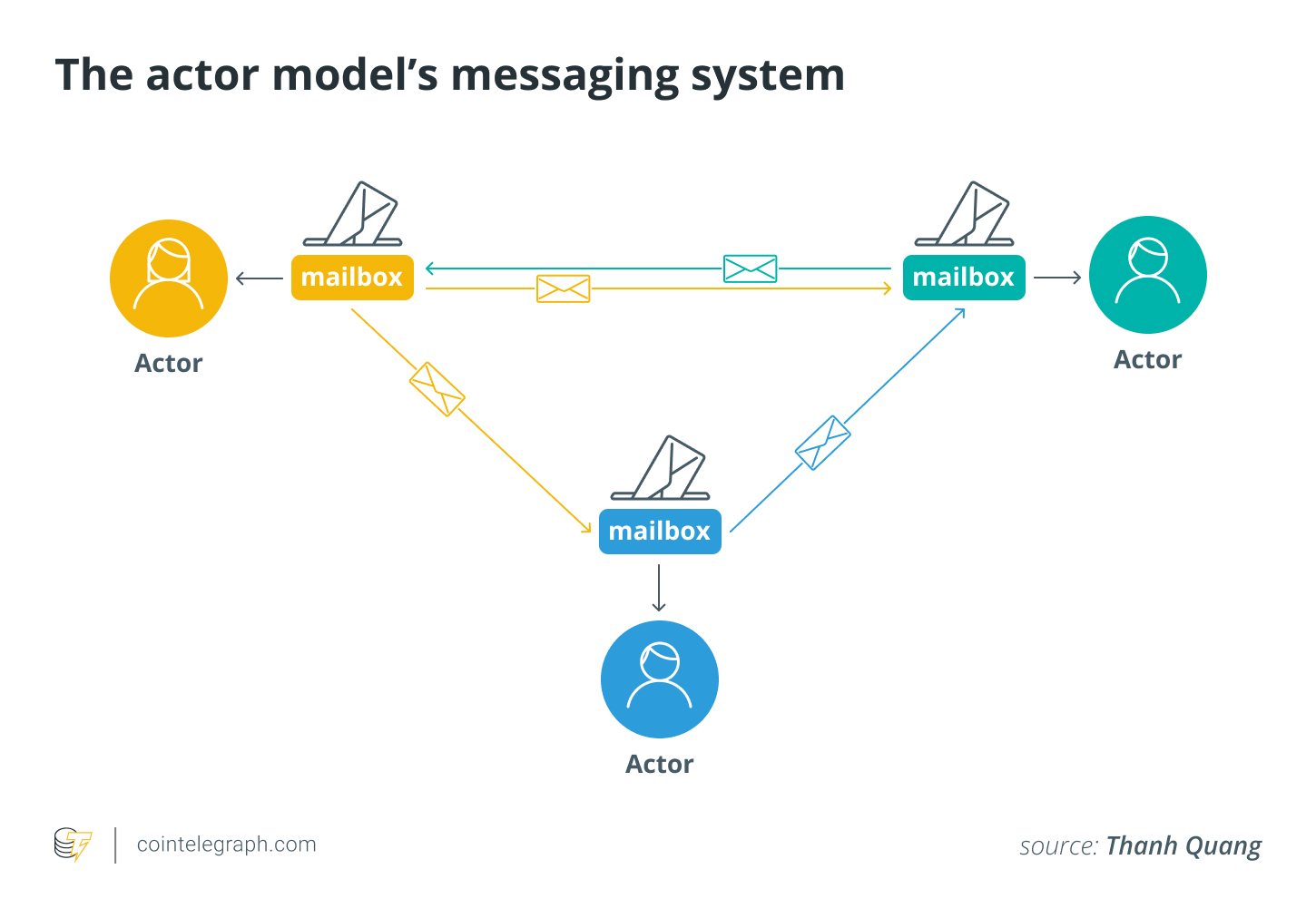
Messages between actors are retrieved from the mailboxes and processed in cycles. Once an actor has received and processed a message, he or she can send a message to another actor, create an actor, or change its status.
How is this beneficial for DApp development?
Asynchronous message processing in blockchain programming offers several key benefits that contribute to the overall efficiency, scalability, and reliability of DApps.
First, asynchronous message processing enables non-blocking processing of transactions and smart contracts.
Recent: ETF filings changed the Bitcoin story overnight – Ledger CEO
Unlike synchronous processing, which requires each transaction to be executed sequentially, asynchronous messaging allows simultaneous execution of multiple tasks.
This parallel processing capability improves the performance of the blockchain network as it can process a greater number of transactions and calculations simultaneously, resulting in shorter transaction processing times and improved overall throughput.
Jack Platts, co-founder of Hypersphere – a crypto venture capital fund that has invested in gaming projects – told Cointelegraph: “In traditional synchronous systems, multiple tasks often have to wait for each other, leading to a delay in processing a large volume of transactions.”
Platts continued: “In the context of blockchain networks, this parallel processing capacity becomes critical for maintaining high transaction throughput. As more transactions are initiated by users, the system can process them simultaneously, ensuring faster confirmation times and overall better network performance. This is especially crucial for blockchain gaming, where real-time interactions and fast processing are essential to providing a smooth and enjoyable gaming experience.”
Some blockchain games, such as Ember Sword, have already integrated parallel processing into their development processes. Mark Laursen, co-founder and CEO of game development company Bright Star Studios, told Cointelegraph: “In developing Ember Sword we leverage parallel processing using our ECS [entity component system] solution. Normally it would be necessary to manually integrate multithreading and make complex decisions per system.”
Laursen continued: “In our scenario, however, the requirements for read, write, and order dependencies are specified, allowing our engine to discern the most efficient method to schedule and parallelize those systems.”
Let’s say a player of a blockchain game wants to transfer an in-game item in the form of a non-fungible token, such as moving a legendary sword from his chest (long-term storage wallet) to his inventory (wallet that used for gaming).
The transfer process can be instantaneous with low or near-zero costs, just as a player can simply click and drag a sword from their inventory and move it to a merchant or chest in a traditional game.
Additionally, asynchronous messaging allows blockchain developers to design DApps that are more resilient to fluctuations in network conditions and temporary outages.
Pavel Salas, chief growth officer at Gear Foundation – the organization behind the Gear Protocol – told Cointelegraph: “The actor model actually increases the reliability of applications running on blockchain,” adding:
“Since actors process messages independently, failures or issues with one actor do not affect others, preventing subsequent failures and improving the overall robustness of the system. And if there are disruptions or network problems, the actor model ensures that the system recovers quickly and continues to function seamlessly.”
This can be beneficial for blockchain gaming DApps if there is a network outage, allowing the game to continue running despite any issues with the blockchain.
Furthermore, asynchronous message processing improves the scalability of blockchain networks. Traditional synchronous approaches can lead to bottlenecks and performance degradation as the number of users and transactions increases.
Asynchronous messaging, on the other hand, enables the distribution of tasks across multiple nodes, allowing the system to scale more efficiently and handle higher transaction volumes without sacrificing performance.
Salas said: “As the user base and activity within the DApp grows, the system can easily manage the increased messaging traffic without causing bottlenecks or delays. Even as a single application grows, it will still manage messages sequentially.”
This scalability is critical as blockchain networks look to support a growing user base and accommodate diverse use cases.
Salas further explained how the process works: “Through the actor model, individual actor programs act as shards, ensuring that the system can be shared across the design as the number of programs grows. […] Vara processes all transactions without distributing across groups of nodes; each node handles everything. However, within Vara each program works independently, has its own status and processes and sends messages according to its specific logic.”
“In blockchain gaming, where real-time interactions and fast processing are crucial, the actor model’s sharding capability allows for fast processing of game-related actions and events, supporting a seamless gameplay experience.”
“As the number of actor programs increases, the system distributes and distributes the workload, effectively accommodating the growing user base and maintaining a responsive and efficient network.”
Another benefit of asynchronous message handling is the support for event-driven architectures in DApps. Instead of constantly asking for updates, DApps can subscribe to specific events or messages, allowing them to respond quickly and efficiently to changes on the blockchain.
This event-driven model reduces unnecessary computational overhead and saves network resources, leading to more efficient and responsive applications.
Additionally, implementing actor messaging capabilities can significantly improve the overall user experience by reducing longer transaction validation wait times. By applying asynchronous processing, the actor can receive a message confirmation of his transaction along with a pending transaction ID.
Then, any computation tasks or external data dependencies can be managed by the same or an alternate actor in a subsequent block, ensuring efficient processing without compromising the responsiveness of the blockchain network.
Magazine: 6 questions for JW Verret – the blockchain professor who follows the money
This real-time feedback is especially crucial for applications that require quick confirmations.
As the blockchain ecosystem continues to grow and diversify, leveraging asynchronous message processing becomes essential for creating powerful AAA-style gaming DApps that can meet the demands of a growing user base and meet different use cases across industries.
By adopting this methodology, developers have the opportunity to push the boundaries of decentralized gaming and potentially realize the full potential of blockchain technology within the gaming sector.