

Intellectual property (IP) is quietly becoming one of blockchain’s most practical frontiers – not as digital art, but as programmable infrastructure connecting AI, gaming and creative rights. BeInCrypto spoke with Andrea Muttoni, President and Chief Product Officer of Story, an on-chain IP platform building the rails for global licensing and royalty automation.
In this interview, Muttoni explains why adoption could be a cultural moment rather than a technical milestone, how the $IP token aligns value with creative activity, and what legal interoperability means for the next decade of digital rights.
The rise of programmable IP and the architecture behind the story
Story Protocol, the company behind the Story Network, launched in February 2025 and aims to become the ‘IP layer of the Internet’.
IPRWA is the largest untapped RWA market with a market size of $80 billion for IP.@Aria_Protocol has already brought revenue-generating rights from Justin Bieber to BTS onchain, with over $100 million TVL of new music coming soon.$ARIAIP × $IP will lead the next wave of RWAs. pic.twitter.com/csxq1lN1xr
— Story (@StoryProtocol) October 15, 2025
After raising $54 million in 2023 and another $80 million in 2024, led by a16z, the team launched a purpose-built layer 1 blockchain. It enables tokenized works (IP) assets, Programmable IP Licenses (PILs), and a royalty module for real-time, on-chain revenue distribution.
“We built Story to make intellectual property programmable across media,” says Muttoni. “Whether it’s AI-generated data, virtual assets or film IP, creators need a transparent way to license and monetize their work.”
Proponents see this architecture as a foundation for transparent provenance and composable licensing. Critics question whether smart-contract licenses can hold up in court without legal recognition.
The evolving turning point for on-chain IP
With more than $80 trillion in creative assets worldwide, on-chain IP is emerging as a market layer connecting creators, enterprises and AI platforms. Story already hosts more than 200 teams and 20 million IP registrations for entertainment, gaming and data applications.
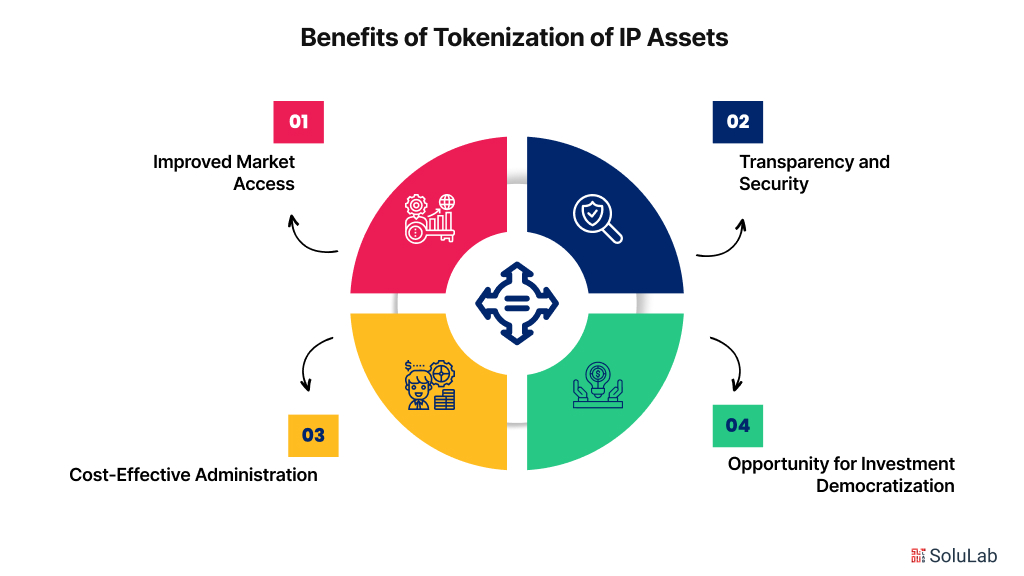
Benefits of Tokenization of IP Assets | SoluLab
“There will not be a single turning point for on-chain IP as intellectual property continues to evolve,” Muttoni said. “We built Story to evolve in parallel – with integrations between AI, gaming and Hollywood – so creators can track and license their works directly.”
“The real turning point may not be the raw numbers, but a cultural moment – like a remix of BTS art turned into a game with automatic revenue sharing via Story,” he added. “If millions use on-chain IP without realizing it’s Web3, then the shift has happened.”
This view is consistent with WIPO’s World Intellectual Property Report 2024, which notes that global IP capacity remains concentrated in fewer than ten economies. Digital IP markets, the report adds, still rely on institutional rather than technical integration. The turning point for tokenized IP may depend as much on policy harmonization as product adoption.
Efficiency and new royalties follow the story
Traditional royalty systems like ASCAP pay creators quarterly through layers of intermediaries. Story wants to modernize that process.
“Today, royalties flow through opaque intermediaries and take months to reach creators,” he said. “On Story settles programmable royalties in seconds instead of months – and moves globally without friction. That’s transformative for independent artists and emerging markets.”
But as the IMF’s 2025 Fintech Note warns, real-time tokenized settlement could increase systemic risk if supervision and liquidity buffers lag behind. Immediate payout is powerful, but without safeguards it can exceed regulations. Story’s long-term success may depend on its integration with regulated financial rails.
Incentives and integration across the IP economy
“Our current IP system is broken,” Muttoni said. “Creators and enterprises are fighting AI companies, but what is needed is a technology framework in which IP can be freely licensed and protected at scale. The story provides the rights that organizations can integrate into – not compete with.”
Legal battles between AI developers and rights holders expose a structural divide: The internet has outpaced the infrastructure that protects creative work. The World Economic Forum’s 2025 tokenization report notes that such markets evolve “non-linearly and in stages.” Adoption usually begins within permitted, regulated environments – not in open networks. Story’s claim of “legal interoperability” may thus require a phased rollout, in line with data privacy and jurisdictional standards.
UX simplification and creator retention
“Licensing and rights management have long been the preserve of studios with lawyers,” says Muttoni. “Through our IP portal, anyone can register IP on-chain in minutes – no lawyers, no middlemen, no platform fees. The goal is to make licensing intuitive, not bureaucratic.”
Yet the US Patent and Copyright Offices’ 2024 report to Congress emphasizes that blockchain transfers do not change IP law. Copyright and trademark transfers are still needed written, signed agreements. For now, Story’s on-chain licenses act as metadata layers, not binding instruments, until the enforceability of smart contracts is codified.
Reflexivity and Story Token Governance
“Reflexivity is normal in crypto markets,” Muttoni said. “But IP registered on Story is tied to real-world use cases. The $IP token allows for licensing, staking, and governance – a productive asset tied to creative activity, not speculation.”
The CFA Institute’s 2024 analysis offers a more reserved view: tokenization can unlock new asset classes, but faces valuation opacity and custody risk. Institutional investors, he argues, will treat IP tokens as infrastructure evolution, not a speculative play – a position that could dampen the hype surrounding Story’s $IP token.
Data as a market signal
As AI’s need for rights-cleared data grows, new metrics can define IP value: licensing volume, accrued royalties, and origination velocity.
“Some of the most valuable intellectual property will be assets licensed for AI training,” Muttoni said. “The bottleneck of AI is not computing power, but the data that has been cleared of rights. Poseidon, a project on Story, lets anyone license real-world data as IP, creating measurable value between data providers, AI developers and users.”
This echoes comments from Rayhaneh Sharif-Askary, Head of Product & Research at Grayscale, who described Story as “linking blockchain coordination to AI model training.” She noted that Poseidon’s model could turn everyday human activities into tokenized, rights-cleared data for machine learning. Her comments demonstrate how programmable IP could unite creative economies and AI development within one infrastructure.
The overlap between IP and AI underlines a broader policy debate. The WIPO 2024 report notes that innovation thrives when law, research and trade evolve together. Story’s long-term success may depend less on the token mechanisms and more on whether global IP management keeps pace with technology.
Conclusion
Programmable IP is shifting from concept to infrastructure. Story’s mix of automation, governance, and interoperability places it at the intersection of culture and code. But as reports from WIPO, IMF, WEF, CFA and the US Copyright Office emphasize, progress will be gradual and driven by compliance. If successful, Story could redefine how creative rights move through the global economy; if not, it may remain a prototype pending regulatory changes.
The post How Story Protocol Wants to Rewrite the Economics of Intellectual Property appeared first on BeInCrypto.