

FedEx Corp has formally joined the Hedera Council, becoming a governing member of the decentralized network to digitalize global supply chains and move operations “on-chain.”
FedEx Corp. can now make governance decisions for the Hedera Council after it joins the decentralized network.
Since announcing the partnership, Hedera’s own utility token, $HBARhas risen more than 7%. The $HBAR token is now trading around $0.097 per unit at the time of publication.
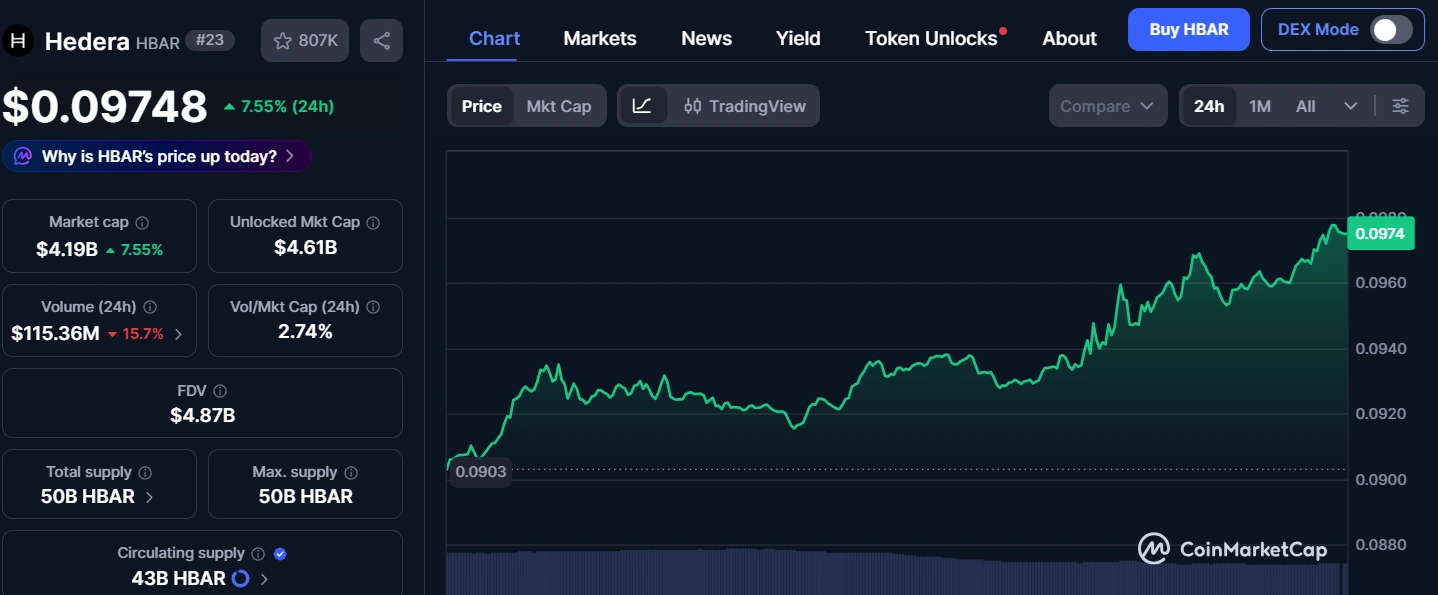 $HBAR turns green as FedEx Corp joins Hedera Council to move supply chain on-chain
$HBAR symbolic price. Source: CoinMarketCap
How does FedEx plan to use Hedera’s technology?
FedEx Corp has officially became a member of the Hedera council to integrate enterprise-level blockchain technology into the world’s most complex supply chains. As part of the agreement, FedEx will not only use the technology, but also play an active role in managing the Hedera network.
Hedera’s own utility token, $HBAR increased by more than 7% within a 24-hour period, with the price hovering around $0.097. The token’s market capitalization also increased by 7.4% to $4.19 billion.
There is also renewed interest from institutional and private investors.
Currently, shipping goods across borders requires multiple jurisdictions, various paperwork and manual verification processes, but now with Hedera’s public distributed ledger, FedEx is creating a shared, trusted platform where data can be instantly verified by all parties without a central authority checking the information.
Under this system, every time a package is moved or a document is signed, a digital fingerprint of that action is recorded in the Hedera ledger. Because the ledger is decentralized and immutable, no party can change the data, providing a high level of trust for customs officials, partners and customers.
Vishal Talwar, FedEx Corp’s chief digital and information officer, said the digital transformation of supply chains is “inevitable.” He stated that logistics operations require a way to share data among many parties without increasing security risks as they become digital-native.
Hedera’s architecture allows FedEx to keep its sensitive operational data private within its own systems, while only posting the necessary “verification” data to the ledger.
FedEx will provide the computer hardware needed to help run and secure the blockchain.
As a member of the Council, FedEx has an equal voice with other global giants such as Google, IBM, Dell and Deutsche Telekom. They will participate in decisions regarding software updates, treasury management and the overall strategic direction of the Hedera network.
Institutional adoption of digital assets
Instead of real-world use cases, Hedera has focused almost exclusively on enterprise adoption. The market’s positive reaction to the news appears to have been fueled by FedEx’s announcement, especially as it outperforms the modest recovery that the top cryptos by market cap are experiencing today after a prolonged period of intense pressure.
In the meantime, large companies continue to actually implement Hedera’s blockchain technology in their companies.
Lloyds Banking Group and Aberdeen Investments successfully executed the first foreign exchange transactions in Britain using tokenized real-world assets (RWAs) as collateral on the Hedera network.
Avery Dennison, another member of the Hedera Council, uses the network for its atma.io platform to track billions of unique items in the supply chain. The integration of FedEx creates a more “interoperable” ecosystem.