
This new Bitrix24 report reveals the 2026 technology priorities that will drive business performance, from eliminating technical debt to adopting AI-native systems, intelligent automation and autonomous agents. Discover the strategic roadmap leaders need to accelerate growth in the AI era.
WASHINGTON, DC / ACCESS Newsline / December 16, 2025 / As Q4 2025 planning shapes the year ahead, every business leader—from the nimble startup CEO to the global enterprise manager—is finalizing their strategic wish list. But before any budget is allocated to the bright promise of AI and its exponential future, a critical issue must be addressed: the inevitable “lump of coal” under the digital boom that is tech debt.
For too long, outdated systems and quick-fix software have been seen as a necessary evil. But that technical debt is the business equivalent of taking out a high-interest loan to fix a leaky roof: the interest payments—the constant maintenance, the crippling slowness, the nagging risk—quickly devour your future budget. Instead of driving growth, this liability becomes a digital anchor. In the age of autonomous AI, that anchor is an existential risk.
Like the visionary Isaac Asimov once did theorized about the dangers of static data systems (a theme central to his work). Foundation series), a company stuck in the past cannot survive the exponential future, and its wisdom will be overshadowed by mere calculation – the same way that starlight from a dead galaxy is eventually drowned out by new nebulae.
This feeling is validated by the findings Bitrix24’s Tech Stack speed and performance analysis. The study identified three core priorities: retiring technical debt to build a flexible, cloud-optimized foundation; investing in intelligent, self-driving systems (such as AI-Native ERP and Intelligent Automation) for superior ROI; and accelerating performance through next-generation technologies to enable faster Time-to-Value and sustainable growth.
By 2026, the mandate is clear: companies must stop pouring budget into reactive maintenance – such as constantly patching fragile legacy systems – and invest aggressively in a cloud foundation designed for lightning-fast speed and performance. This pivot isn’t just about efficiency; it’s the prerequisite for unlocking competitive acceleration in the coming AI revolution, and ensuring your business is built for the star maps of tomorrow, not perpetually restoring yesterday’s steady orbit.
Your tech wish list for 2026: plant the mighty oaks of ROI
If your company is a super-fast spaceship, you wouldn’t fill the fuel tank with sand. Likewise, this year’s budget is an opportunity to jettison low-value distractions and invest in the twin propulsion systems that guarantee measurable orbital acceleration: Intelligent Automation and the AI-Native central core.
Smart companies don’t spread seeds and hope for the best; they strategically plant mighty oaks. They allocate money to systems that promise immediate, systemic intelligence and measurable return on investment (ROI). The goal is not just to be digital; it’s about being intelligent, a fundamental shift that industry experts see as the key to achieving massive productivity growth in every department, from the command bridge to the runway.
What are the top two ROI priorities for companies in 2026?
According to recent industry research among enterprise software users, the highest returns will come from systems that automate execution and consolidate intelligence, essentially making your operations self-driving.
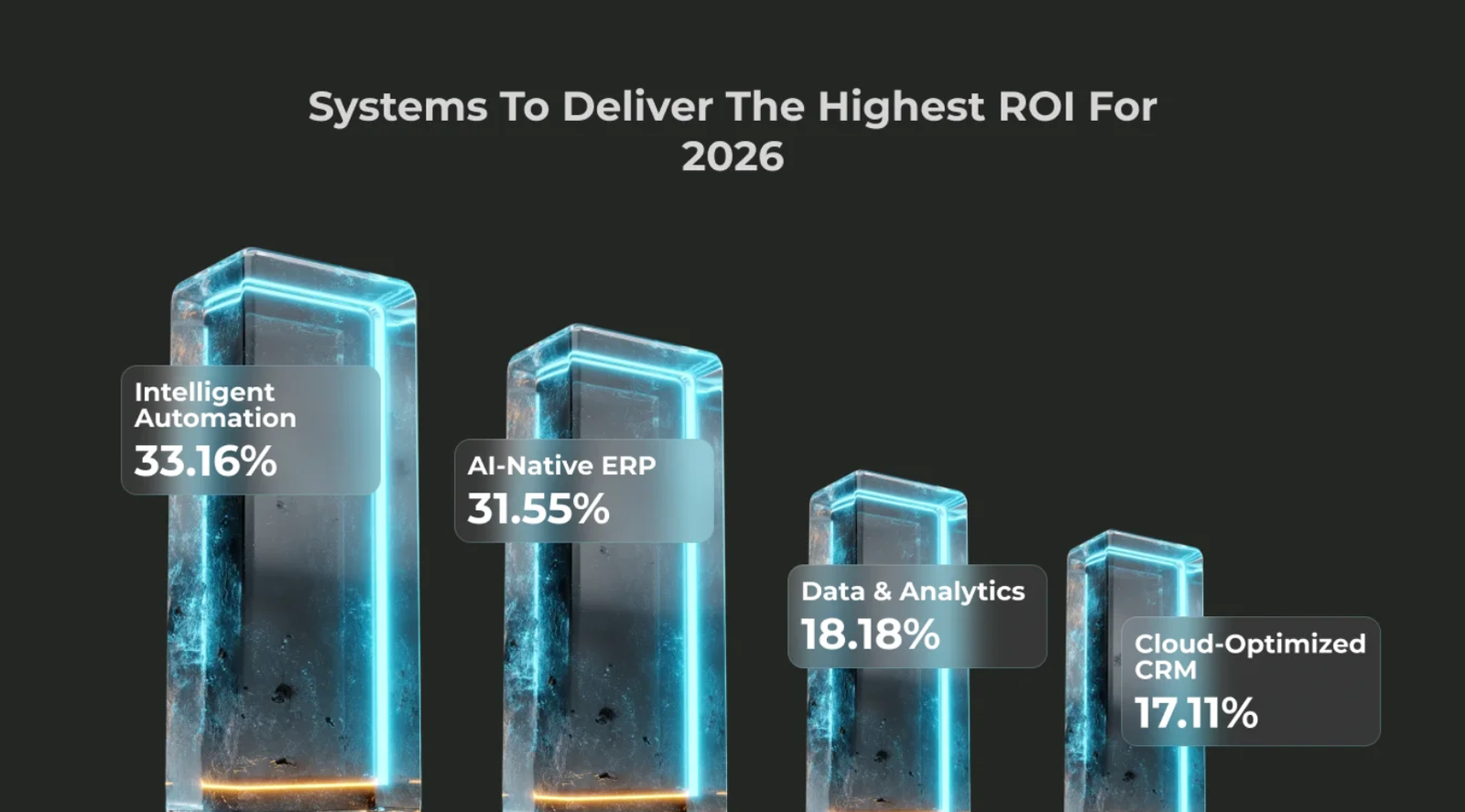
Intelligent Automation (IA): the digital worker: This is the undisputed champion, selected by 33.16% of companies. Think of IA as hiring a tireless, 24/7 digital colleague for every person on your team. It’s the antidote to the mountain of crushing, repetitive tasks that burn out small teams and undermine business efficiency. This is not simple automation; are hyperautomation – solutions that automatically perform complex, multi-step processes such as receiving a customer order, checking inventory, processing the invoice and updating the CRM, all in a seamless digital relay. The financial evidence is compelling: successful automation programs are often the fastest way to justify investments, enabling labor savings 20% or moreand free up your top talent for strategy.
AI-Native ERP: the central nervous system: Chosen by 31.55%this priority signals a demand for an integrated system that acts as the “brainFor decades, companies relied on siled tools – one for accounting, one for inventory, one for operations, all shouting at each other across department walls. AI native ERP is the movement away from that patchwork, creating one central nervous system. This allows the ‘brains’ to analyze real-time data from all corners of the business to predict bottlenecks, optimize pricing and manage cash flow like a master conductor orchestrates an orchestra. This shift is in line with Gartner’s focus on AI-native development platforms as strategic core trends for the future.
The other investments – Data & Analytics (18.18%) and cloud-optimized CRM (17.11%) – are the strategic artillery. Analytics investments are focused on identifying and reducing high Customer Acquisition Cost (CAC)while optimized CRM applies AI insights directly to sales and acts as a smart compass to increase conversion rates and map profitable trade routes.
The accelerator engine: why self-driving agents win
The future of efficiency isn’t about better maps; it’s about self-driving cars. Autonomous agents are overwhelmingly preferred by the market for good reason: they don’t simply follow a process; they orchestrate the results, but they need a modern, cloud-optimized road network to function.
If Intelligent Automation is the strategy, the fuel for the engine is one key technology: Autonomous Agents.
What single technology will most accelerate a company’s tech stack?
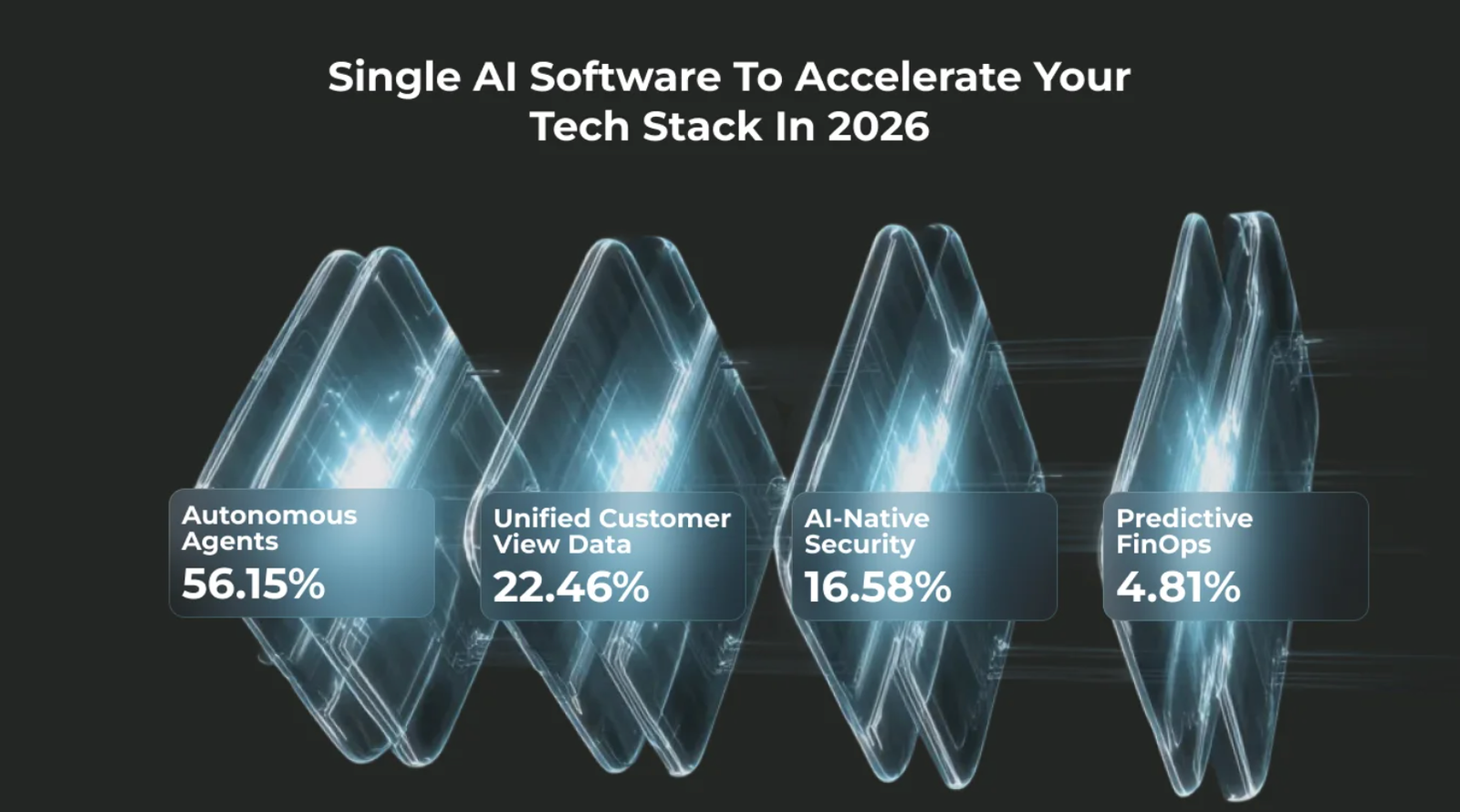
The answer is overwhelming Autonomous agentsselected by a dominant 56.15% of business users. This technology aligns with Gartner’s strategic trend of “Multiagent Systems,” which analysts predict will dominate the 2026 forecast and drive dynamic workflow orchestration.
Think of traditional automation (Robotic Process Automation, or RPA) as a train on a fixed track: it can only follow the exact route you program. Autonomous agents are your digital co-pilots. They don’t just follow a recipe card; you give them the destination – “Onboard this customer in accordance” – and they navigate through traffic, reroute for construction work and adjust the GPS (systems) on site. This enormous leap ensures that automation is moving towards level 4 autonomy.
The strategic catch: Autonomous agents are the desired future, but they are completely paralyzed by the past. Agents need modern APIs (digital ‘plugs’), flexible workloads and distributed data to achieve a high degree of autonomy. Legacy systems, with their rigid, monolithic architectures and outdated data formats, actively prevent the cross-system coordination necessary for scaled intelligence. It is the fixed train tracks that prevent the self-driving car from maneuvering. The overwhelming preference for Autonomous Agents confirms that the market is ready for a transformation that legacy systems are actively hindering, making debt repayment essential. Legacy systems ensure that gravity prevents takeoff.
The Ghost of Christmas Past: The Technical Debt Crisis
Enter corporate turmoil: the high interest charges that quietly siphon off capital and increase security risks throughout your organization. Ignoring your technical debt is no longer a cost-saving measure – it’s an existential threat to the stability of your business.
Your 2026 budget should quantify the financial and safety burdens of transporting aging infrastructure. This is the “lump of coal” that steals your vacation budget and threatens the stability of your business.
How are outdated systems crippling businesses of all sizes?
Full study results: https://www.bitrix24.com/resources/from-tech-debt-to-holiday-cheer-the-b2b-guide-to-a-cloud-optimized-tech-stack.php
About Bitrix24
Bitrix24 is a leading digital workplace platform used by more than 15 million teams worldwide. It unifies chat, video, tasks, CRM, and collaboration tools in one place, helping organizations work smarter, communicate better, and build more connected, engaged teams.
Contact details:
Vlad Kovalskiy
American marketing manager
[email protected]
SOURCE: Bitrix24