
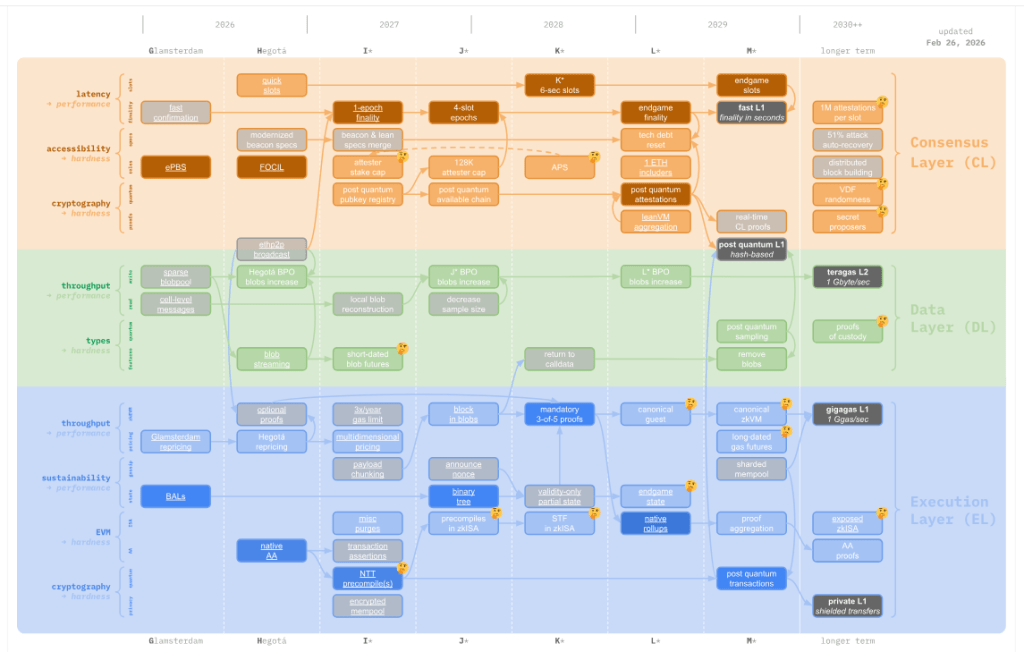
Ethereum users will soon be able to interact with the blockchain in ways that were not possible before. According to co-founder Vitalik Buterin, native smart accounts – a feature that has been in the works for more than a decade – are now expected to arrive within the year as part of the network’s upcoming Hegota upgrade.
Related reading
Privacy tools benefit the most
For privacy-minded users, this shift may be more important than most people realize. Protocols like Railgun have long relied on intermediaries called “public broadcasters” to push through transactions. These middlemen are a persistent source of headache for users.
Reports say Buterin wants to remove them completely by replacing that system with a general-purpose public memory pool, eliminating the middleman and putting more control directly in the hands of the user.
His words were direct: “Intermediate minimization is a core tenet of the non-ugly cypherpunk Ethereum – maximize what you can do even if the entire infrastructure of the world except the Ethereum chain itself goes down.”
That is a powerful statement. And it shows how seriously the Ethereum team takes self-sufficiency at the protocol level.
Now, account abstraction.
We have been talking about account abstraction since early 2016, see the original EIP-86: https://t.co/HYLSTLHgWH
Now we finally have EIP-8141 ( https://t.co/jYqeS55j6P ), an omnibus that wraps up and resolves every remaining problem that was AA…
— vitalik.eth (@VitalikButerin) February 28, 2026
A decade in the making
Buterin acknowledged the long road to getting here. He pointed out that account abstraction has been discussed since early 2016. Now that EIP-8141 has been bundled into the Hegota fork, the goal is to finally solve every problem the concept was originally intended to solve – and then some.
The Ethereum Foundation’s public roadmap, called the “Street Map,” places native account abstraction in the second half of 2026.
The technical approach proposed focuses on what Buterin calls “frame transactions.” Instead of a transaction being a single action, it becomes a series of frames.
Each frame can point to another’s data, and each frame can authorize a sender or a gas payer. One frame handles the signature check. Someone else takes care of the implementation. It is modular in design and built to be widely usable.
This also means that paying transaction fees without holding ETH becomes possible. Users can pay for other tokens via a paymaster contract or a specialized exchange that supplies ETH on site – no third party required.
Related reading
Quantum resistance also applies
The Hegota upgrade doesn’t stop at smart accounts. Buterin also rolled out a separate quantum resistance roadmap earlier this week, which identified four areas of concern: validator signatures, data storage, user account signatures, and zero-knowledge proofs.
Existing accounts are expected to fit into the new framework without being left behind, gaining access to batch operations and transaction sponsorship along the way.
After ten years of promises, the pieces finally seem to be falling into place.
Featured image from Unsplash, chart from TradingView