

Ethereum has been under pressure for much of December, and the rfall below $3,000 has left a visible mark on the positioning of investors.
On-chain data now shows a notable deterioration in profitability across the network, with ETH supply’s share of profits falling below 60%. At the same time, institutional demand has declinedwith data from Glassnode showing how both retail profitability and institutional participation in Ethereum have weakened simultaneously.
Related reading
Ethereum’s win rate drops below 60%
The drop in Ethereum’s percentage profit supply was one of the most obvious signals of stress for Ethereum. Ethereum investors have fallen into deeper losses, and this is a reflection of the recent price action.
Speaking of price action, Ethereum had initially regained the $3,000 price level on December 22. During this time, the percentage of ETH supply in profits fell back above 60% and reached as high as 63%. However, this pause was only short-lived and the price action fell back below $3,000 after just a few hours.
When ETH fell below $3,000 again, the share of supply with unrealized gains fell below 60%, compared to over 70% earlier in December. This decline shows that the pullback has not been limited to recent buyers, but is also starting to impact investors who gathered at the beginning of the month.
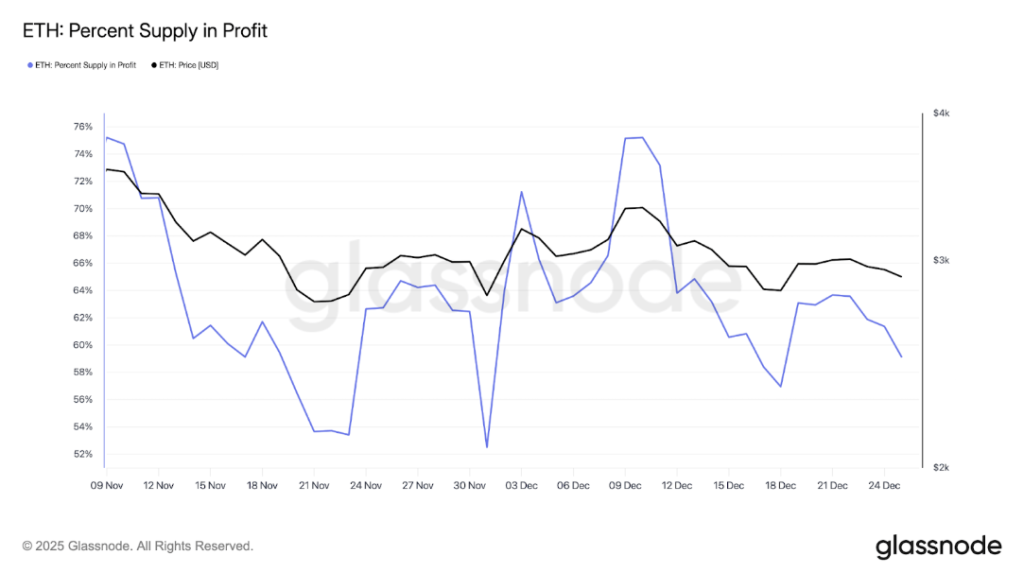
ETH percent offer in profit. Source: Glassnode
Net outflows from ETFs indicate declining institutional participation
The weakness in on-chain profitability and price action is also a reflection of trends in the ETF market. Another data metric from Glassnode shows that since then In early November, the 30-day moving average of net inflows into US Spot Ethereum ETFs turned negative and stayed there. These continued outflows indicate a phase of moderate participation and withdrawal from institutional traders.
The ETF chart below shows that inflows that supported Ethereum’s rise to new all-time highs in August have declined. replaced by persistent outflow through November and December. This matters for price action because demand for ETFs has been a major source of incremental buying. Now that that bid has weakened, Ethereum has struggled to absorb sell-side pressure, which has contributed to its failure to stay above $3,000.
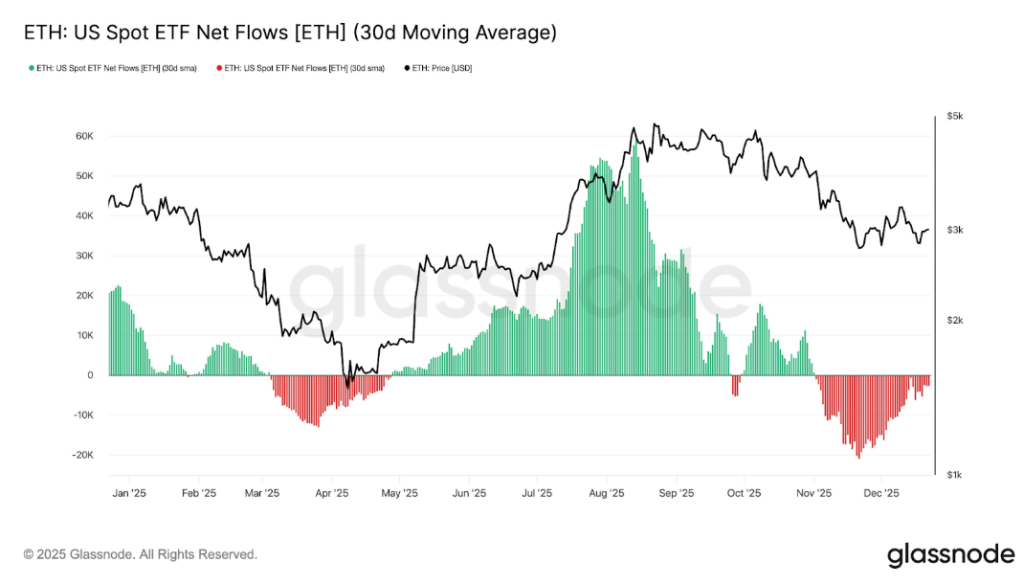
ETH: US Spot ETF Net Flows. Source: Glassnode
The combination of negative ETF net flows and Ethereum’s recent price behavior helps explain rising unrealized losses. Interestingly enough, different data sources in the chain also reveal several examples of whale addresses reducing their exposure to Ethereum outside of spot ETFs.
Lookonchain for example recently marked activity from a wallet believed to be linked to Erik Voorhees, who traded 4,619 ETH, worth approximately $13.42 million, for Bitcoin Cash (BCH) in the past two weeks after being inactive for almost nine years. Voorhees later responded by clarifying that the wallet is not his and that he does not have any Bitcoin Cash in his possession.
Related reading
Lookonchain be too to sales pressure Arthur Hayes, co-founder of BitMEX, who sold a total of 1,871 ETH for approximately $5.53 million in the past week.
Featured image from Unsplash, chart from TradingView