

Announcements
October 31, 2025·Last updated on October 31, 2025
If you’ve ever purchased a domain name, you’ve worked with a domain registrar. But behind the scenes there is another player that you probably never see: the domain registry.
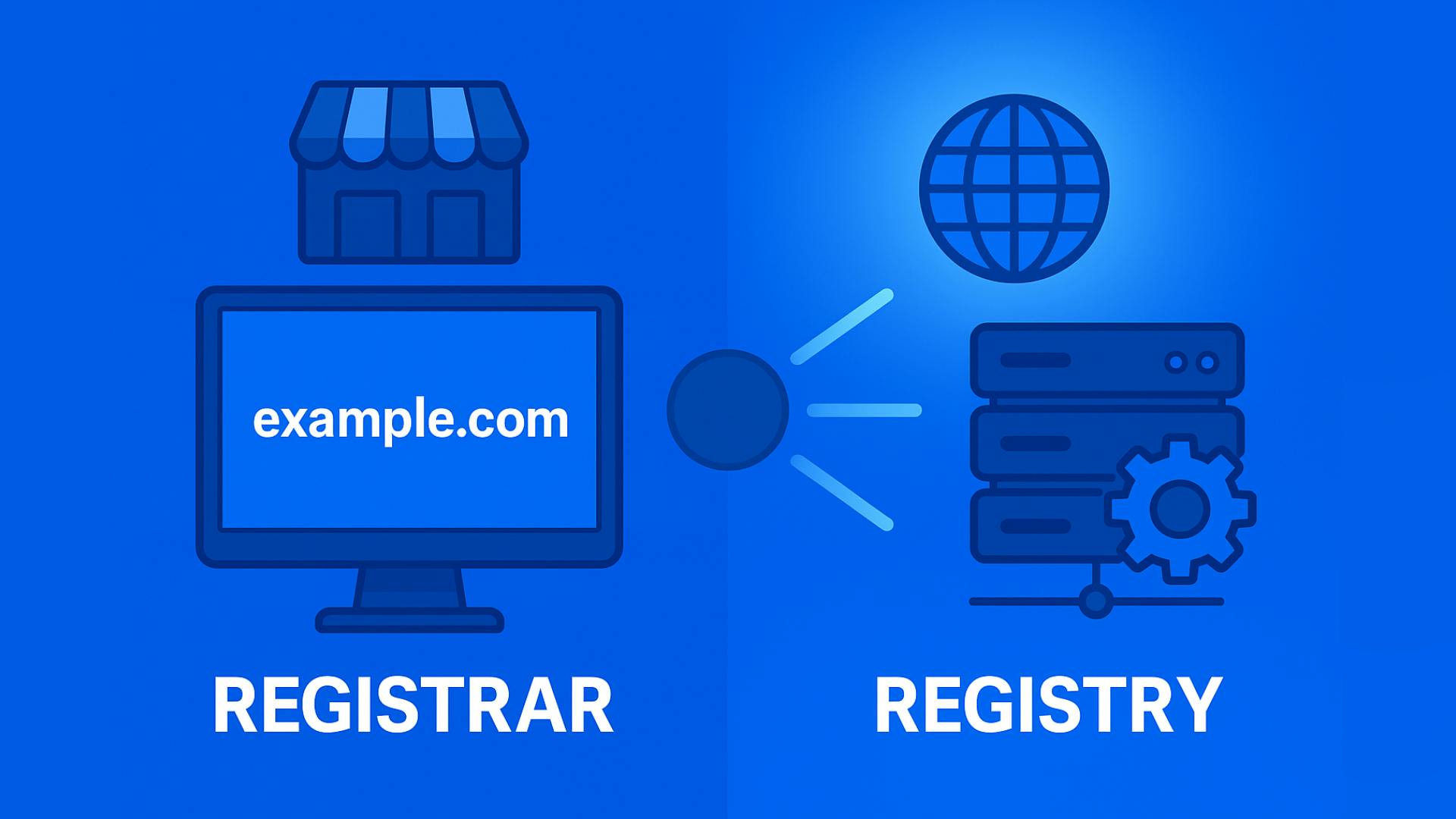
A domain registrar is your direct point of contact: the company where you search for domains, make purchases and manage your settings.
Think of registrars like Unstoppable Domains, GoDaddy, Squarespace, and IONOS as the stores of the domain world. They provide customer service, process payments and help you configure your domain settings.
Domain registries work very differently. These organizations maintain the master database for specific top-level domains such as .com or .org. For example, VeriSign manages the registry for .com and .net domains, and their infrastructure supports 56 percent of DNS hosts worldwide. Registries control domain assignment policies, generate zone files, and handle the technical operations that keep domains functioning.
The analogy with retail works perfectly here. Registrars sell domains ‘retail’ to you and me, while registries operate ‘wholesale’ with regulated prices. When you purchase a .com domain from a registrar, that registrar must notify VeriSign and pay them a fee, which is built into the price you pay.
Both registrars and registries operate under the supervision of ICANN, the global organization that coordinates Internet functionality. ICANN accredits registrars through Registrar Accreditation Agreements, creating accountability standards for both parties.
- Function: Registrars handle transactions and customer support, while registries maintain the central domain database.
- Your interaction: You work directly with registrars for purchasing and management, but rarely interact with registries.
- Responsibilities: Registrars provide customer service, complete WHOIS information, and submit updates to registries. Registries maintain administrative data, control policies, and manage domain infrastructure.
This collaboration ensures a seamless experience. When you update domain settings through your registrar, they pass these changes to the registry, which updates the database accordingly. The system works because each player focuses on what he is good at.
When you buy a domain, you are not just making a purchase. You initiate a coordinated process between registrars and registries that makes your domain work on the Internet. This is exactly what happens.
Your domain journey starts with a search. When you check if a name is available through an ICANN-accredited registrar, that registrar will immediately query the appropriate registry to confirm availability. Find a name you want? You provide your contact details: name, address, email address, telephone number and full payment. The registrar acts as your gateway to the registry and handles the commercial side of your purchase.
Your registrar doesn’t just take your money and call it done. They package your registration information and payment and then send everything to the appropriate registry via the Extensible Provisioning Protocol (EPP), a secure system that handles these exchanges. Major registrars prefer EPP because it automates thousands of daily transactions. A portion of what you paid goes directly to the registry as a wholesale fee.
The registry receives your information and adds your domain to their central database. This is where it gets technical. Registers work as ‘thick’ or ‘thin’. Thick registers store all your contact details. Thin registries only store your name servers, registrar name, and basic metadata such as creation date. Your registrar will keep the rest. Either way, once your domain ends up in that database, it’s officially yours.
Your registrar will be your point of contact for everything related to domains. Do you want to change DNS settings? Update contact details? Dealing with extensions? Your registrar manages all of this and communicates changes back to the registry’s database. Most domains are automatically renewed annually. If any problems arise with the renewal, please contact your registrar immediately. They are your lifeline to keep your domain active.
This back and forth between the registrar and the registry continues throughout the life of your domain, keeping your online presence connected to the Internet infrastructure.
Think of registrars and registers as the difference between your local store and the warehouse. Both are essential, but they play completely different roles in getting domains for your digital doorstep.
Registries manage the master database for specific TLDs such as .com or .org. They are the ultimate authority and maintain every registered domain within their respective TLDs. VeriSign manages the registry for .com and .net domains and provides the technical infrastructure and DNS management that ensures that these domains continue to function.
Registrars operate on the client side. They handle the commercial aspects of domain registration and act as your gateway to the registry system. Registration, customer relations, DNS management, privacy protection: registrars manage the services you actually interact with.
Companies like Unstoppable Domains, GoDaddy, Namecheap and IONOS offer customer-facing tools and interfaces that make domain ownership accessible and manageable.
Here’s something most people don’t realize: you’ll probably never have to deal with a registry directly. Domain owners work exclusively through registrars for purchases, renewals, transfers and support. Registrars provide all the customer-oriented services that make domain ownership manageable.
The only way to register and use a domain name? Through a registrar. This separation keeps database management separate from customer service functions.
Registries establish policies for their TLDs: eligibility requirements, registration rules, the works. Some country code TLDs require you to live in specific countries. That’s the call of the registry.
ICANN oversees the entire system, accrediting registrars through Registrar Accreditation Agreements and setting standards for domain systems. Registrars must follow both ICANN requirements and individual registry policies and remain responsible for any domain sold, including domains sold through resellers. This hierarchy maintains consistency across the entire domain ecosystem.
Choosing the right domain registrar is more important than you might think. Your choice affects everything from pricing to safety and customer service if something goes wrong.
ICANN accreditation is not just a nice-to-have. It’s your first line of defense against sketchy operators. Accredited registrars complete a formal application process, pay a non-refundable application fee of USD 3,500 and sign the Registrar Accreditation Agreement (RAA). This accreditation serves as a basic check on legitimacy, but does not necessarily guarantee quality service. The current list of accredited registrars can be found on the ICANN website.
Registrars such as Unstoppable Domains, Namecheap, and Cloudflare have all completed this process, giving users added confidence in choosing a registrar that meets ICANN’s global standards.
Some registrars offer ultra-low prices for the first year, sometimes as low as $0.98, but these are often followed by significantly higher renewal fees. It is also common for additional fees, such as ICANN fees (typically USD 0.18), to be added at checkout.
Look for registrars who are honest about long-term costs, including renewal prices and fees. At Unstoppable Domains we strive for transparent pricing, with renewals at cost for DNS domains and no renewals at all for Web3 domains.
WHOIS privacy protection should be your first priority. This feature protects your personal contact information from public databases, and the best registrars add it at no extra cost.
Look for these essential security features:
- Domain locks to prevent unauthorized transfers
- Two-factor authentication (2FA)
- DNSSEC support
- Registry locks for high-value domains
Most leading registrars now offer this protection as standard. Unstoppable Domains includes them by default for all DNS domains.
Real customer experiences tell the story that marketing texts don’t tell. Red flags include confusing interfaces, surprise fees, weak security ratings, and unresponsive support teams. Professional developers often compare registrars like Namecheap, Cloudflare, and Porkbun based on their transparency and support. Unstoppable Domains is also being reviewed across platforms and communities as it continues to expand its DNS and onchain offerings.
Pay special attention to reviews about renewal processes and technical support. That’s where you need them most.