

According to State Street’s 2025 global researchmajor investors have moved past pilot projects and are making clear bets on digital assets and blockchain.
Nearly 60% of institutional investors surveyed say they plan to increase their crypto allocation in the coming year. Average exposure is expected to double within three years, indicating solid plans rather than empty talk.
Institutions drive the allocation of digital assets
Reports have revealed that private markets are the first target. Private equity and private fixed income topped the list for tokenization as companies look to unlock illiquid holdings and make them more easily tradable.
By 2030, a majority of respondents expect that between 10 and 24% of institutional investments will be made through tokenized instruments. That is a big change compared to pilots and proofs of concept.
Our 2025 global research into #digitalassets and emerging technologies are showing a decisive shift in adoption and strategic commitment among institutional investors #tokenization and blockchain-enabled transformation. Read more: https://t.co/hzk1f3dZ1O pic.twitter.com/tULwI2Ke88
— State Street (@StateStreet) October 9, 2025
Benefits mentioned by investors
Investors gave clear reasons for the pressure. Increased transparency was cited as an important benefit by 52%. Faster trading was chosen by 39% and lower compliance costs by 32%.
Nearly half of those surveyed say they expect cost savings of more than 40% thanks to greater transparency. These figures help explain why more and more companies are taking action now instead of waiting.
Operational shifts along the way
Reports indicate that the shift is not just about portfolios. Forty percent of respondents already have a dedicated digital assets team or business unit. Nearly a third say blockchain and related digital activities are now part of their broader digital plans.
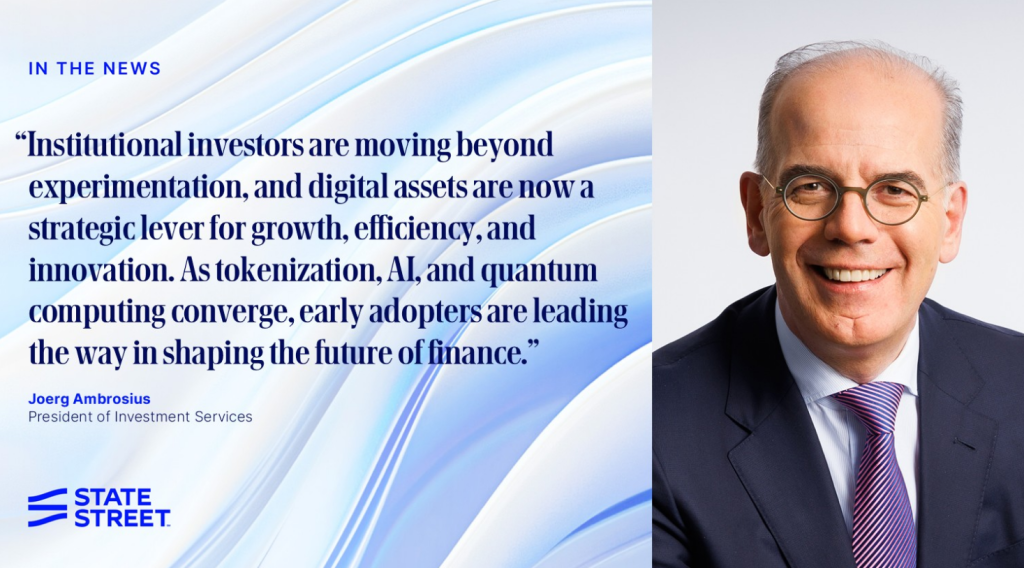
Joerg Ambrosius, president of Investment Services at State Street, said institutional clients view these instruments as strategic levers for growth and efficiency, not just experiments.
Donna Milrod, chief product officer at State Street, added that companies are building teams and planning new products such as tokenized bonds, on-chain wrappers, stablecoins and tokenized cash.
One in five companies plans to set up new digital asset groups in the short term. That suggests that organizational changes will follow capital commitments. Many managers are rewriting workflows and adding staff with blockchain skills.
At the same time, more than half of respondents said generative AI and quantum computing could have a greater impact on investment activities than tokenization alone, although most see these technologies as working together and not replacing each other.
The survey covered senior executives from different regions and institutions of different sizes, and looked at both strategy and operational readiness.
Featured image from Unsplash, chart from TradingView