
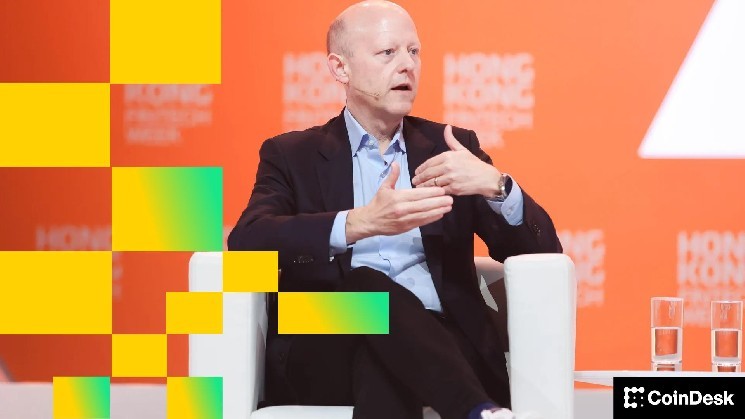
Circle (CRCL), the company behind the $76 billion stablecoin USDC$0.9998 is getting closer to launching its payments-focused Arc blockchain and entering a testing phase with a wide range of institutional partners.
The company said Tuesday that it has deployed the public testnet version of Arc, which has already involved more than 100 financial institutions, asset managers and technology companies such as Visa, HSBC, BlackRock and Anthropic.
“Combined, these companies reach billions of users, move, exchange and store hundreds of trillions in assets and payments, and support local economies in Africa, the Americas, Asia, Europe and the Middle East,” said Jeremy Allaire, CEO of Circle.
The move comes as stablecoins, a $300 billion class of crypto tokens pegged to fiat money, are becoming increasingly embedded in traditional finance. Meanwhile, major banks and asset managers are also exploring the use of blockchains to move instruments such as bonds, funds and credits, often called tokenization of real-world assets (RWA), for operational gain.
They would be huge markets. Citi predicted that stablecoins could be worth $4 trillion by the end of the decade, while tokenized assets could reach a market size of nearly $19 trillion by 2033, according to BCG and Ripple.
Banks, asset managers on board
Circle said Arc is intended to serve as a base layer for financial services, from tokenized funds, cross-border payments to foreign currency (FX) settlement. It will offer features such as US dollar-based fees, one-second settlement and optional privacy controls, tightly integrated with Circle’s stablecoin and payments platform.
Among the companies exploring Arc are traditional financial heavyweights such as State Street, Deutsche Bank, Invesco and Société Générale. They are joined by digital asset players including Coinbase and Kraken, fintechs such as Nuvei and Brex, and global technology providers such as AWS and Mastercard.
For example, Visa is using the testnet to evaluate how a stablecoin-backed payment infrastructure could accelerate the global movement of money. BlackRock’s head of digital assets, Robert Mitchnick, said the company is exploring how Arc’s support for stablecoin settlement and onchain FX could unlock “additional utility” for the capital markets.
Invesco is using the testnet to evaluate how blockchain can make tokenized funds operate more efficiently, while Société Générale is focusing on programmable settlement and transparency in cross-border capital flows. HSBC, one of the world’s largest global banks, said it is testing Arc’s potential for faster, more transparent international payments.
State Street is testing digital asset custody integration. SBI Holdings is evaluating how to extend regulated financial services to on-chain environments. Deutsche Bank, Standard Chartered and First Abu Dhabi Bank are also participating, indicating growing interest from global banking networks.
The launch has also attracted interest from asset managers such as WisdomTree and infrastructure players such as AWS, Mastercard and Cloudflare. Fintech companies Nuvei and Brex are testing Arc’s ability to support merchant payments and cross-border settlement. Exchanges such as Coinbase, Kraken and Coincheck are participating, in addition to DeFi protocols including Aave AAVE$234.72Curve (CRV) and Maple (SYRUP).
Anthropic, the company behind artificial intelligence (AI) assistant Claude, also plans to integrate AI-powered developer tools into Arc.
Stablecoin issuers in multiple regions are also active on the testnet, including Australia’s Forte (AUDF), Brazil’s Avenia (BRLA), Mexico’s Juno (MXNB), and Philippines’ Coins.ph (PHPC). These regional issuers are evaluating Arc’s stablecoin swap and FX infrastructure.
Circle said the long-term goal is for Arc to evolve into a decentralized, community-governed system. With Circle leading the initial rollout, the roadmap includes opening up validator participation and establishing public governance frameworks to guide the future development of the network.
Read more: Why Circle and Stripe (and many others) are launching their own blockchains