

Cathie Wood argues that the next phase of US policy and macroeconomics could recreate a risk regime from the early 1980s, one that, in her story, strengthens the case for bitcoin as a portfolio diversifier even as it complicates the “digital gold” narrative. In a post on X, the CEO of ARK Invest said “The next three years could be Reaganomics on steroids,” pointing to deregulation, tax cuts, “sound monetary policy” and “peace through strength” as ingredients for a stronger dollar and capped gold prices.
Her January 15 “New Year’s Letter,” titled Cathie Wood’s 2026 Outlook: The US Economy Is A Coiled Spring, explains the mechanisms behind that analogy and explicitly places crypto in the policy and productivity story.
A macrothesis of the ‘coiled spring’
Wood’s central claim is that the US looked sturdier than it actually is because the weakness spread through interest rate-sensitive sectors rather than hitting the entire economy at once.
“Despite sustained real gross domestic product (GDP) growth over the past three years, the underlying US economy has been in a rolling recession and has evolved into a coil spring that could rebound strongly in the coming years. In response to COVID-19-related supply shocks, the record-breaking 22-fold increase in the Fed Funds rate from 0.25% in March 2022 to 5.5% in the sixteen months ended July 2023 will boost housing, manufacturing and non-AI capital spending, pushing low- to middle-income America into recession.”
Related reading
She anchors the housing segment with a specific low: Existing home sales fell 40%, from 5.9 million annually in January 2021 to 3.5 million in October 2023, which she notes is “a level last seen in November 2010.”
From there, Wood focuses on policy impulses and cash flow relief. “Thanks to the confluence of deregulation and lower taxes (including tariffs), inflation and interest rates, the rolling recession that has characterized the US in recent years could reverse quickly and sharply in the coming year and beyond. Deregulation is unleashing innovation in every sector, led by the first AI and Crypto Czar, David Sacks, in AI and digital assets. Meanwhile, lower taxes on tips, overtime and Social Security should deliver significant refunds to US consumers this quarter, potentially boosting real disposable income growth from ~2% annualized in the second half of 2025 to ~8.3% this quarter.”
She also argues that companies’ cash flows could be boosted by accelerated depreciation, writing that this could push the effective corporate tax rate “down toward 10%,” with a 100% first-year depreciation for equipment, software and domestic R&D made permanent and retroactive to January 1, 2025.
Gold, Bitcoin and the dollar
Wood’s inflation case is concrete and component driven. She points out that oil is falling from around $124 on March 8, 2022 to a level about 53% lower, and is down about 22% year-over-year from ARK’s January 12 data cut. She adds that single-family home sales prices have fallen by about 15% from the October 2022 peak, while existing home price inflation (three-month moving average) has slowed from about 24% annualized in June 2021 to about 1.3%.
On labor, she cites non-agricultural productivity up 1.9% year-on-year (third quarter), wage bill per man-hour up 3.2% and unit labor costs up 1.2%. Then she pushes for a real-time check: Truflation is at 1.7% annualized on January 7, almost 100 basis points below CPI-based inflation.
The crypto hook comes from its attempt to split gold’s recent run from bitcoin’s role in wallets. “In 2025, the price of gold rose 65%, while the price of Bitcoin fell 6%. While many observers have attributed the 166% increase in gold prices from $1,600 to $4,300 since the end of the US stock bear market in October 2022 to inflation risk, another interpretation is that global wealth creation… has surpassed the ~1.8% annual increase in gold supply worldwide.”
Related reading
Wood then relies on supply schedules and correlations. She notes that Bitcoin supply is “mathematically measured” and will rise ~0.82% per year over the next two years before slowing to ~0.41%, and argues that diversification – not the rhetoric of “digital gold” – is the cleaner allocator lens. In ARK’s correlation matrix, which uses weekly returns from 1/1/2020 through 6/1/2026, bitcoin’s correlation is 0.14 with gold, 0.06 with bonds, and 0.28 with the S&P 500; the correlation between the S&P 500 and bonds is 0.27.
Finally, she brings it back to the currency market: After a year that saw the trade-weighted dollar (DXY) fall 11% in the first half and 9% for the year, Wood argues that higher returns on invested capital in the US, driven by budget, deregulation and US-led technological breakthroughs, could push the dollar higher, echoing the early Reagan period when “the dollar nearly doubled.”
If Wood’s “Reaganomics on Steroids” framework gains traction, the near-term market implication is less about a single Bitcoin price target and more about positioning: a regime she says will include falling inflation, lower rates, and heavy AI investment (investments in data center systems up 47% to nearly $500 billion in 2025, up another 20% to roughly $600 billion expected in 2026) is there one that allocators can revisit. Bitcoin is on the risk spectrum, and whether its low cross-asset correlation is the more sustainable proposition than any comparison to gold.
While Wood’s 2026 outlook does not publish a specific Bitcoin price target, ARK has previously outlined 2030 scenarios for BTC of around $300,000 (bear), $710,000 (base), and $1.2 million (bull).
At the time of writing, BTC was trading at $95,685.
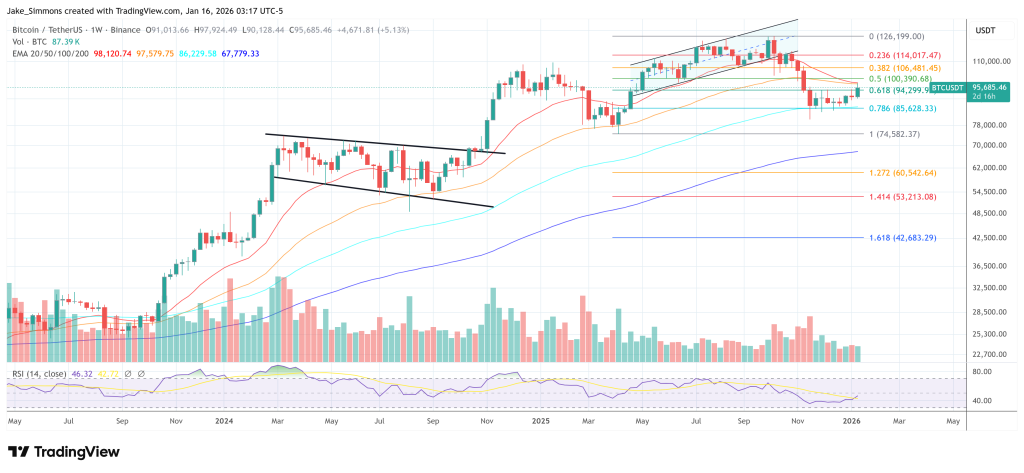
Featured image created with DALL.E, chart from TradingView.com