

Table of contents
Program Details and ObjectivesArbitrum’s Recent MomentumApplication Process and Next StepsFrequently Asked Questions
Castle Labs, a research firm led by analysts Chilla and CryptoNdee, has introduced a grant program offering up to $50,000 per project to support innovative builders in the market. Arbitration blockchain, aimed at stimulating new ideas and long-term development within the ecosystem.
The initiative, which has been operational for eight months and still has four months to go before the deadline, aims to fund early-stage startups that prioritize originality and alignment with Arbitrum’s goals. This move comes as Arbitrum continues to demonstrate strong growth in transaction volumes and user engagement, strengthening the network’s position as a hub for decentralized applications.
Program details and objectives
The grant program, administered by Castle Labs on behalf of the Arbitrum DAO, focuses on “new protocols and ideas” and provides financial support to teams building sustainable projects primarily based on Arbitrum, although multi-chain approaches are acceptable if Arbitrum plays a prominent role.
With a total of 240 applications received to date, the program has approved less than 10 percent, reflecting a rigorous selection process that emphasizes quality over quantity. Applicants can apply for funding of up to $50,000 to help cover development costs for prototypes, milestones and initial launches.
Castle Labs has outlined clear criteria for evaluation, starting with innovation as a core requirement. Projects should introduce new primitives or unique features rather than replicating existing applications from other chains. Approved beneficiaries include Cyclo Finance, which explores new financial mechanisms; Maldouy, which bridges off-chain use cases with on-chain infrastructure; and Alloc8, operating at the intersection of decentralized finance (DeFi) and artificial intelligence (AI). These examples illustrate how the program values originality across industries including DeFi, consumer apps, and AI, while remaining open to other verticals as long as they bring something new to the table.
Beyond innovation, ecosystem alignment is critical, meaning projects must integrate well with existing Arbitrum tools and contribute to the network’s vision of supporting DeFi builders, AI initiatives, and applications that drive broader adoption.
The evaluation also assesses team quality, favoring transparent groups that are open to know-your-customer (KYC) processes and able to execute them even if they do not have extensive crypto experience. Feasibility comes into play through well-defined milestones and key performance indicators (KPIs) that are trackable and realistic, so that the grant leads to tangible progress without over-promising.
Finally, impact and sustainability are balanced, favoring experiments that can scale, attract users, and benefit the community in the long term. Castle Labs encourages applications that explore how the project remains viable after funding ends, and avoids short-term projects that fail. This structured approach helps filter out low-effort submissions, such as those generated by AI without substantive team involvement, which was a common problem in the review process.
Arbitrum’s recent momentum
The grant program comes amid notable progress for Arbitrum, which has solidified its position as the leading Layer-2 scaling solution for Ethereum. At the end of October, the network reached a milestone of 2 billion on-chain transactions, underscoring its scalability and user appeal.
The number of daily active wallets is in the hundreds of thousands, with recent 24-hour periods seeing more than 2.6 million transactions. Arbitrum also became the first Layer-2 to surpass $400 billion in cumulative swap volume on the Uniswap protocol, per facts from Dune dashboards, a benchmark that reflects its dominance in decentralized exchange (DEX) business.
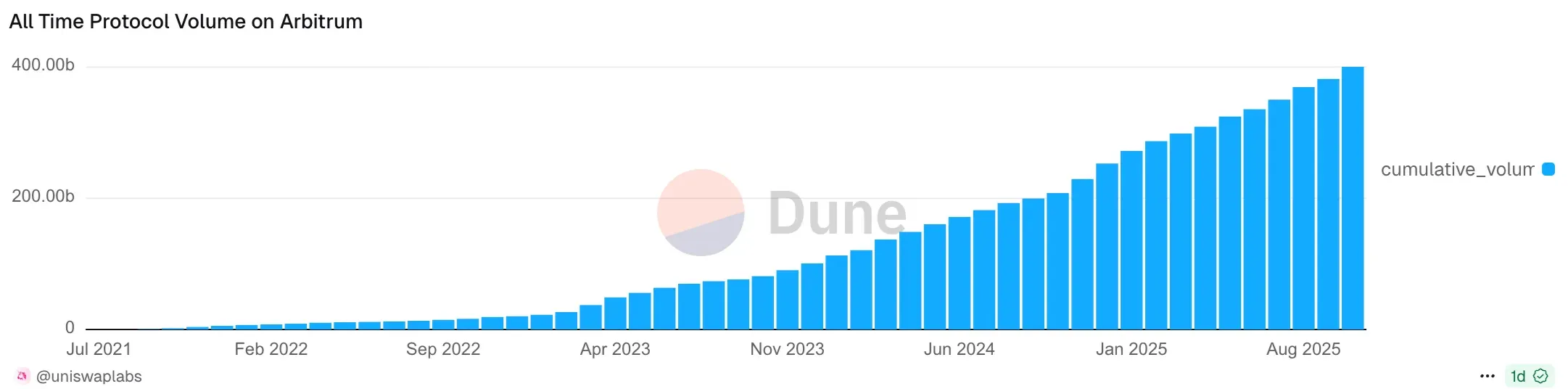
All Time Protocol volume on arbitrageum
Other measures provide a further picture of growth. Recently, Arbitrum’s Total Value Locked (TVL) ecosystem has stabilized at a high level, supporting DEX volume of over $1.1 billion. By the second quarter of 2025, the network had facilitated more than $27.5 billion in bridge assets, representing 17.3 million transfers and 4 million users. These figures are tracked through platforms such as DefiLlama And Arbiscanshow that Arbitrum outperforms peers in areas such as perpetual futures volume and on-chain revenue, making it an attractive base for new projects.
Application process and next steps
Interested developer teams should review Castle Labs’ guidelines and ensure their proposals highlight innovation, team strengths, achievable goals, and potential impact. You can register via the linkwhere applicants describe their project vision and milestones and how these align with Arbitrum. Castle Labs advises against generic or AI-powered pitches, preferring authentic ideas from dedicated teams.
Once approved, beneficiaries will receive funding in installments linked to milestones, with ongoing support to track progress. This setup not only supports individual projects, but also contributes to Arbitrum’s broader goal: fostering a vibrant, experimental community. Builders considering multichain strategies should emphasize Arbitrum’s role, perhaps taking advantage of its low-cost transactions or integration with the Ethereum mainnet.
Sources:
- Announcing $50,000 Arbitrum DAO Grant (Chilla https://x.com/chilla_ct/status/1983207757256777916
- Arbitrum One Daily Transaction Chart (Arbiscan): https://arbiscan.io/chart/tx
- Arbitrum chain TVL and statistics (DefiLlama): https://defillama.com/chain/arbitrum
- All Time Protocol volume on Arbitrum (Dune Analytics): https://dune.com/queries/3582330/6032713