

BNB Chain has overtaken TRON to become the most active network for stablecoin transactions, fueled by rising DEX volume and spillovers from Binance’s trading incentives. But analysts at ARK Invest noted that the space has become more fragmented.
Summary
- BNB Chain has overtaken TRON as the busiest network for stablecoin activity, driven by increasing on-chain trading and Binance-backed incentives.
- While Ethereum and its Layer 2 systems still dominate institutional settlement, BNB Chain is now leading in user engagement and decentralized exchange volume.
- According to the report, the market is becoming increasingly fragmented, with liquidity spread across multiple chains rather than concentrated on a single network.
BNB Chain has quietly dethroned TRON as the largest network in stablecoin activity.
According to ARK Invest’s “The DeFi Quarterly” report, approximately 192 million addresses have interacted with them since the first stablecoin hit the market. Tether’s (USDT) dominates with about 115 million of those, while the now-defunct Binance USD (BUSD) still accounts for 35 million, and USD Coin (USDC) is close behind with 31 million.
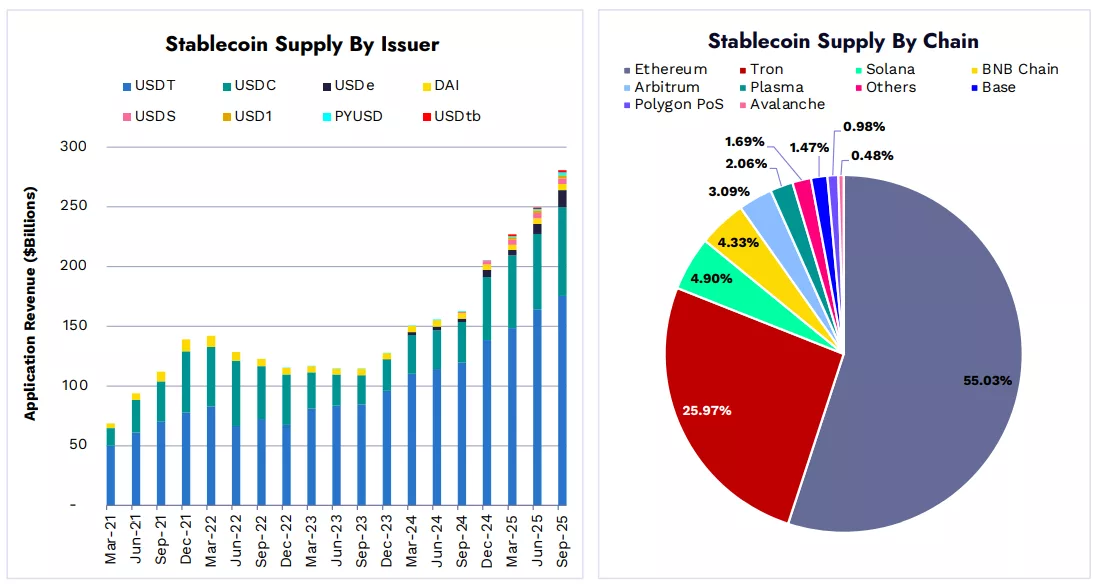
Stablecoins by issuer and chains | Source: ARK Invest
As ARK analysts put it, quarterly adjusted transaction volume for stablecoins “has since grown 43%, reaching nearly $9 trillion in the third quarter of 2025,” implying that stablecoins are circulating faster and across more networks than ever before.
Network shares
Ethereum is still the biggest elephant in the room. Especially if you include the Layer 2s like Base and Arbitrum, which together handle around 48% of total stablecoin transactions. Meanwhile, TRON built its footprint by transporting USDT flows into emerging markets, a dynamic that kept it relevant long after newer players entered the scene.
But network shares have shifted, as the report shows that Ethereum’s share of the stablecoin supply has increased from 51% to 55%, while TRON’s has fallen from 32% to 26%. And somewhere in that realignment, BNB Chain stepped in and picked up the slack as Solana lost ground and its trading operations migrated elsewhere.
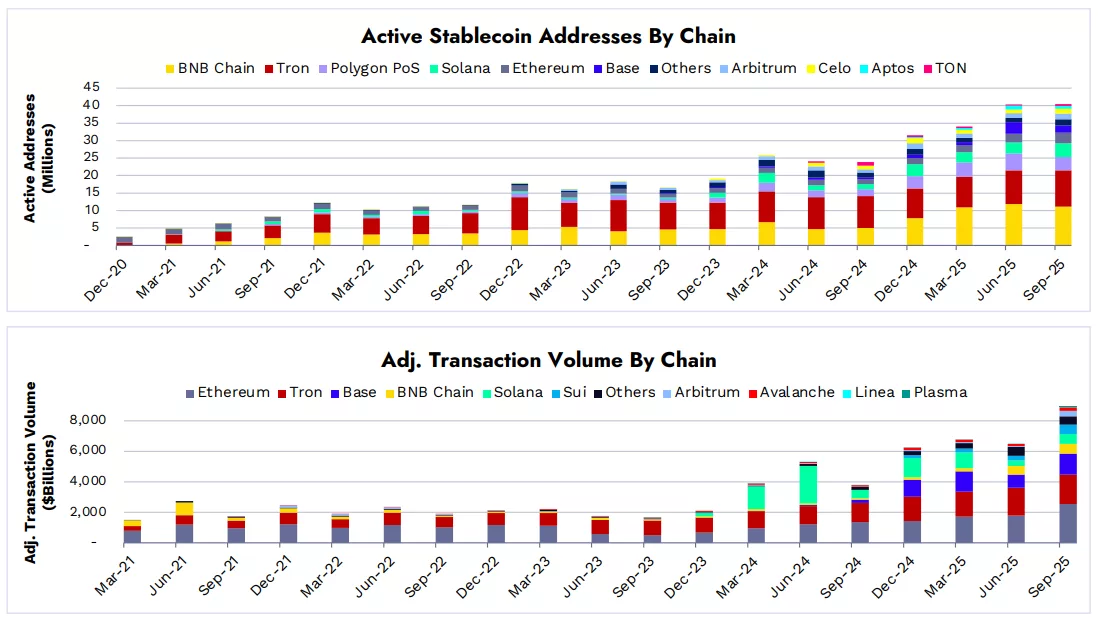
Active stablecoin addresses per chain | Source: ARK Invest
This line from the report shows the change in supply allocation across chains. BNB Chain’s gains came as Solana lost ground and spot DEX activity shifted.
DEX volume tells the same story. Since the end of 2024, decentralized trading has increased by about 61%, from about $1 trillion to $1.7 trillion. Meanwhile, Solana’s share fell from 47% to 19%, while BNB Chain’s soared from 11% to 47%.
Tree of TVL
As ARK Invest explained, the change followed Binance’s zero-fee trading program, noting that the program “caused a surge in PancakeSwap volume and redirected memecoin trading from Solana to BNB Chain.”
The program also made certain trading flows more attractive on BNB Chain, as traders shifted memecoin and retail liquidity to the chain that was closely tied to Binance, the report said.
You might also like: BNB Chain unveils $45 million airdrop reward for traders who ‘suffered losses’ from memecoin crash
Moreover, BNB Chain also distinguishes itself through trading efficiency. As of Q3 2025, the chain had the most spot DEX volume relative to total value locked (TVL). According to the report, the network’s quarterly volume rose 94.7x that of TVL, a ratio well above Ethereum’s approximately 3.83x.
While Ethereum still attracts a lot of long-term capital that moves less frequently, BNB Chain concentrates higher turnover and more speculative flows.
Increasing competition in a fragmented space
Trends in stablecoin offerings are also changing. Together, USDT and USDC market share fell slightly this year from 93% to 89% as newer entrants gained ground. Ethena Labs’ USDe rose about 68% to nearly $14 billion, while PayPal’s PYUSD rose 135% to about $2.4 billion, with most of that on Ethereum, ARK notes.
Moreover, the DEX-CEX ratio has also changed. As on-chain trading has gained over centralized platforms, the ratio will increase by approximately 192% by 2024.
While BNB Chain may not replace Ethereum as the primary network for the custody of institutional stablecoins or as the main settlement node, with Ethereum and its Layer 2 networks still handling the bulk of dollar-denominated transactions, it has nevertheless taken the cake in terms of active user engagement and DEX-led trading, the report said.
As ARK’s report suggests, the broader result is a fragmented market. One in which stablecoins move across more chains and locations than ever. That fragmentation brings new challenges in terms of liquidity and routing, but also leaves room for each network to specialize in what it is good at.
Read more: Ondo Global Markets Pushes RWA Adoption to BNB Chain