
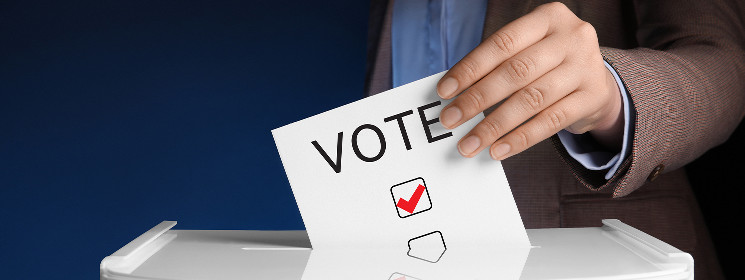
Does your country run free and fair elections? How do you know? Do you trust the results? Are you satisfied with how it organizes voting and results-gathering, or is there room for improvement?
Democracy as a topic is in the headlines constantly this year, with national elections in several of the world’s most influential countries. Technology is playing an ever-greater role, from voting machines to ballot scanners and digital tallying. Whether you find this topic controversial or would simply prefer a more efficient process with fully provable and auditable outcomes, blockchain offers a potential solution that all democratic governments should consider.
The ‘trust issue’ with elections these days
Saying there are growing “trust issues” with elections and voting in the 21st century would be… an understatement. In the United States, we went from punch machine “hanging chads” and court challenges in 2000 to outright riots over the results in 2016 and 2020. Voting machine technology has faced transparency complaints. Final results are delayed, boxes full of hard-copy ballots may or may not have been counted. Claims of fairness or cheating and disparaging opponents’ claims often depend on whether your preferred side won or lost, and not a serious examination of the processes. And that’s just the U.S.—Europe has also had its share of post-election “color revolutions,” accusations of “rigged” referendums, and other manipulations of process.
Whether you personally think modern elections are “free and fair,” rigged, or something in between, it’s clear there are millions of people out there who feel their power as voting citizens in a democracy is being eroded. New voting technologies are introduced to speed up results, but without much public input into how it’s done. At stake is every voter’s small share of control over major military decisions, economic policies, environmental controls, and general cultural changes that directly impact our lives.
People would like to have more ability to audit results and hold electoral officials to account. Since smartphones became ubiquitous, we’ve seen evidence of this need in social media posts every election cycle, calling for people to “selfie their ballot“—that is, take a photo of their ballot as proof they voted the way they did. In countries where ballots are marked with pencils or by punch machines, we see advice for voters to make their choice clearer.
There are some obvious problems with self-recording a ballot for auditability. One is that not enough people would do it to have any impact on a disputed outcome. Another is that it connects a vote to an individual identity—this is a bad idea as it could be used by bad actors engaging in vote-influencing/buying. It may also be illegal in some jurisdictions for the latter reason.
While we’re at it, we’d still like to enjoy any benefits digital and networking technologies bring to the process. Electronic results could be fast or even instant. There wouldn’t be cases of newly-discovered ballot boxes or claims of multiple ballots per person.
Blockchain’s immutable (and auditable) records
What we need is a process where a verified (real-life and eligible) individual can cast a digital vote that is impossible to change after the fact (i.e., an immutable record). That record also verifies the individual has voted, and only once. The permanent record must connect the individual to their vote, but how they voted should not be viewable to anyone other than that voter.
Does this sound like a hard problem? Actually, it isn’t. Blockchain technology is perfectly capable of performing these functions. In a long-form article published on X, Brendan Lee described a system for capturing election data on a blockchain as “possible (even easy).”
“Crucially, the system prevents observers from connecting any individual voter to the ballot paper they used by separating the registries and randomising the distribution of ballot papers,” he wrote. This also relies on “a robust voter enrolment system which is accurately maintained.”
https://t.co/VKxdXdlODR
— Brendan Lee (@Brendan_Lee__) October 21, 2024
Every eligible voter would be issued a single-use digital token, allowing them to vote on a computer or mobile device. Under Lee’s system, the actual ballot could still be paper—the voting token would be invalidated instantly as they receive their paper from electoral officials. Each ballot paper is unique and printed with its own identifying QR code to prevent reproduction. Voters record their vote with a pen or pencil, and the ballot (along with its QR code) gets scanned and photographed, which “activates” the vote and records the choice in an immutable record.
Results can be tabulated as soon as the ballot is scanned. Randomized distribution of ballots prevents the discovery of any connection between the voter and their voting choice. Ballot papers remaining unused at the close of voting are also registered as such (since they can’t be activated without a valid voting token from a unique individual, no one else could use it).
If anyone has any doubts about this process, remember that similar techniques are used for paper cash. Every bill has a unique serial number and other authentication features, but these aren’t tied to the person spending it. QR codes are actually more pseudonymous since they’re not human-readable.
If it’s so good, why hasn’t blockchain voting been introduced already?
Utilizing blockchain records for auditable elections is a clear use case, perhaps even a no-brainer for those who understand what the technology can do. So, it raises the question: why is blockchain voting not a thing in 2024? Some possible reasons might be:
1. The current socio-political climate has produced a populace skeptical of any introduction of new and poorly understood technologies into elections;
2. Decision-makers themselves have a limited understanding of what blockchain is capable of, and/or how trustworthy it really is (this problem is not unique to elections);
3. It requires a degree of technological access and proficiency among voters (to manage eligibility tokens) that not every citizen has;
4. Blockchain, with potential unforeseen problems/risks, is still seen as too cutting-edge. An inability to scale or transact affordably at high capacity is a major one here;
5. There isn’t (yet) one specific blockchain everyone trusts for the task;
6. There’s still a degree of reliance on human integrity in the process;
7. The more cynical take: our governments don’t actually want auditable voting.
Let’s disregard points #6-7 for now since they’re a politically charged and divisive can of worms, and each deserves its own separate discussion. We should note there are still plenty of countries in the world where voting remains paper-only, and this is because the hard copy is auditable to a degree most people trust (at least in theory).
The continued existence of paper-only ballots suggests both electoral officials and the general public are skeptical of new election technologies. However, many jurisdictions have embraced digital voting machines of various kinds for this purpose despite lingering concerns about their integrity. Some of these issue a paper receipt, and some don’t (again for the reason that it can connect an individual to their vote in a human-readable way).
Therefore, current digital voting systems would seem like a poor solution compared to what blockchain can achieve, yet deployment of these systems is growing. That would appear to nullify the first two points, at least in places where these machines are widely used. The issue remains a very controversial one.
Technology-related issues
Points #3-5 will likely solve themselves as time passes. Even today, it’s difficult to fully function in society without some degree of technological access/proficiency. Knowledge of blockchain and its capabilities grows every year.
Points #4-5 are problems the blockchain industry itself must solve. Lee estimates 250 million registered voters in the United States, requiring at least 500 million transactions within 12 hours (one for the voting token, one to register the vote).
BSV is already fast and scalable. It’s about to become even more so with the activation of Teranode, which can process several billions of transactions every hour. Its network is, therefore, able to process all electoral transactions on top of its regular daily functions. Lee said the transaction costs for a single U.S. national election could be as low as US$1,000 on the blockchain side, plus the costs of printing/scanning paper ballots.
“Because the system is so simple, it will be easy to educate people on the concepts and ideas at play,” Lee added.
What’s the situation for blockchain voting in the real world?
CoinGeek asked Lee about his own personal experience building a workable on-chain voting system and any hurdles he encountered.
“The hardest part is getting the idea accepted,” he said. “We had a prototype called Decision Point. I actually generated about 50 ballots and 50 right-to-vote tokens for people. It was to vote on which sandwich was best. But it was very manual and slow. Took me several hours to do a few tokens. But they worked.”
Would it have been hard to build and scale a system that performed fast enough to handle elections? “For sure,” Lee added. “It would not be hard to do—like, it is super easy.”
He said the Australian Electoral Commission (AEC) had shown interest in building a blockchain-based voting system in the past, but had “found that it didn’t work.”
“They tried to make it about identity and signatures. But when you read the legislation, you can’t have any of that. So, of course, it didn’t work, and the AEC went back to paper.”
99% of “blockchain developers” don’t realize you don’t need to use signatures if the application doesn’t require them, Lee added. A digital ID per se isn’t necessary for this to work. In fact, under his proposed solution, “you don’t need any ID, but it will only be as secure as your voter rolls.”
The system could be built with any jurisdiction in mind, fitting with its local regulations, Lee said.
“You build it to meet the requirements of the legislation. The voter doesn’t need to sign the token. The person handing them the ballot signs to say they have handed them a ballot. That’s not really needed, but it’s a nice back-stop.”
Ultimately, “it will come down to the legislation in each place we build it for.” And if someone in the BSV or wider blockchain industry can build a workable system, “there is no reason the 2028 USA election couldn’t be on-chain in at least 10 states, and then nationwide in 2032.”
The alternative: starting out smaller
One strategy is to trial a blockchain voting process at smaller organizations rather than attempt to sell it to national electoral commissions first. There, the chosen technology can prove itself in places and on issues with less at stake (i.e., less likely to cause riots if something goes awry).
Another Australian who’s spent years thinking about blockchain voting is Eli Afram. After developing a system called “b-vote”, he decided to use the technology in a product called AnonSurvey, aimed not at large-scale elections but at everyday polls and surveys. This sort of demonstration assists in solving problems #4-5 as people discover blockchain voting benefits by actually using them.
AnonSurvey’s homepage says 130 clients have used the tool to date, and results have been favorable.
“We’ve been using it for various small-scale operations,” Afram said. “I think people are just more interested in it than real-world-scale usage. (We’ve) got someone now who’s just wanting to use it for his business. It’s got some business scope.”
A fast, scalable blockchain with the capacity to handle high transaction volumes—like BSV—is perfect for the task of ensuring digital voting is free, fair, and fully auditable by both voters and electoral officials. The question is no longer whether we should use this technology in elections of any importance but how. Whether it’s a full package ready to pitch to governments or a simpler form ready for testing in more mundane polls, the task (as always) is for a talented developer with a good understanding of the requirements to build a demonstration model that shows what it can do.
It may take a while, and as we’ve noted above, there are several hurdles and barriers to overcome. Some of them may not be evident on the surface. However, with major issues at stake and more new technologies creeping into the democratic process every year, what is clear is the need to build and maintain trust. Trust shouldn’t be a hard sell, yet it sometimes can be.
Watch: Blockchain & Metanet’s role in combating fake news
title=”YouTube video player” frameborder=”0″ allow=”accelerometer; autoplay; clipboard-write; encrypted-media; gyroscope; picture-in-picture; web-share” referrerpolicy=”strict-origin-when-cross-origin” allowfullscreen=””>