
What is Flare Network?
The Flare Network is an interoperable Layer 1 proof-of-stake blockchain, which uses the Ethereum virtual machine (EVM). Flare (FLR) was created in 2020. Basically, the EVM converts smart contracts into instructions that a computer can read. This allows the network to execute Turing-complete smart contracts. Turing completeness means it can perform almost any computational task as long as there is enough memory to run it.
It can combine several powerful properties to create an ecosystem of decentralized applications. In a nutshell, Flare wants to bring smart contracts and interoperability to blockchains.
The Ripple blockchain powered by XRP is one of the main goals and inspirations of the Flare network. Flare proposes to scale PoS blockchains without compromising their security. It does this by ensuring that the security of the network is not just tied to its own tokens, as is the case with most if not all PoS networks.
Who is behind Flare Networks?

The CEO and co-founder of Flare Network is Hugo Philion. Before creating Flare, he was the founder of the Future Generations modular building system. His expertise is in investing and he holds a Bachelor of Science in Investment and Financial Risk Management from Cass Business School.
He later obtained a Master of Science in Machine Learning from UCL. He also has experience as a commodity derivatives portfolio manager for two funds with a value of more than $1 billion.
Sean Rowan is Flare’s second co-founder and CTO. Sean has been active in the blockchain community since he and colleagues at UCLA and TCD developed secure communication protocols for cars using blockchain-based public key infrastructure in 2015. Prior to that, he graduated from Trinity College Dublin with a combined BA in Mathematics and a BE in Electronics and Computer Engineering.
He then went on to University College London to get a Master of Science in Machine Learning, probably where he first met Hugo Philion. In addition, Sean worked as an R&D Engineer at RAIL in Dublin, Ireland, where he developed back-end network software for robotic medical assistants. In November 2019, the cover of TIME magazine showed the most recent iteration of this robot from RAIL.
How does Flare Network work?
The Flare Network acts as a Turing Complete Byzantine Agreement Network, using the Flare Consensus Protocol. Turing complete means that the Flare network can execute Turing complete smart contracts, which can emulate any computer algorithm. This makes it easier for any developer or computer using a coding language to execute smart contracts on the network.
In addition, Flare uses the Ethereum Virtual Machine to implement this smart contract. EVM makes it easier for Ethereum developers to build applications on Flare.
To promote interoperability between different blockchains, the Flare network uses two protocols. The first is a State Connector and the second is an Oracle Time Series Outbreak (FTSO). State Connectors help collect external data from other blockchains. This data is processed on-chain to provide consensus on the status of each blockchain Flare connects to.
That way, the Flare network can recreate what happens on the blockchain it connects to. On the other hand, Flare Time Series Oracle (FTSO) enables decentralized time series data collection. They are collected across other blockchains over a consistent period of time. Data can include things like data statistics, asset prices, and more.
The Flare network can communicate over both protocols and exchange data across multiple blockchains. This promotes interoperability, especially when building and using applications across different networks.
Features of Flare network
Ethereum Virtual Machine (EVM)
Software that helps deploy and execute smart contracts on the Ethereum blockchain is known as the Ethereum Virtual Machine (EVM). In addition, it provides a setting in which programmers can create decentralized apps (DApps) on the network. EVM performs a similar function in Flare Network by hosting DApps and running smart contracts. This allows Ethereum developers to take advantage of the network.
Flare State Connector protocol
A smart contract called the Flare State Connector protocol enables the Flare network to collect information from any linked blockchain. By using separate certificate providers, it does this in a decentralized and secure manner. These service providers independently retrieve information from a relevant blockchain. When there is sufficient agreement, The Flare Network will release this information.
Oracle Protocol Outbreak Time Series (FTSO)
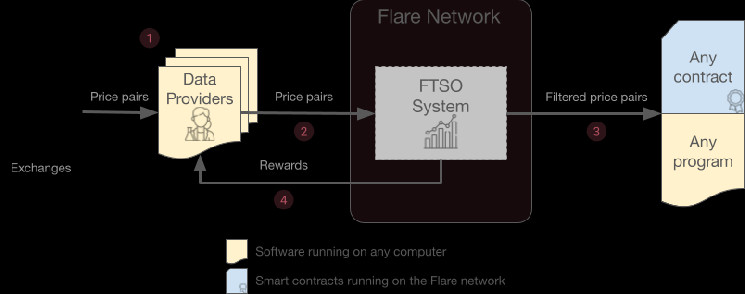
FTSO workflow
Flare Time Series Oracle Protocol (FTSO) is another cross-chain data collection and authentication feature on the Flare Network. Unlike Stateful Connection Protocol, FTSO collects time specific data. FTSO uses independent data providers to ensure data collection is decentralized and secure. Time-specific data can come from places such as cryptocurrency exchanges. It is then automatically weighted according to the voting power of the information provider. The average is calculated to provide an estimate that can be used on Flare after weighting the data.
Songbird
Songbird is Flare’s ‘Canary’ network. This is a test/testnet with exactly the same features and functionality as Flare. This is where Flare’s independent developers and teams can run real tests on the test network. They do this to see how their changes will affect the Flare network. This makes it easier and more secure to test and deploy the proposed changes without the risk of compromising the main network.
FLR Token
FLR is the native token of Flare Network. The basic usage is similar to other native tokens – to prevent spam attacks. If transactions were free, then spamming and clogging the network with useless transactions would also be free.
What is the FLR token used for?
FLR can be used for the following functions:
These three components are intended to enable an ecosystem of Spark-based applications called Spark Dependent Applications (SDA). SDA can also allow unreliable representation of tokens on other networks. Even networks that don’t support smart contracts.
Token allocation
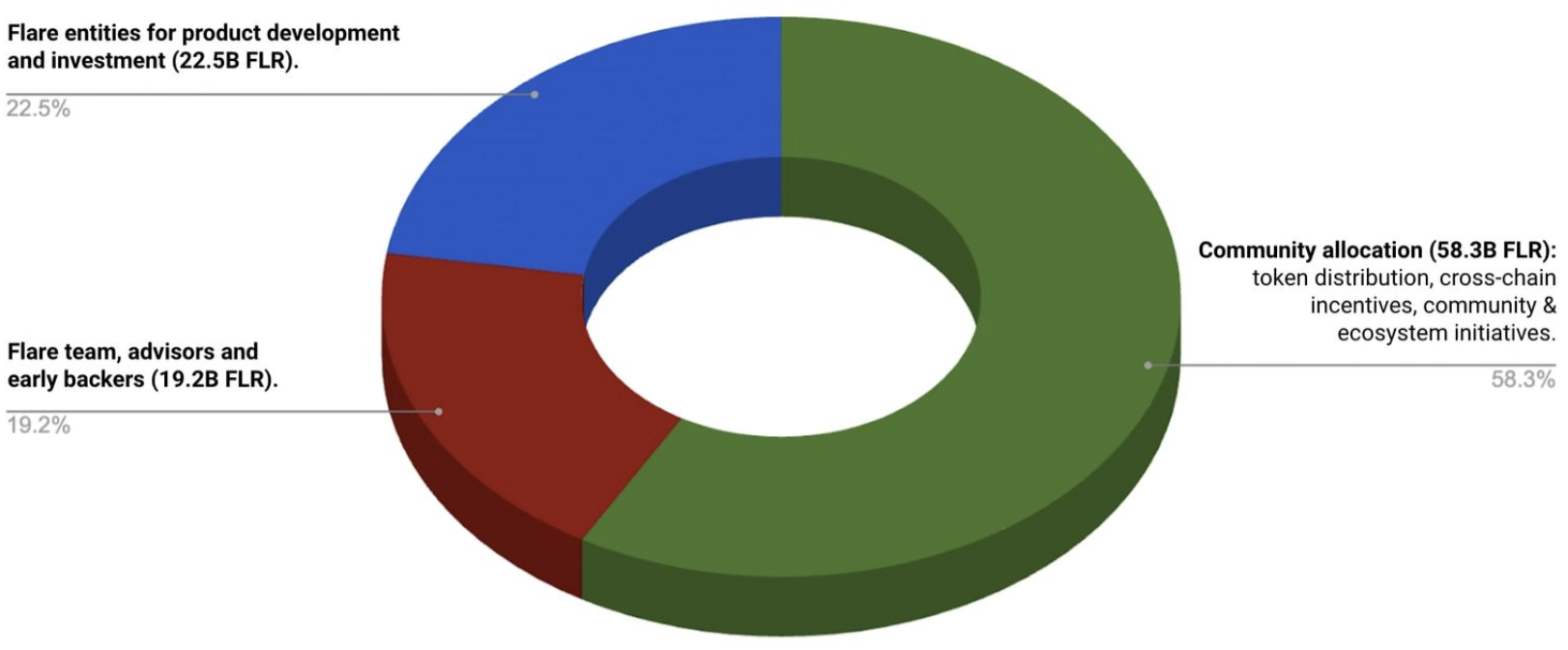
Initial Token Distribution: Macro view of the total FLR allocation
There are 100 billion FLR tokens available for distribution to key network stakeholders. 58% of the tokens go to the Flare community via airdrops. Then 19% is allocated to the development team, lawyers and consultants. Finally, Flare spends 22.5% of its tokens on investment and product development.
The first token distribution event was scheduled for 2020. Due to the aforementioned Ripple lawsuit, the first airdrop took place at a token distribution event on May 9. January 1, 2023. Eligible XRP holders received FLR 4.28 billion through centralized exchanges such as Binance, Kraken, Kucoin, and OKX.
The FLR 4.28 billion airdrop represents 15% of the tokens allocated to the community. The remaining 85% of the tokens will be distributed depending on the votes of the current holders who are expected to pocket their FLR tokens.
Pros and cons
The first advantage of the Flare network is the ability to make blockchains interoperable. This is an advantage for blockchain developers and users when trading; Flare’s technology enables the transfer of information between multiple blockchains.
Second, Flare networks help PoS blockchains grow without compromising their security. Flare supports this by allowing smart contract platforms to scale without just linking network security to their own token. The network also provides an environment to build DApps without worrying about code incompatibilities due to Turing completion. Finally, by integrating the Ethereum Virtual Machine, Flare continues to act to scale the smart contract network.
While there are many advantages, there are also some disadvantages to the network. The main and biggest limitation is Flare’s reliance on the Ripple network. The network delayed its launch and airing for two years due to Ripple’s lawsuit. The network will be at a long-term disadvantage if it is heavily influenced by a blockchain’s functions.
Conclusion
In general, Flare Network is a layer 1 blockchain ecosystem and a decentralized oracle network. The protocol features a unique stack and token generation system built to enable programmability and cross-chain communication. The goal of the project is to enable HODLer to unlock liquidity and expand DeFi adoption.
Flare users have many advantages. First, the network improves interoperability across the market, enhancing liquidity. Users can access DeFi features with a deep pool of liquidity by using Flare. This structure also supports scalable EVM-based smart contracts, making it an ideal solution for Ethereum developers looking for lower costs.
Another thing to remember is that Flare started with Ripple, but in theory it could add smart contract functionality and interoperability to any blockchain. Since three-quarters of the value in public blockchain tokens cannot be reliably used with smart contracts, Flare currently has a huge potential growth curve ahead of it.
DISCLAIMER: The information on this website is provided as general market commentary and does not constitute investment advice. We recommend that you do your own research before investing.