
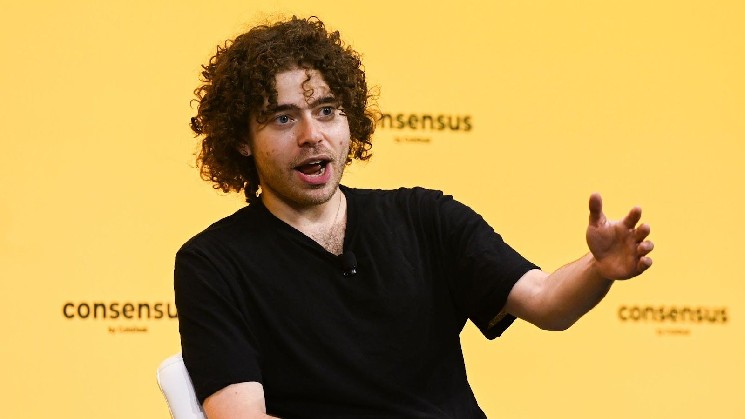
Miami Beach — When Shayne Coplan launched Polymarket, he didn’t have a team or major funding. What he had was a blockchain, a strong belief and a laptop.
“I’m a solo founder. I literally started with almost no money,” Coplan said Wednesday during a talk at Cantor Fitzgerald’s crypto, AI and blockchain conference in Miami Beach. “The nice thing about blockchains is that a child in his bedroom – or in his bathroom, in the office or whatever it is – gets the opportunity to innovate and experiment with financial applications.”
He praised the open nature of blockchain for allowing him to create a functioning global market without traditional institutional support. “The barrier to entry to build something innovative in traditional fintech is prohibitive for anyone trying to create something new, who is young and doesn’t have a lot of capital and doesn’t have a lot of time,” he said.
Launched in 2020, Polymarket allows users to trade based on the likelihood of real-world outcomes – from elections to Fed decisions to celebrity gossip. The platform does not work based on opinion polls or expert predictions. Instead, it lets the market determine the opportunities.
“When people follow an election, or an election that affects their livelihood, they want to know who’s going to win,” Coplan said. “The polls are okay, here’s a random group of people… but they consistently lean one way or another. It’s just noise.”
He believes the markets offer something fairer: a price backed by conviction and risk.
“We have a cycle where when there’s a big election, everyone goes to Polymarket, everyone checks it. Then everyone comes out and makes up a conspiracy theory about why it’s wrong,” he said. “If Cuomo is trading at five cents to gain one dollar… if it’s actually worth 40 or 50 cents and it’s trading at five cents, then you should buy it. You should put your money where your mouth is.”
Every transaction on Polymarket is peer-to-peer and prices reflect the collective belief. “It’s not a function of how much money was put on each candidate,” Coplan explains. “At any given time there are yes shares… and if you look at the order book, there are bids and asks.
Whatever the center is, that’s the probability. That is the current value of winning one dollar, if all goes well.”
Beyond politics, Coplan sees a broader potential: prediction markets as tools for decision-making, even in public policy.
“You can say: what are the chances that Cuomo will win if Sliwa does not drop out, and what are the chances that he will win if he does drop out?” he said. “From the markets, if you structure it properly, you can support decision-making in society on an unprecedented scale.”
Coplan also believes Polymarket can compete with older betting platforms by offering something traditional sportsbooks cannot: fairness.
“When you bet or trade on the outcome of a game… there is a monopoly on pricing. You are trading against the house every time,” he said. “They can set any price they want. If you make money, they can ban you. They can profile you and give you worse prices or set a cap.”
“This is America. You see something that is inefficient and that hurts consumers – if it’s a financial market, but it’s positioned as an entertainment product designed to lose – you can’t complain when alternatives to the financial market come along.”
Coplan foresees that Polymarket will eventually play a role in sectors such as insurance, where consumers often face bundled services and high premiums.
“If you resign or try to hedge against some kind of exotic risk, you’re often dealing with a company that has a sales force or a risk department… and you end up paying really bad prices,” he said. “The great thing about Polymarket is that you can see people creating a Polymarket for the same kind of risk… people who deal with price risk can provide liquidity. People who are good at sales can allow them to hedge those risks.”
He also discussed the role that AI agents could soon play in the trading markets. “You’re seeing a lot of people experimenting with these AI agents that can gauge sentiment, monitor the news and basically form their own opinions… if they see a misprice, they can try to correct the market,” he said. “Even if there is very little liquidity, or a small liquidity subsidy, you will let these agents go and people will compete to build the most accurate agents.”
Coplan said the long tail of niche markets – anything that involves uncertainty – is a big part of Polymarket’s potential. “Will it generate a lot of volume? No. But will it unlock a new format of information? Yes,” he said. “Polymarket odds – the percentage probability of something – could be expanded to a much larger range of odds.”
As Polymarket prepares to scale its US presence and attract new users through a beta exchange, Coplan remains focused on staying ahead of legacy institutions – and building a platform that delivers on blockchain’s original promise.
“We’re just trying to build the best product,” he said. “Something that people like to use, where your opinion really matters.”