
Wall Street’s attitude toward Bitcoin has shifted from euphoric to deeply skeptical after last year’s busy long trade unraveled, according to Alex Thorn, head of research at Galaxy Digital. In an interview on What Bitcoin Did, Thorn said the shift has less to do with conspiracy theories or a single bearish catalyst than with depleted demand, heavy selling to long-term holders and a market now struggling to find a new narrative.
Thorn pushed back on claims that companies like Jane Street are responsible for Bitcoin’s weakness, calling this line of thinking “Twitter cop.” He argued that most of the outrage stems from frustration over price action and not from evidence of deliberate suppression.
“What do we think would be the actual incentive for them to lower the price?” said Thorn. “Bitcoin is a multi-trillion, well, whatever it is, a point-something-trillion-dollar asset. It’s hard to manipulate markets of scale in any specific direction because it’s a free market and it’s a big one.”
– Bitcoin didn’t crash because of Jane Street
– the distribution of whales was significant, inevitable, necessary and healthy
– wall st negativity about BTC is real, but wrong
– the fundamental value of bitcoin is real and correct
– you have to robotmaxx, otherwise you will be trapped forever https://t.co/GUMAARf7Pl pic.twitter.com/QQhDy3RNrg— Alex Thorn (@intangiblecoins) February 28, 2026
Why Wall Street is wrong about Bitcoin
His broader explanation was simpler. From late 2024 through the period between the U.S. election and the inauguration, Bitcoin was, he said, long “the most popular trade in the world.” That changed when capital rotated elsewhere. AI-linked stocks, semiconductor names, energy plays, quantum stocks and gold all started to grab attention, while Bitcoin’s momentum faded.
Related reading
At the same time, Thorn said, long-term holders were consistently dividing coins in strength. He described that sale as structural rather than alarming. “That’s literally how distribution happens and how you make money on a transaction,” he said, arguing that older holders taking profits are part of Bitcoin’s maturation rather than a sign of failure.
He went further, calling the distribution of whales constructive for the network in the long term. “Technically, you want to sell more. You want it to be distributed to people who buy it at a higher cost,” Thorn said. “The realized price is higher and that’s a good thing. That means that people, with enormous amounts of money, are willing to buy Bitcoin at very high prices. To me that is a core signal of adoption.”
Still, Thorn acknowledged that sentiment has deteriorated sharply, especially among professional investors. According to him, Bitcoin’s inability to behave like “digital gold” since September has damaged the narrative that many allocators had believed in. Wall Street, he said, took that label too literally.
Related reading
“We did not intend for the trade to occur with a high beta for GLD,” Thorn said. “The characteristics are golden. Trading behavior hasn’t fully caught up yet. The delta between those two things, if you believe it will eventually close, is your alpha.”
This mismatch has worsened the institutional mood just as broader macroeconomic fears have worsened. Thorn said investors are concerned about AI from both directions: that it may fail to justify massive investments, or that it may succeed so thoroughly that it destroys jobs and destabilizes markets. If stock prices turn around as a result of that uncertainty, he suggested, Bitcoin could struggle to stay isolated.
Still, Thorn drew a line between short-term sentiment and long-term belief. “We really need to focus on explaining the fundamental purpose, use cases and value to a holder of Bitcoin as the reason it is rising,” he said. “Stop begging for Jay Powell to buy your bags. That’s not nearly as sustainable as the reason it’s going up is because people deeply understand Bitcoin’s savings technology.”
For Thorn, that’s the real story now: Wall Street may have turned negative, but the longer-term battle is still over whether more investors will see Bitcoin as a sustainable store of value rather than a transient macro trade.
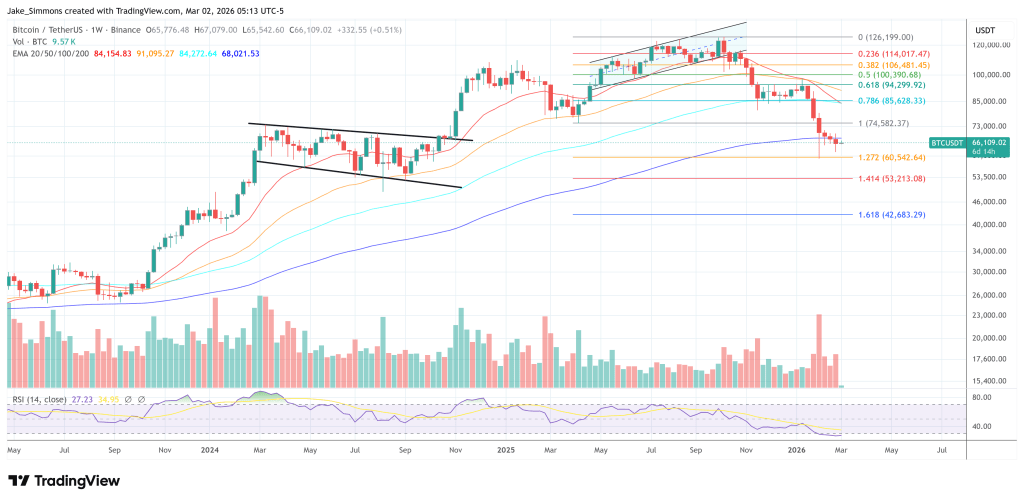
At the time of writing, BTC was trading at $66,109.
Featured image created with DALL.E, chart from TradingView.com