

The latest Jane Street debate about X is met with a blunt rebuttal from Ari Paul. The founder of BlockTower, who says he worked as a market maker on Wall Street 15 years ago, argues that Bitcoin’s inability to move higher is better explained by spot selling rather than a long-running suppression campaign.
Paul’s answer was direct. “In short: no,” he wrote, before adding that market makers “game the system” in many ways, but with liquid products like BTC ETFs the effect is usually limited to “meaningful but small costs to consumers,” rather than a lasting distortion to the price of the underlying assets. He described the distinction as between short-term microstructure plays and a broader claim that one company stopped Bitcoin from reaching much higher levels.
Bitcoin manipulation? Small movements, quick returns
To make that point, Paul pointed out the kind of behavior that desk traders are familiar with. “For example, market makers can manipulate the price to execute stop limit orders,” he wrote. “But that’s usually within an intraday timeframe. So they can use an asset like MSFT or BTC 2% in a weak market to trigger stops, and a few seconds or minutes later the price is largely back to where it was before.” According to him, that is still manipulation, but it is not the same as structurally keeping Bitcoin below an imagined fair value for months.
Related reading
That argument rightly contradicts a more conspiratorial story now circulating online about why Bitcoin isn’t already worth $150,000. Paul’s counterresponse does not deny that large Wall Street firms can determine short-term trading conditions. It rejects the stronger claim that such activity is the central explanation for Bitcoin’s broader price path.
Paul’s key point was much less dramatic. “Why did BTC drop? Because OGs sold tens of thousands of coins and not enough people wanted to buy them.” This line closely aligned with the views of noted on-chain analyst James Check, who argued that “Jane Street didn’t suppress the Bitcoin price” and that “HODLers did all that,” by selling large amounts of spot into the market.
Jane Street did not suppress the Bitcoin price people.
HODLers all did that.
It’s just not that hard: stop summoning your inner salty goldbug and start blaming the manipulators.
People. Sold. A. Fuckton. By. Place. Bitcoin. https://t.co/CrWgPUzUFP pic.twitter.com/N3VhgYjKhm
— _Checkmate 🟠🔑⚡☢️🛢️ (@_Checkmatey_) February 26, 2026
He added: “My point has always been the same; manipulation is something that always has been, always will be, and is indeed the literal job of big Wall Street firms. However, you don’t need that as a central argument to explain why the price hasn’t gone higher, nor why it’s gone lower. That can be well explained by looking at the spot-sell side.”
Paul did leave room for exceptions. He wrote that there are rare cases in which Wall Street manipulates assets in significant ways over an extended period of time, but said these cases are unusual because they are risky and harder to profit from than people think.
Related reading
“There are rare exceptions where Wall Street manipulates an asset in significant ways over the longer term, but this is quite rare because it is very risky and not as easy as it seems to make a profit. 99% of the time when an asset is not moving the way you want and people are screaming for ‘manipulation’, it is best to embrace the cognitive dissonance and avoid the ‘easy way out’ of blaming manipulation,” Paul wrote.
That leaves the current Jane Street argument in a narrower framework. Yes, large companies can influence intraday flows, liquidity and execution quality. But based on Paul’s report, this is far from proving that one market maker is the reason Bitcoin is not trading materially higher.
Notably, Jane Street’s theory gained new attention after Terraform Labs’ administrator sued the company in Manhattan federal court, alleging insider trading related to Terra’s collapse in 2022. The complaint says Jane Street used a private chat called “Bryce’s Secret” to obtain non-public information and alleges that an $85 million UST transaction on Curve contributed to a sell-off; Jane Street has denied wrongdoing and called the case opportunistic.
At the time of writing, BTC was trading at $66,090.
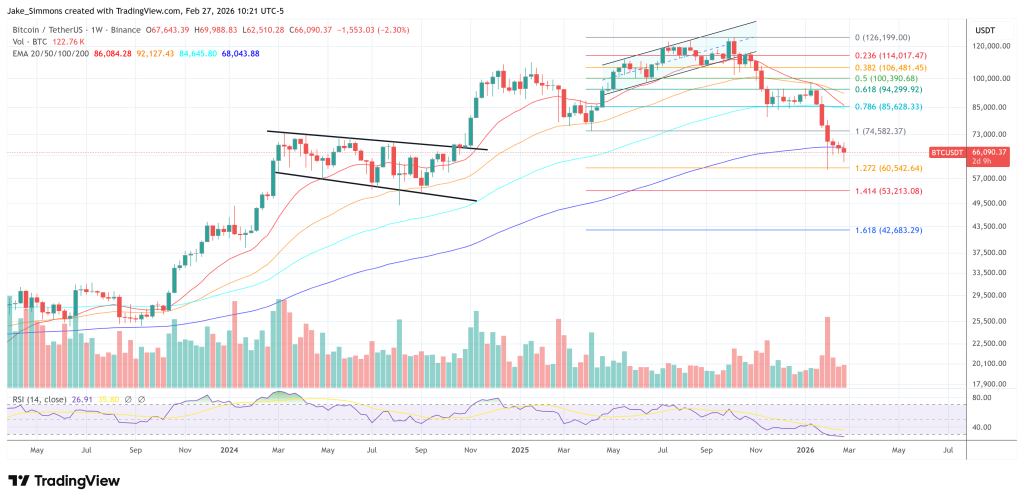
Featured image created with DALL.E, chart from TradingView.com