
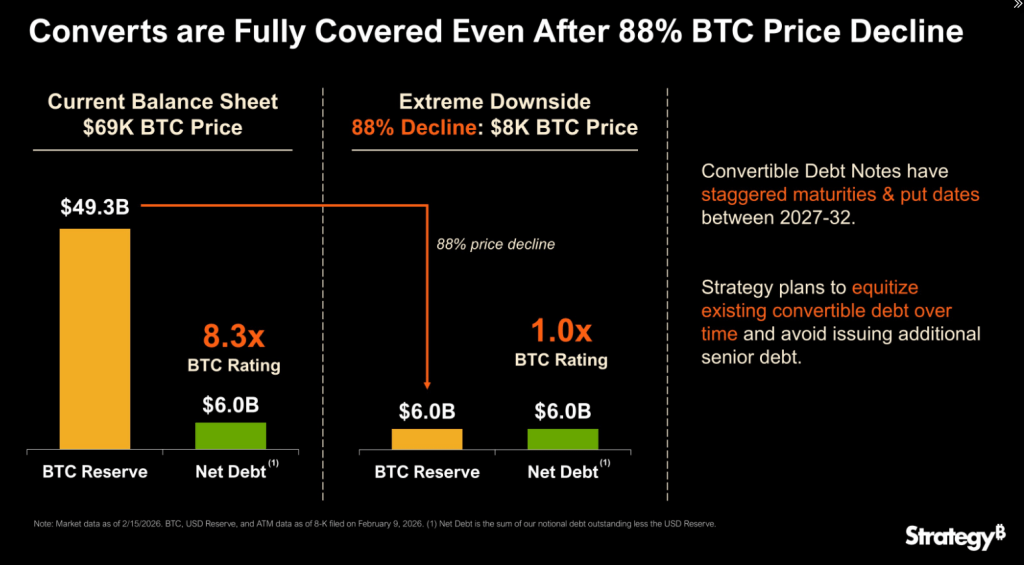
According to Strategy founder Michael Saylor, the company believes it can meet its obligations even if Bitcoin falls sharply, to a low of $8,000. That claim is easy to set. The reality behind it is more complex.
Related reading
Debt cushion and what it means
According to reports, the company currently has a net debt of around $6 billion against its crypto holdings. On paper, a sharp decline in BTC’s market value could bring reserves roughly in line with that obligation.
But balance sheet math is not the whole story. Timing is important. Liquidity windows, market access and investor reactions can change the practical options available to a company under pressure. What management calls a “cushion” can be thin in a stressed market.
Strategy can withstand a downturn in the economy $BTC price to $8,000 and still have enough assets to fully cover our debts. pic.twitter.com/vrw4z4Ex9q
— Strategy (@Strategy) February 15, 2026

Conversion plan and shareholder considerations
The company has a plan to liquidate certain convertible notes over the next three to six years. That means debt is exchanged for equity instead of being converted into new senior loans.
According to reports, this poses some risk to shareholders through dilution and extends deadlines for cash payouts. The interest remains payable as long as the notes exist, so the company is not free from short-term costs.
If the markets choke or the share price weakens dramatically, the terms and outcomes of the conversion could change. What looks manageable now can be reshaped by turbulent markets.
Our plan is to settle our convertible debt over the next three to six years. https://t.co/yRsCuCRNHl
— Michael Saylor (@saylor) February 15, 2026
Buying in decline
The buying continued. One recent purchase added 1,142 BTC at a time when unrealized losses were in the billions. That pattern shows confidence, but also increases awareness.
Accumulation while sustaining large paper losses increases the company’s sensitivity to Bitcoin swings. Market moves can turn that bet into long-term volatility for the stock. Investors who trade the stock as a proxy for crypto risk know this all too well.
CEO comments and the longer term
Reports have revealed comments from Phong Le suggesting an 80% decline would take years for the operational side of the business to materially damage.
That timeline depends on stable access to credit markets and predictable cash flow. Both could be disrupted when asset prices fall and lenders become cautious. The company’s position assumes a sudden freeze in financing channels.
Political pitch and broader appeals
Saylor has also pushed for the US to take a reserved stance on Bitcoin, similar to the way it treats gold, and is pushing for laws that would promote Bitcoin adoption. These advocacy movements are positioned as long-term efforts to shape policy.
Related reading
The political winds may change. U.S. President Donald Trump and other leaders may have different priorities, and legislation is a slow process.
Based on reports, the documents and public comments outline a path that could technically withstand a deep slump in BTC.
However, along that path, shareholders will be asked to absorb volatility and potential dilution while hoping markets stay open long enough to convert and adjust.
Featured image from Unsplash, chart from TradingView