

Ethereum regained the $3,150 level after a volatile session on Sunday, leaving traders divided on what comes next. Some analysts warn that ETH’s recent rebound is nothing more than a temporary pause before the downtrend resumes, while others see signs of a possible bullish reversal at current levels.
Related reading
New data from Binance shows that Ethereum is now entering a delicate phase. Price momentum has clearly weakened, but open interest remains relatively high despite the decline from the $3,900 region. This disconnect highlights a major shift in the behavior of the futures market: Traders are holding positions but not increasing them aggressively.
The 30-day open interest Z-Score currently stands at 0.50, indicating that the OI is just slightly above the 30-day average – well within normal volatility ranges. Unlike previous corrections, which saw open interest rise amid heavy selling, the current reading does not indicate extreme debt build-up nor panic-driven position closings.
This unusual combination – weakening momentum combined with stable open interest rates – underlines a market in transition. Whether Ethereum resumes its downtrend or begins to recover will depend on how quickly momentum returns to the spot and futures markets in the coming days.
Open interest rate stability indicates a market that wants to reposition itself
According to the Arab chain report on CryptoQuant, Ethereum’s $6.61 billion in open interest highlights that traders are still holding on to a substantial portion of their positions despite the sharp drop from $3,900 to less than $3,200. This divergence – a falling price but a steady OI – is characteristic of market repositioning phases, where traders reduce activity without completely exiting the market.
The supporting numbers reinforce this view: the OI avg30 is $6.44 billion, and the OI std30 is $329 million, indicating that current swings are well within normal volatility ranges. There are no signs of aggressive position building or liquidation pressure.

With a Z-Score of 0.50, the modest increase in open interest does not indicate overwhelming bearish leverage. Instead, it shows that traders are still engaging with the market and selectively building new positions as the price falls. This level of participation is important: it indicates that the derivatives market is active, but not overheated.
Ethereum’s price weakness, caused by declining momentum after failing to maintain previous highs, leaves the market at an inflection point. If large traders are predominantly short, stable OI could support the continuation of downward pressure. However, if long positions dominate, the same stability can lay the foundation for a recovery once momentum returns.
Related reading
Testing momentum as bulls try to regain control
Ethereum is trying to stabilize above the $3,150-$3,160 zone after a volatile multi-week decline. The chart shows ETH recovering from a local low near $2,750, forming a short-term bullish structure. However, momentum remains fragile. The 50-day SMA continues to slope downward and is well above current price action, reinforcing the broader downtrend. Until ETH can break and close above this moving average, upside attempts will likely encounter resistance.
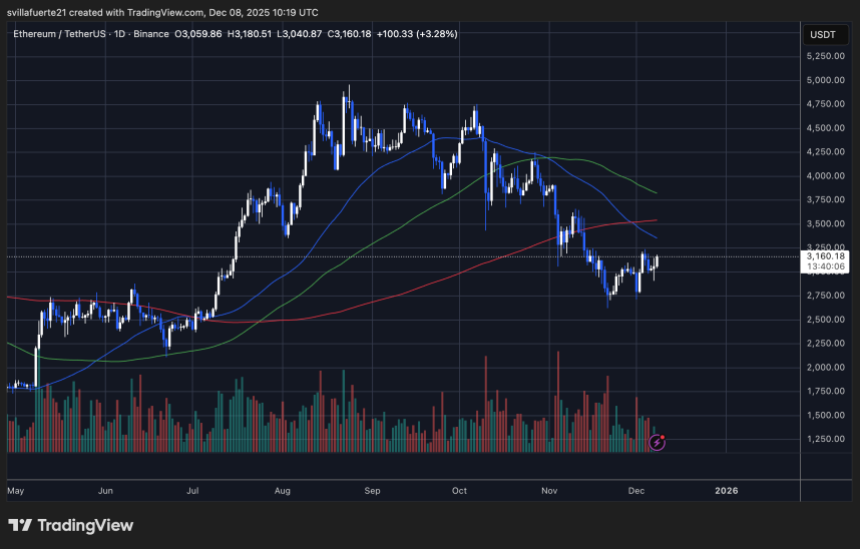
The 100-day SMA is also declining and converging with the $3,350-$3,400 region – an area that could act as the next major ceiling for any bullish continuation. Meanwhile, the 200-day SMA remains flat but just above the price, creating an additional barrier around $3,250-$3,300. This cluster of resistance levels confirms that Ethereum is still operating within a corrective structure despite the recent upswing.
Related reading
Volume is down noticeably compared to the heavy sales-side peaks in November. This suggests that the recovery may be driven more by easing selling pressure than by strong demand on the spot market. If volume remains weak, ETH may struggle to build enough momentum for a sustainable recovery.
Featured image of ChatGPT, chart from TradingView.com