
The recent Amazon Web Services (AWS) outage that took out major crypto and fintech platforms including Coinbase, Robinhood, MetaMask, and Venmo has reignited the debate over how decentralized Web3 really is.
While blockchains continued to produce blocks continuously, millions of users were unable to access wallets, exchanges, and decentralized applications (DApps) because their interfaces and application programming interfaces (APIs) were hosted on centralized servers.
“Decentralization has succeeded at the ledger layer, but not yet at the infrastructure layer,” Jamie Elkaleh, chief marketing officer at Bitget Wallet, told Cointelegraph. “True resilience depends on diversifying from hyperscalers to community-driven and distributed networks.”
Elkaleh added that full decentralization is “not yet feasible at scale” because most teams rely on hyperscalers like AWS, Google Cloud and Azure for compliance, speed and uptime. The practical goal, he said, should be a “credible multi-home” infrastructure, distributing workloads across both cloud and decentralized networks to avoid single points of failure.
Elkaleh argued that cloud providers offer scalability and security, but at the expense of concentration risk. “If one region or provider goes down, hundreds of apps are affected,” he said. Hybrid systems, combining the cloud with decentralized storage and community-managed nodes, are the next logical step.
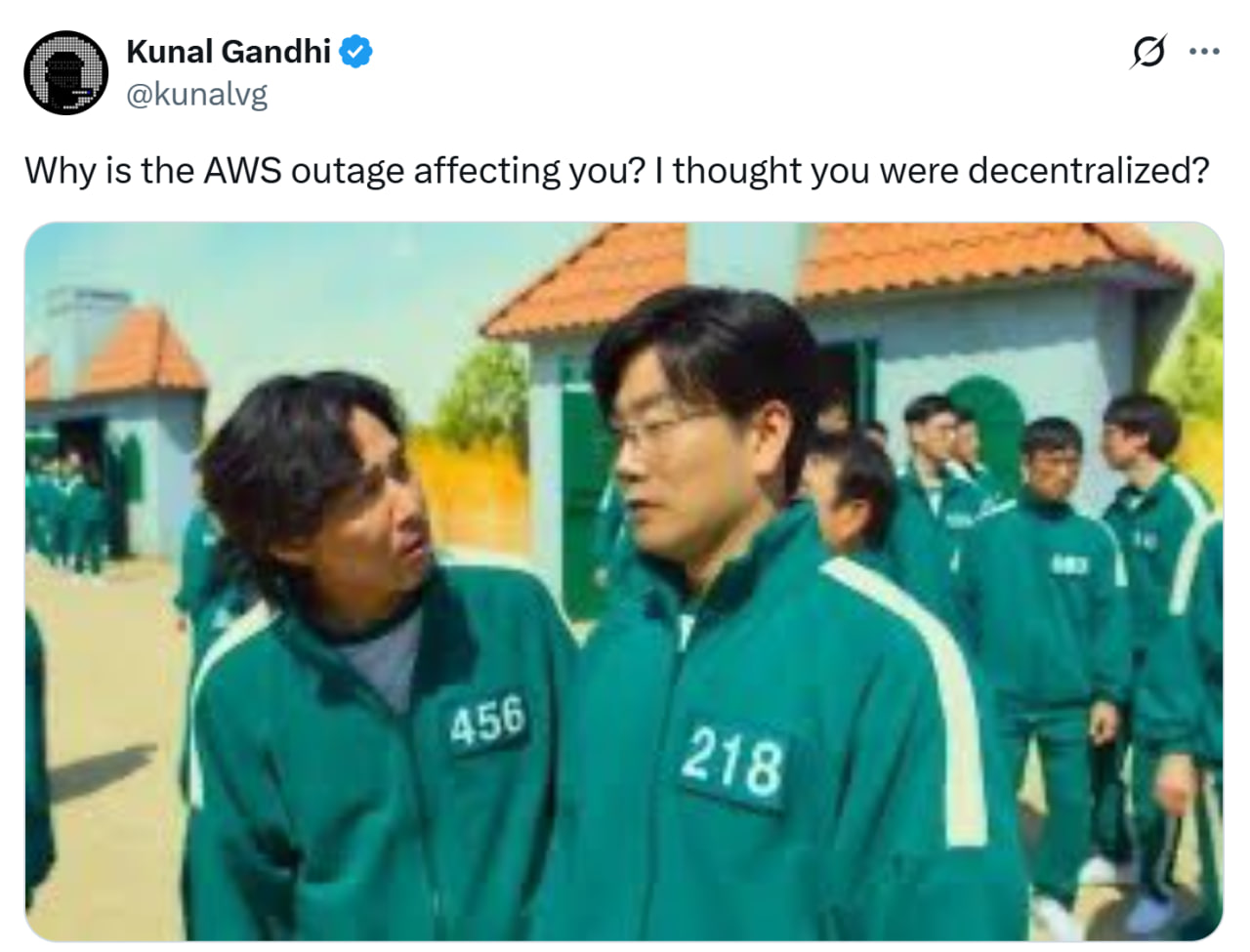
X user making fun of so-called decentralized platforms. Source: Kunal Gandhi
Related: Amazon AWS outage affects Coinbase mobile app, Robinhood
Users were excluded from working blockchains
Anthurine Xiang, co-founder of EthStorage and QuarkChain, said the outage showed that “even in Web3, many services still rely heavily on the centralized infrastructure.”
She explained that true decentralization requires redesigning every layer, from storage to access, so that no single provider can take systems offline. “It’s like the house is okay, but the door is stuck,” said Xiang, describing how users were locked out of working blockchains.
The outage started on Monday and lasted about 15 hours. The outage caused Coinbase’s app and Base network to crash, preventing users from logging in or making trades, while Robinhood traders reported slowdowns and API errors.
The outage also affected MetaMask, with users reporting seeing zero balances in their wallets. “Their assets were safe, but the service responsible for retrieving balance information had gone offline,” Xiang explained, noting that it was not a technical failure of the blockchain itself.
Meanwhile, Jawad Ashraf, CEO of Vanar Blockchain, criticized the crypto industry for all “running on the same servers.” He claimed that about 70% of Ethereum nodes are hosted by AWS, Google or Microsoft. “We’re just paying three different landlords instead of one,” he said.
Building fully decentralized systems is possible, he added, but “most teams won’t be doing this anytime soon” because it’s slower and more complex than running on AWS.
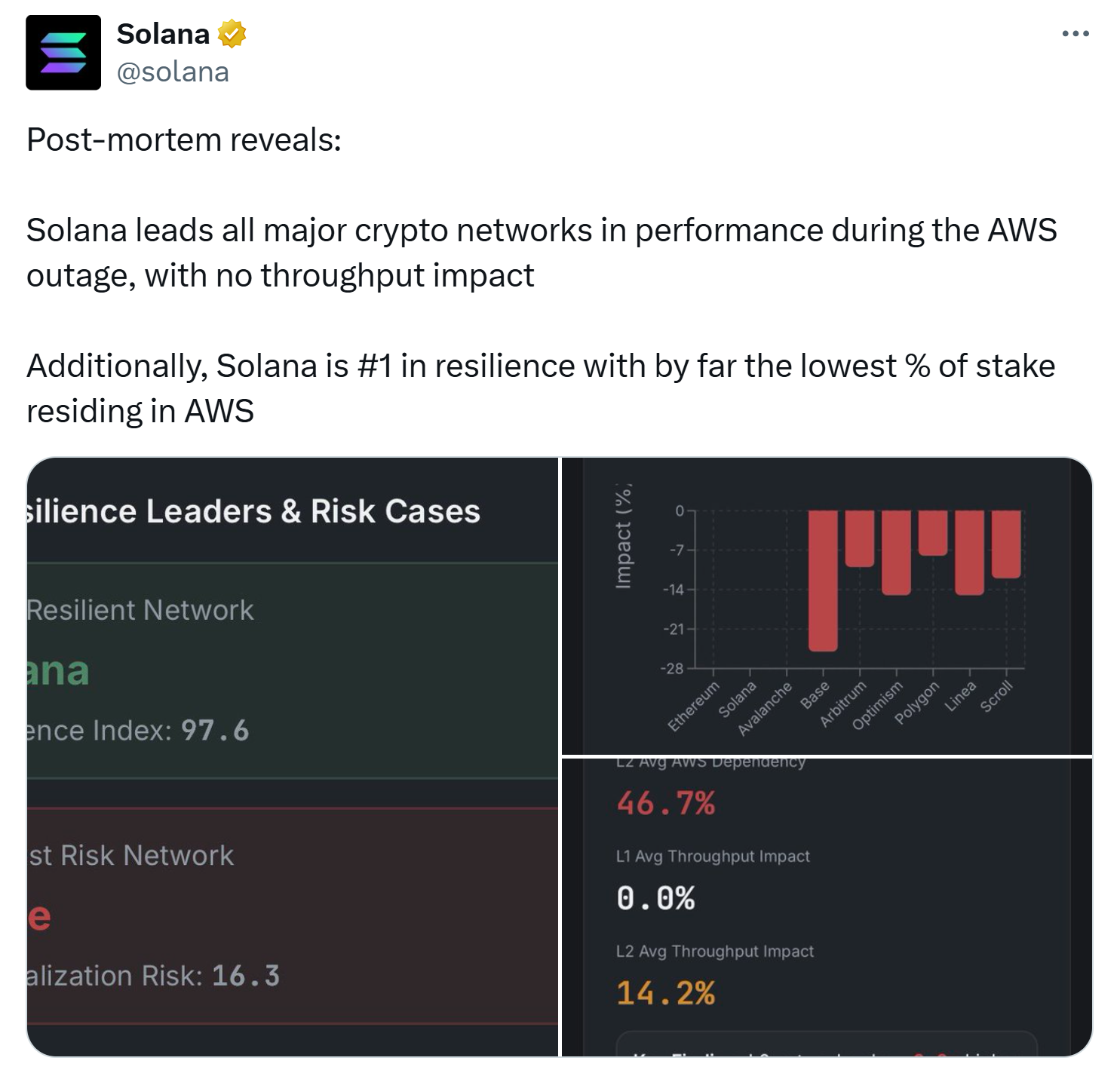
Solana claims the outage will not impact transit. Source: Solana
A wake-up call
Elkaleh said the outage should accelerate investments in decentralized cloud, storage and computing networks such as Akash, Filecoin, Arweave and others. He called on Web3 builders to embrace hybrid models that combine traditional reliability with distributed redundancy.
“Every major disruption is a wake-up call,” he says. “The future of Web3 will not be determined by how decentralized the tokens are, but by how distributed the infrastructure actually becomes.”
Magazine: Back to Ethereum – How Synthetix, Ronin and Celo were born