

Santiago Roel Santos, founder and CEO of crypto investment firm Inversion Capital, said cryptocurrencies are not subject to positive network effects, but other experts disagree.
In a recent Substack post, Santos wrote that “crypto is priced for network effects it doesn’t have.” He also pointed to the network effect valuation system, Metcalfe’s Law, saying it “does not justify the valuation of cryptocurrencies” but instead “exposes them.”
Santos claimed that many of crypto’s network effects are detrimental due to congestion, such as higher fees, poorer user experience and slower transactions. “Facebook didn’t get any worse when it got 10 million users,” he said.
Other experts are pushing back
Some analysts agree that crypto may be overvalued, but others say Santos is applying the wrong framework.
Santos admitted that new blockchains improved transaction throughput, but he argued that this leads to less friction and not increased value. Still, he said liquidity, developers and users can move around, while code can be forked and value capture is weak.
Related: DeFi is already 30% of the way to mass adoption: Founder of Chainlink
Jasper De Maere, agency strategist at leading crypto market maker Wintermute, told Cointelegraph that overvaluing layer 1 blockchains due to negative network effects amounts to “applying consumer app logic to infrastructure,” building on the Facebook example.
“Facebook’s back end suffered from congestion and outages early on; those negative effects were simply internalized and abstracted.”
De Maere said that “users are not intended to interact directly with L1s”, making monthly active users and user stickiness irrelevant. According to him, “the real network effects for an L1 occur at the validator, security, and liquidity layers, not at the end user layer, and that is where the compounding actually takes place.”
Tomas Fanta, director of crypto investment firm Heartcore, said he disagrees with Santiago that fees are getting worse as usage increases. He said that on high-quality blockchains, “fees go from meaningless to meaningless,” and liquidity improves and returns increase as adoption increases.
Ben Harvey, digital asset researcher at crypto trading firm Keyrock, told Cointelegraph that he largely agrees with Santos’ claim that L1 blockchains are overvalued. Yet he doesn’t think this applies equally to all L1s, with scalability of protocols and integration of artificial intelligence being key factors.
Related: Blockchain is struggling to stick to its original purpose: co-founding the Aztecs
Analysts debate the logic of crypto valuation
Santos pointed out some rough mathematical estimates of the value an onchain user has to a blockchain. Given the current total cryptocurrency market cap excluding Bitcoin (BTC) of $1.26 trillion, this would cost the 40 to 70 million monthly active users, which venture capital firm Andreessen Horowitz estimated last month at $18,000 to $31,500 each.
The same report estimates that 716 million people own crypto. This would result in a per-user value estimate of almost $1,760, but it is an overcount because Bitcoin is not excluded. With Santos’ estimated 400 million users, the value would be $3,150 per user.
With Facebook’s 3.1 billion monthly active users and Meta’s market cap of $1.6 trillion, we get a per-user valuation of $516. Moreover, in addition to Facebook, Meta also operates other platforms and services that are priced in.
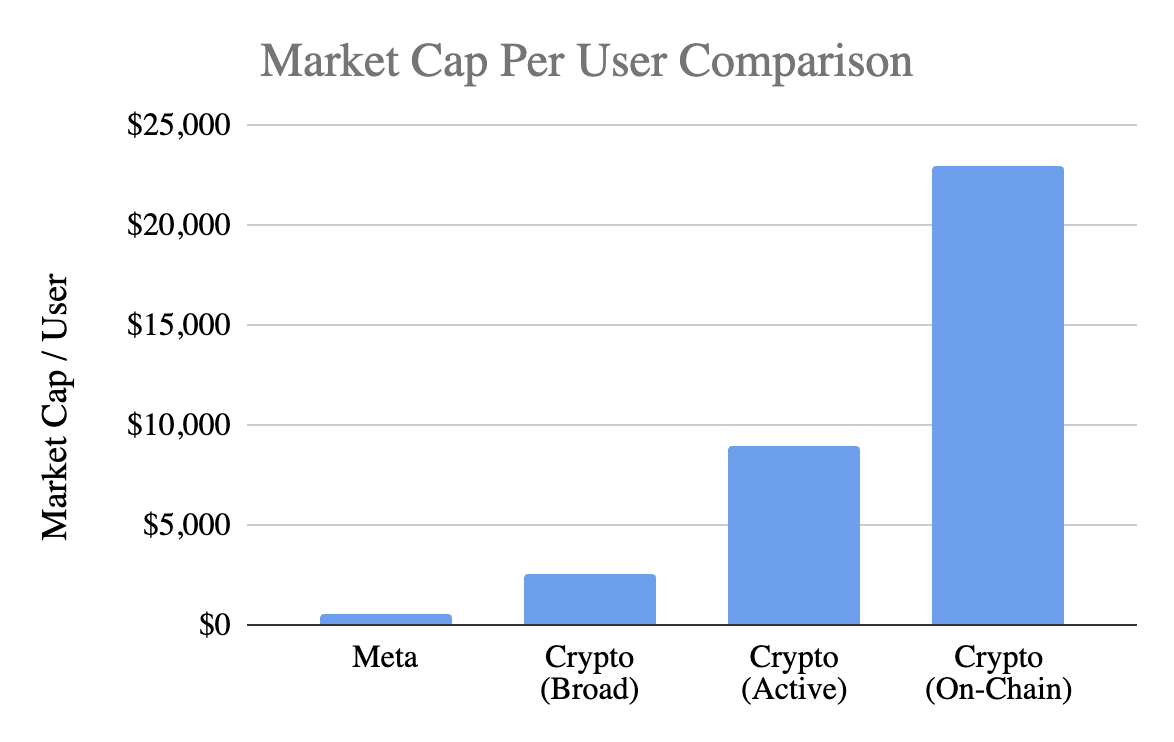
Comparison of market capitalization per user. Source: Santiago Roel Santos
Martin Kupka, a former investor at Web3 investment firm RockawayX, told Cointelegraph that crypto “network effects today can be found in stablecoins, centralized exchanges and perpetual future decentralized exchanges.” He explained that “the more useful it is as a medium of exchange and collateral, the more traders a CEX or perpetual platform has, the deeper the liquidity and the better the execution.”
Wintermute’s De Maere said that “Web3 is modular and the underlying network effects are much easier to see” compared to Web2. He explained that these effects generally emerge in L1 as security and validator concentration, in stablecoins as liquidity, and in decentralized and centralized exchanges, as well as in the application layer where users congregate.
“Because these layers are separable instead of bundled, you can clearly see where the composition takes place,” says De Maere. “Therefore, based on traditional metrics such as ARPU […] they can look overvalued,” he added. The current state of crypto valuation resembles when “we struggled to value Web2 platforms […] and created specific models for this purpose,” he said.
Magazine: Bitcoin whale Metaplanet ‘underwater’ but eyeing more BTC: Asia Express