

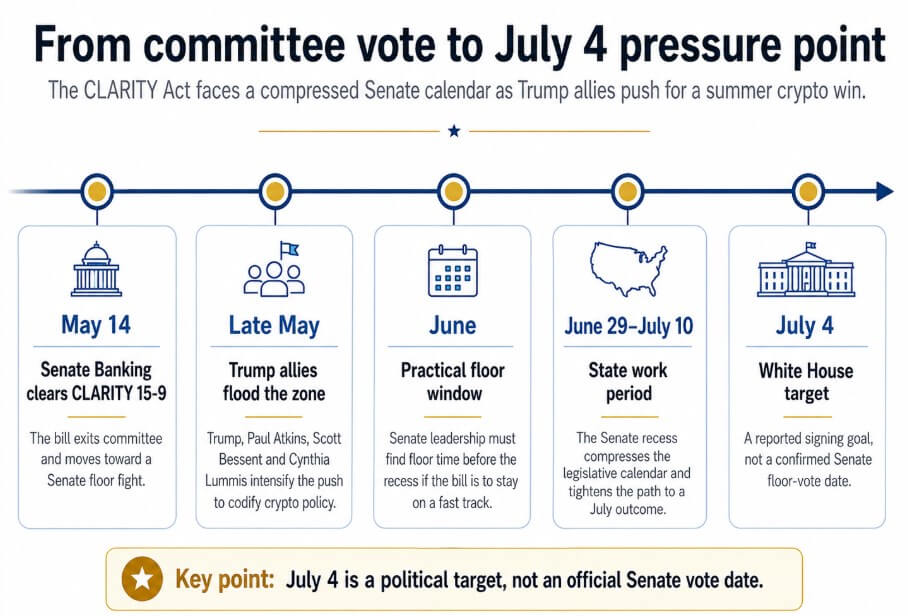
Senate Banking passed the CLARITY Act 15-9 on May 14, and within two weeks, President Donald Trump posted on Truth Social promising to codify a “future-proof” digital asset market that haters couldn’t undo, calling the US the “crypto capital of the world.”
Crypto allies are using the timing to make the argument that a friendly regulatory stance only lasts as long as the regulator owns it, and that the law requires an act of Congress to reverse it.
SEC Chairman Paul Atkins amplified the same line on
Treasury Secretary Scott Bessent urged the Senate to act quickly, warning that floor time is precious, while Senator Cynthia Lummis called this moment the “last chance” to enact CLARITY until at least 2030, with midterm elections as the outer limit.
The Clarity Act and what it stands for
Senate Banking advanced the CLARITY Act, with Chairman Tim Scott declaring it ready for the Senate.
The legislation would divide oversight of digital assets between the SEC and the CFTC, expand CFTC oversight of crypto spot markets, determine when tokens qualify as securities or commodities, require registration and disclosure of covered companies, protect customer funds, and apply Bank Secrecy Act obligations to digital asset companies, turning years of interpretation battles and agency lawsuits into a single legal framework.
The Senate calendar does not include a confirmed date for CLARITY, but the White House is aiming for a showdown as it targets a July 4 signing.
Before signing, Senate leaders must align the banking product with the Senate Agriculture Committee’s separate digital commodities track, pass a merged bill through the full House and align with the House version.
The floor math
Republicans have 53 seats in the Senate, and cloture requires 60 votes, meaning the bill would need seven Democratic or independent votes if every Republican supports it, a threshold the committee reached by just two votes, from Ruben Gallego and Angela Alsobrooks.
Both senators could withhold support on the floor unless the Senate addresses three specific concerns: anti-money laundering provisions that Democratic minority aides say leave illegal financial loopholes around sanctions and mixers, requirements to ban political officials from profiting from crypto ventures they help shape, and stablecoin reward language that banking groups warn could drain deposits from community lenders.
Bank trade associations have positioned themselves as conditional backers, supporting a federal framework in principle but pushing for stricter guardrails on stablecoin rewards, arguing that stablecoin issuers with rewards programs would compete directly with traditional deposit accounts and reduce local lending capacity.
That wedge between the mainstream financial sector and crypto-native industry groups gives Democratic holdouts in the Senate a conventional financial rationale for demanding reviews, aside from AML and ethics concerns.
| Senate Mathematics | To vote |
|---|---|
| Republican seats | 53 |
| Votes needed for cloture | 60 |
| Democratic/independent votes needed if the GOP holds | 7 |
| Democratic yes votes in committee | 2 |
| Additional Democratic/independent votes are still needed | 5 |
The reported July 4 goal relies on Senate leadership maintaining the floor calendar through June, and a state work period running from June 29 to July 10, reducing practical floor time to the weeks before the recess begins.
If leadership does not address CLARITY by the third week of June, the July 4 signing goal will become logistically untenable and any remaining action will have to occur between the end of the recess and the beginning of the recess in August.
Which seven votes will determine the fate of the Clarity Act?
If Gallego and Alsobrooks retain their committee votes and compromise language produces five or more additional Democratic or independent votes, with banks accepting narrower stablecoin reward limits, CLARITY could produce the first broad federal market structure law for digital assets in US history.
The CFTC’s statutory oversight of spot markets gives crypto companies a legal footing that will outlast future administrations, as overturning a statute requires an act of Congress, a higher procedural barrier than just a presidential appointment.
The Crypto Council for Innovation and the Blockchain Association have both argued that a signed bill would accelerate institutional adoption and consolidate U.S. leadership, a claim that carries more weight once it has the force of law behind it than as a lobbying position.
If Democrats find the AML language insufficient, Republicans reject ethics requirements, and the crypto industry lobby keeps stablecoin rewards in place, the seven-vote threshold will not be met and the floor fight will stall.
| Scenario | What needs to be done | Result | Market/Policy Implication |
|---|---|---|---|
| Bull Case: Compromise is adopted | Gallego and Alsobrooks hold firm; 5+ more Democrats/independents accept changes; banks accept narrower stablecoin limits | CLARITY clears the Senate and walks to Trump’s desk | Crypto will have a sustainable legal market structure |
| Base case: July slips | Negotiations continue, but the Senate agenda shortens the meeting time | Bill stays alive, but the Fourth of July goal becomes unrealistic | The industry maintains momentum, but no definitive certainty |
| Bear Box: Floor Fighting Boxes | Disputes over AML, ethics, or stablecoin rewards remain unresolved | CLARITY misses the June window | Crypto relies on friendly regulators, not sustainable legislation |
The industry has the friendliest regulatory environment in a decade, built entirely on Atkins at the SEC, an accommodating CFTC and a pro-crypto White House, positions that the next administration can leave with new appointees and revised guidelines.
Lummis’ “last chance until 2030” formulation lays out the specific costs on a bear case: If CLARITY misses the June window, midterm elections in 2026 could flip Senate seats and close the legislative trail for the rest of the decade.
Trump’s allies waged a flood-the-zone campaign this week to generate enough public and political momentum in June that Democratic backbenchers in the Senate would face greater costs if they block the bill than if they vote yes on a compromise.
Whether that calculation produces seven or more Democratic votes before the June window closes will determine whether the pro-crypto regulatory reversal becomes law or remains a stance that the next SEC chairman can reverse with a memo.