

A lawsuit in New York seeks to treat some of Bitcoin’s oldest dormant wallets, including addresses tied to the cryptocurrency’s creator, as lost property worth less than $10 each.
The changed complaint is asking a state court to award legal ownership of 39,069 Bitcoin addresses to a pseudonymous plaintiff, identified as Noah Doe, and two Wyoming entities, ABC Company and XYZ Company.
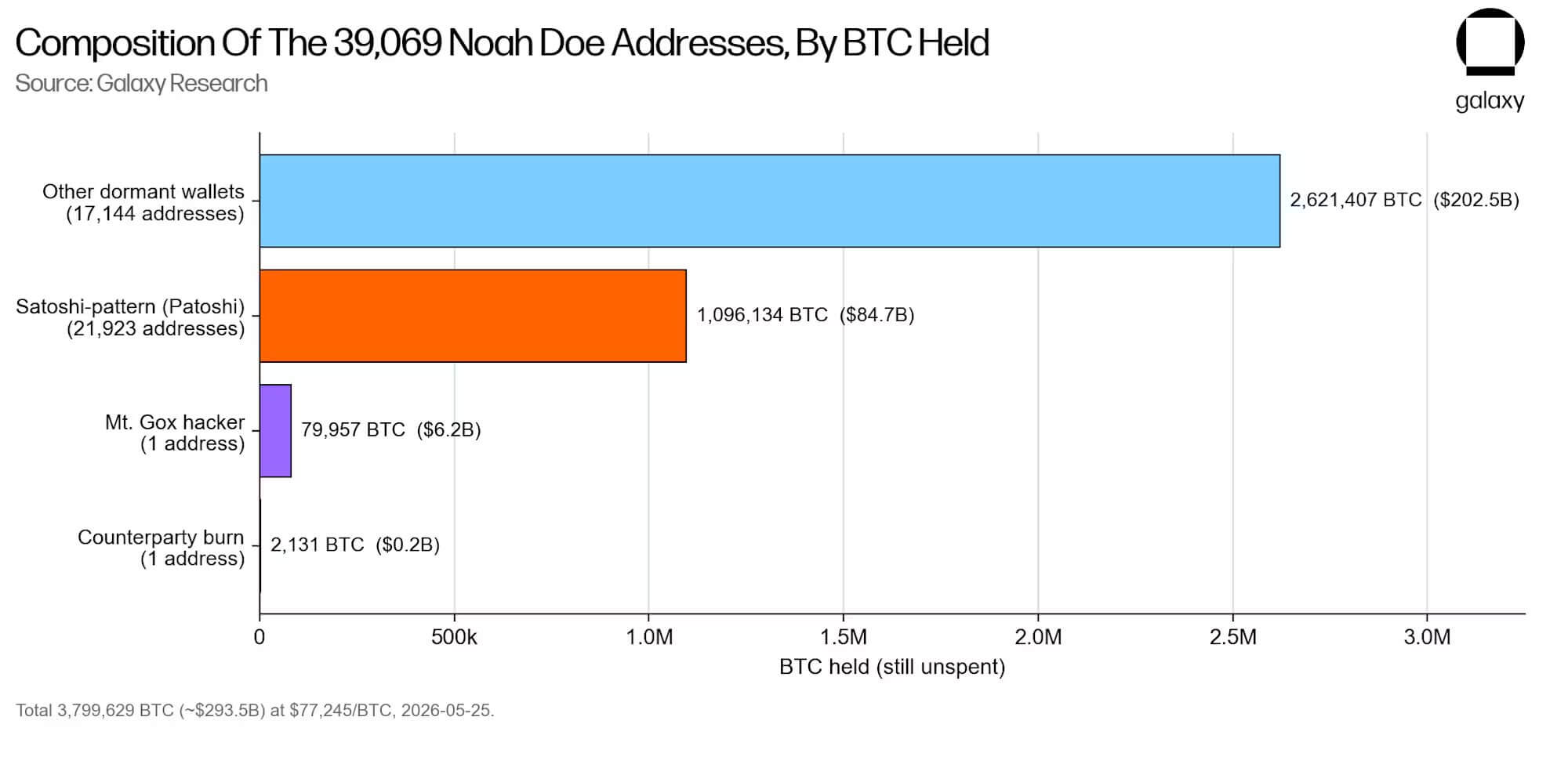
Together, the addresses hold nearly 3.8 million BTC, or about 18% of Bitcoin’s fixed supply of 21 million tokens.
Galaxy Digital stated that almost all of the 39,069 defendant addresses overlap with wallets that received small on-chain transactions in 2025.
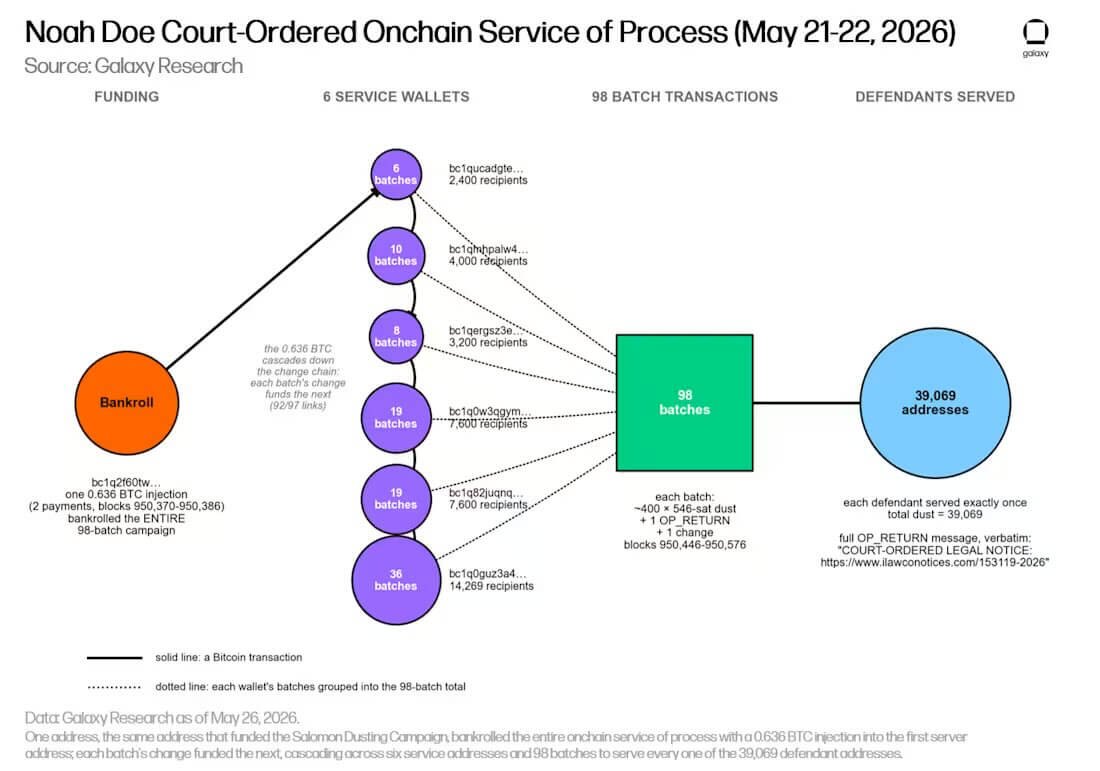
At the time, Salomon Brothers used Bitcoin’s OP_RETURN function to serve legal notices on the dormant wallets, claiming the right to seize them under the “Doctrine of Abandonment” unless the owners responded within 90 days.
After that campaign, hundreds of addresses moved coins and were excluded from the lawsuit. The addresses that remained silent became the defendant set.
An old lost and found statute meets dormant Bitcoin
The plaintiffs’ case hinges on an attempt to fit dormant Bitcoin addresses into New York’s lost property law, a framework designed for physical items to be found, reported and returned.
Noah Doe and the two Wyoming-based entities claim the wallets qualify as abandoned property because they were identified, reported to authorities and left unclaimed for more than a year.
According to the complaint, plaintiffs placed lists of the addresses on USB drives and delivered them to the New York Police Department’s 17th Precinct, followed by an on-chain notification campaign using OP_RETURN messages, a press release, and a claims window intended to demonstrate reasonable efforts to reach the owners.
The plaintiff’s legal efforts rely heavily on Article 7-B of New York’s Personal Property Law, which allows a finder of lost property to claim title after the required holding period if no rightful owner appears.
In ordinary cases, that framework applies to property that is handed over to police and held while an owner is given time to come forward. The lawsuit asks the court to extend this logic to public blockchain addresses whose owners are unknown, inaccessible or silent.
To expedite the lawsuit, the plaintiffs are relying on a controversial valuation strategy, claiming that an unnamed independent expert has valued the contents of each individual wallet at less than $10 because the private keys needed to move the coins are unavailable.
Notably, New York law offers finders a shortcut to property valued at less than $10 if they have made reasonable efforts to locate the owner and have been unsuccessful.
However, data about the chain contradicts this assessment. Galaxy Digital stated that the 39,069 addresses hold an estimated $293.5 billion worth of Bitcoin at current market prices.
A further breakdown of the wallets showed that the average address in the legal claim contains 97.25 BTC, worth approximately $7.5 million, while the median contains exactly 50 BTC, or approximately $3.86 million.
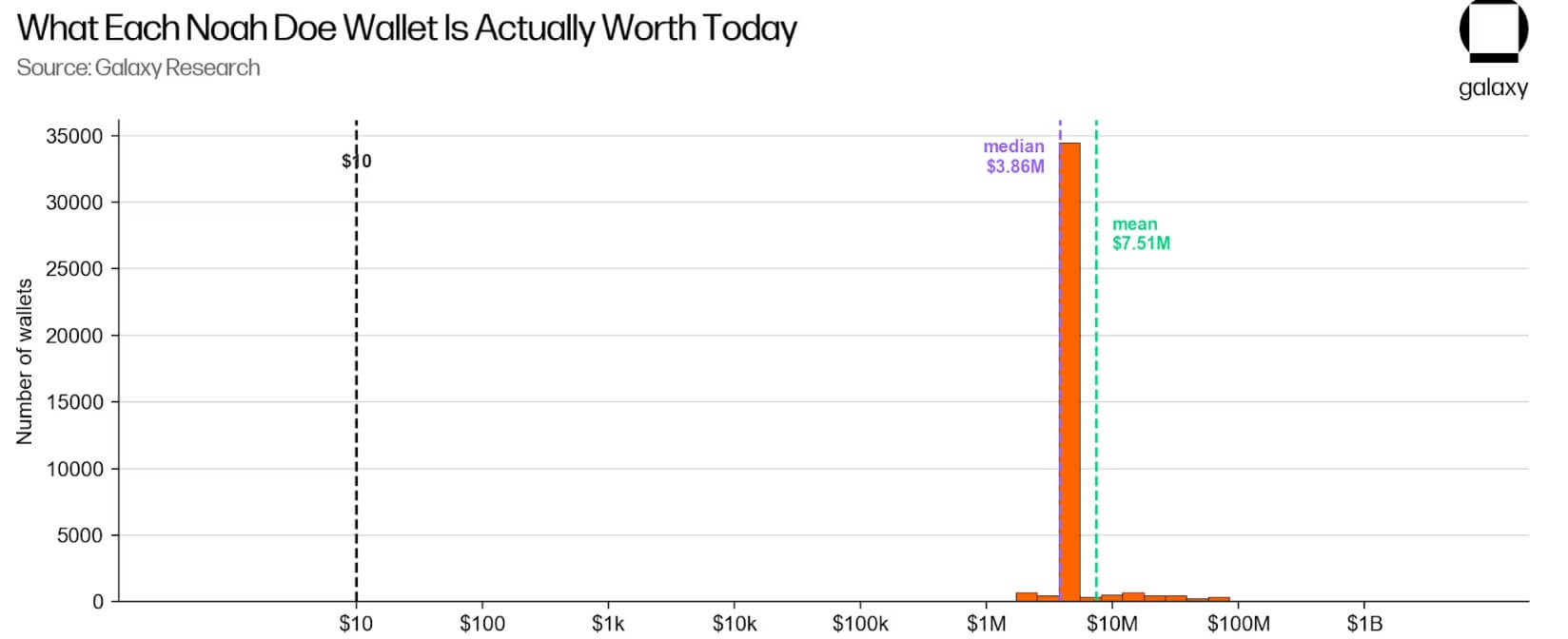
That median of 50 BTC reflects Bitcoin’s original mining reward, meaning many of the defendants appear to be early block payouts that have remained untouched since the network’s early years.
That gap between the legal valuation and the current market value is at the heart of the dispute. If the court accepts the plaintiffs’ position that each address is worth less than $10 because recovery is uncertain, they can argue that ownership was acquired a year after each set of addresses was found.
However, if the court values the property based on the Bitcoin registered at those addresses, the lawsuit becomes much more difficult to place on the expedited track that the plaintiffs are using.
The wallet list reaches the earliest history of Bitcoin
The addresses mentioned in the lawsuit date back to Bitcoin’s earliest years, landing some of the network’s most watched and controversial wallets in a claim based on abandonment.
Galaxy Digital said the list of defendants is anchored by approximately 21,923 Patoshi pattern addresses, a group of early mined wallets long associated with Bitcoin’s pseudonymous creator Satoshi Nakamoto.
These addresses hold approximately 1.096 million Bitcoin, making them one of the largest dormant pools of BTC on the ledger.
Its inclusion gives the case its market importance, but also complicates the plaintiffs’ theory.
Satoshi-linked coins are not obscure assets that have disappeared from view. They have been studied by researchers, investors and forensic analysts for years, as any move from those wallets would likely become one of the most scrutinized events in Bitcoin history.
Meanwhile, another target is a wallet containing 79,957 Bitcoin that blockchain researchers have linked to the Mt. Gox breach in 2011. These coins are commonly treated as stolen and disputed property, a status that sits uneasily with a lost property claim based on abandonment.
In addition, the list also contains a counterparty-linked fire address with 2,131 Bitcoin. Burn addresses are used to remove coins from circulation by sending them to destinations where they cannot be spent.
In that case, the legal claim hits a technical wall, because the address is designed in such a way that no owner can later show up with a private key and move the money.
Many of the remaining wallets last moved between 2009 and 2013, when Bitcoin went from having no market price to trading for a few hundred dollars. Some may have been early miners. Some may reflect lost keys. Others may be cold storage, estate assets, or wallets managed by holders who have chosen not to move their coins.
That uncertainty goes to the heart of the dispute. Bitcoin’s ledger records movement, not intent. A wallet can sit untouched for 15 years because the owner is no longer there, the key is lost, the coins are deliberately held or the address can never be issued.
The lawsuit asks a court to infer the coin’s abandonment from inactivity, even though the blockchain alone cannot explain why a coin has been idle.
This mix shows how difficult it is to apply a physical lost property statute to blockchain records.
A judgment would create leverage, not control
Market analysts emphasize that even a landslide victory in court for the anonymous plaintiffs would not immediately trigger a satoshi.
This is because a court order cannot generate the private cryptographic keys needed to authorize a transaction, nor can it override the immutable mathematics of a decentralized network.
Instead, the real value of a favorable judgment lies in its usefulness as a legal weapon straddling the line between Bitcoin’s permissionless ledger and traditional financial institutions.
If Noah Doe obtains a quiet title declaration from a New York court, that document would serve as a powerful cloud over the title.
Should the legitimate owner of a targeted wallet ever move its Bitcoin to a centralized exchange, an institutional custodian, or a commercial bank, plaintiffs could seek court orders to freeze the accounts. This would trigger lengthy domestic lawsuits, forcing the real owners to come forward and prove their identities.
That dynamic reveals a deep irony at the heart of the matter. The plaintiff was granted permission by Judge Kathy J. King to proceed under a pseudonym, citing the threat of physical violence or kidnapping if his identity were linked to a multi-billion dollar claim.
Yet the legal mechanism he uses forces the actual owners of the dormant wallets to forfeit their own privacy and reveal their identities simply to defend their assets.
Because the defendants are anonymous cryptographic addresses, no traditional defense counsel is expected to appear in court.
Galaxy Digital stated that a technical bankruptcy is likely by the end of June 2026, approximately 30 days after the on-chain process service was executed, and that a formal motion for a default judgment is expected later this summer.
However, the company argued that a victory is highly unlikely. New York judges retain broad discretion in assessing applications for depositions, especially as they face new legal frameworks, questions about process servers and a $10 nominal valuation that puts a $293 billion fortune.
Alex Thorn, head of research at Galaxy Digital, concluded:
“It would be extraordinary if a New York court were to hand three anonymous parties legal ownership of approximately $293 billion worth of BTC, including the coins most closely associated with Satoshi Nakamoto, on a lost and found theory supported by a questionable valuation of less than $10.”