
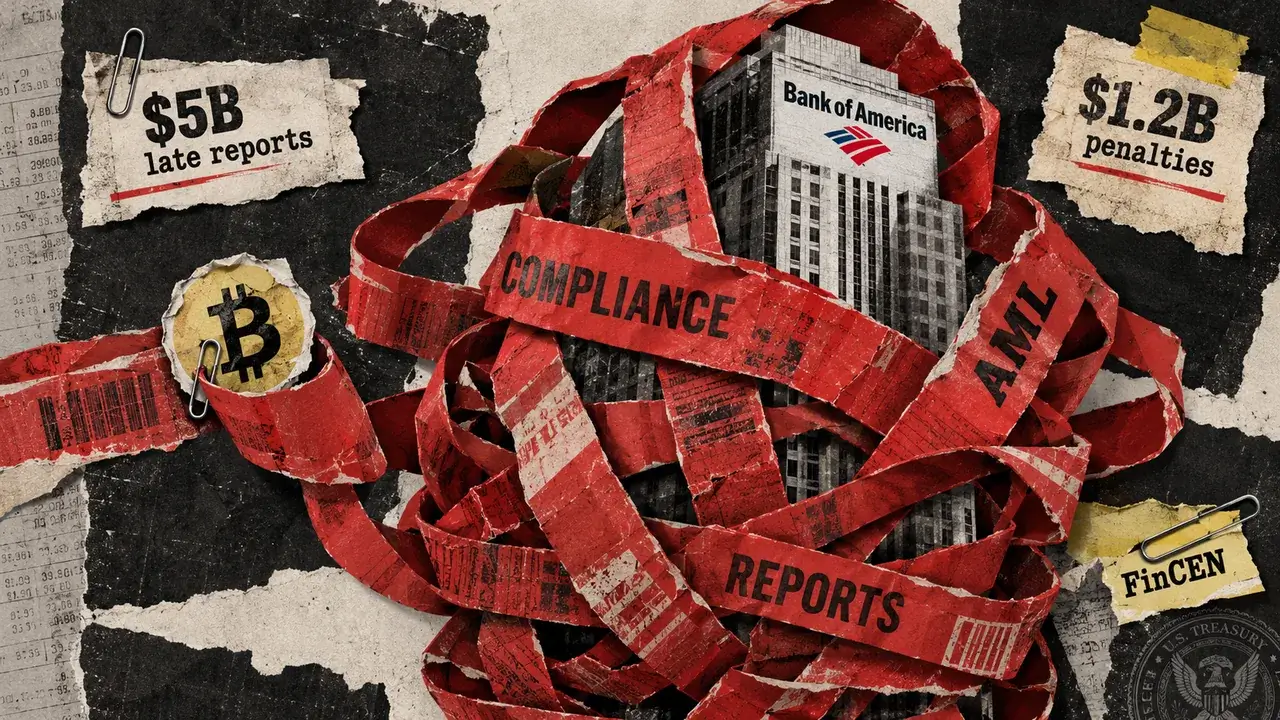
In December 2023, Senator Elizabeth Warren questioned Bank of America CEO Brian Moynihan about whether crypto companies handling financial transactions should adhere to the same anti-money-laundering regulations as traditional banks. Moynihan’s response was a resounding “Absolutely.” Fast forward to October 13, and the Treasury Department announced hefty penalties totaling over $1.2 billion against Bank of America. The Financial Crimes Enforcement Network (FinCEN) revealed that the bank had willfully violated the Bank Secrecy Act by failing to report more than $5 billion in suspicious transactions in a timely manner.
The regulatory findings at Bank of America were severe, with FinCEN levying a $1.2 billion penalty, including the Office of the Comptroller of the Currency’s (OCC) record $750 million fine – the largest civil money penalty ever assessed by the OCC against a bank. Additionally, the Office of Foreign Assets Control (OFAC) announced an $11.6 million settlement for 475 apparent sanctions violations.
The violations admitted by the bank spanned its anti-money-laundering program, due diligence on foreign correspondent accounts, and the filing of suspicious activity reports. Over $1 billion of the belatedly reported transactions posed significant illicit finance and national security risks, including ties to Chinese money laundering networks and potential trade-based laundering near the U.S. southwestern border.
The OCC identified deficiencies in transaction monitoring across trillions of dollars in activity, delayed reporting of billions in transactions, inadequate staff expertise in Bank Secrecy Act compliance, insufficient training, audit failures, and inadequate remediation of a December 2024 cease-and-desist order. Treasury criticized the bank for relying too heavily on external sources to identify suspicious activity rather than utilizing its internal monitoring systems effectively.
According to Comptroller Jonathan Gould, Bank of America processes hundreds of trillions of dollars annually, carrying a high and escalating illicit finance risk profile. The widespread breakdowns in compliance have persisted since the 2024 enforcement order. These findings encompass several years, including the period following Moynihan’s Senate testimony, where he advocated for crypto companies to be subject to equivalent AML obligations as banks.
The banking lobby has been pushing for stricter regulations on the crypto industry, with the Bank Policy Institute (BPI) publishing a policy paper in August 2026 titled “Same Risks, Same Safeguards.” The paper highlights the need for extending Bank Secrecy Act requirements to digital asset firms, particularly focusing on stablecoin activities in secondary markets.
Crypto advocates have used the Bank of America case to showcase the industry’s superior know-your-customer (KYC) practices compared to traditional banks. However, it’s essential to note that the comparison is limited to ongoing transaction monitoring, suspicious activity reporting, and correspondent due diligence. The crypto sector has had its share of regulatory challenges, with Binance pleading guilty to Bank Secrecy Act violations and accepting a hefty fine and independent oversight.
Moving forward, the debate between banks and crypto firms will likely center on consistent AML enforcement standards. Crypto companies that can demonstrate auditable on-chain monitoring, wallet screening, and automated controls may argue that they can meet traditional bank standards. This could lead to a discussion on which systems produce more effective and efficient financial intelligence.
If policymakers interpret the Bank of America case as evidence that AML surveillance needs strengthening across the board, both sectors could face heightened compliance requirements. Exchanges, custodians, and stablecoin intermediaries might see expanded Bank Secrecy Act coverage, while decentralized finance (DeFi), wallets, and stablecoin secondary markets could become focal points for regulatory action.
Moynihan’s assertion that crypto firms should adhere to bank standards now serves as a litmus test for both banks and crypto entities: strict enforcement of existing regulations. The events surrounding Bank of America underscore the importance of upholding AML rules and ensuring financial integrity in the banking and crypto sectors alike.