
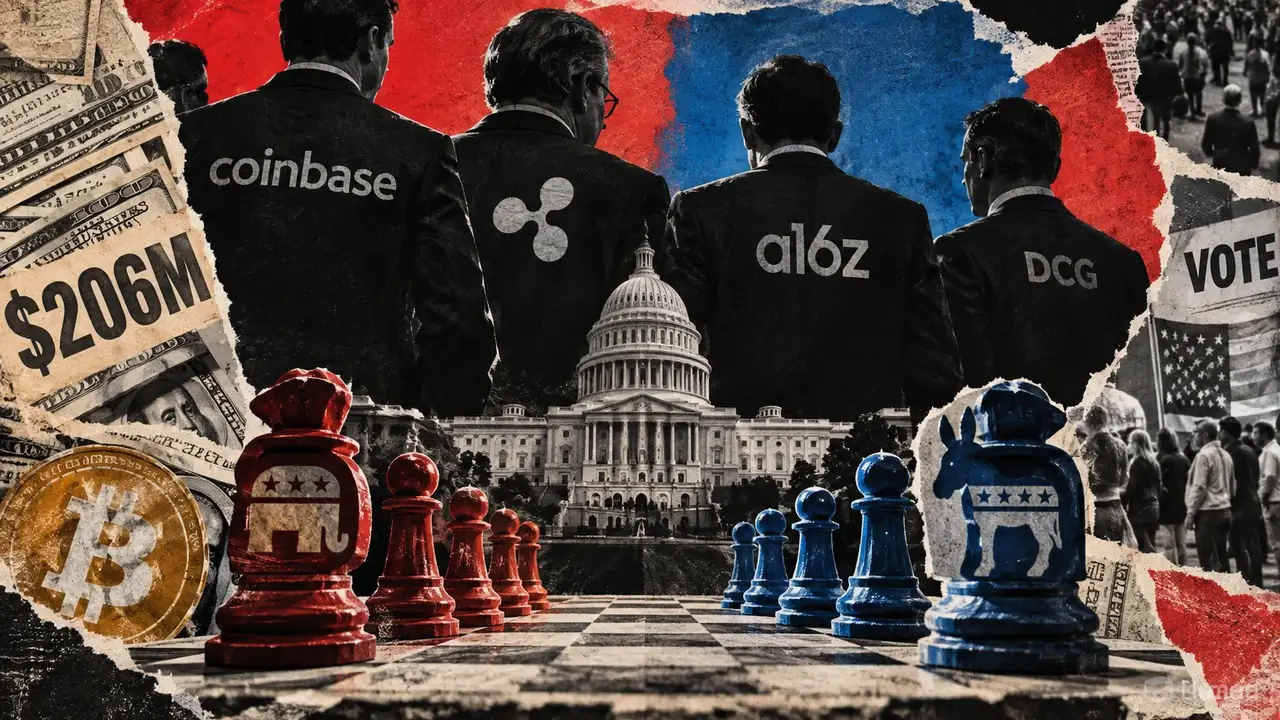
Crypto corporations have been actively involved in political contributions during the 2026 midterm cycle, with a total of $206 million donated to super PACs and hybrid PACs through the second quarter of the year. This makes the crypto industry the largest disclosed corporate donor sector in this cycle, according to an analysis of FEC records by Public Citizen.
However, the $206 million figure only represents corporate donations and does not include the amount spent on campaign ads. The industry’s political activities are spread across several organizations, each with its own financial accounting.
Fairshake, the central committee that anchors the crypto political network, reported $137.9 million in receipts and $93.9 million in disbursements through August 31, leaving $108.3 million in cash on hand. The committee has transferred $70 million to two affiliated PACs, Defend American Jobs and Protect Progress, which support Republican and Democratic candidates respectively.
Notable contributions to the Fairshake network include $56.1 million from Coinbase, $48.5 million from Ripple Labs, and $24 million from Marc Andreessen and Ben Horowitz. These donations cover a narrower network over a different time window than the overall corporate contributions.
The crypto spending is unevenly split by party, with $32.5 million supporting Republican candidates, $21.3 million supporting Democratic candidates, and $15.6 million opposing Democratic candidates. There is no recorded spending opposing Republicans within this network.
Stand With Crypto has endorsed 38 House candidates and mobilized over three million advocates through its platform. Fellowship PAC, backed by Cantor Fitzgerald, has raised $11 million and spent $4.45 million in independent expenditures across 12 races.
Digital Freedom Fund, supported by Winklevoss Capital, reported $22.4 million in receipts but has not spent any on independent expenditures. Fairshake announced a new $30 million commitment to oppose Ohio Democrat Sherrod Brown, with more than $90 million remaining available for the general election.
The bull case scenario suggests that Fairshake and its affiliates will spend a large share of their remaining cash before November, potentially pushing network-wide independent expenditures towards $160 million to $200 million. In contrast, the bear case scenario predicts that most incremental spending will be absorbed by Ohio, with additional cash remaining in reserve or shifting into non-candidate activities.
Overall, the effectiveness of crypto’s political operation in turning fundraising into votes before the midterm elections remains uncertain, highlighting the importance of strategic deployment of financial resources in influencing election outcomes.