
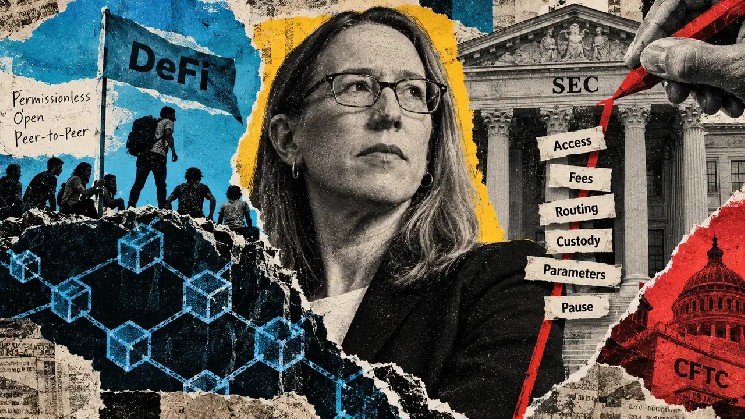
In a recent development on Sept. 17, SEC Commissioner Hester Peirce made a significant statement regarding decentralized finance. She emphasized that investors do not require any exemption to utilize permissionless smart contracts for peer-to-peer trading. This statement draws a clear distinction between decentralized finance and regulated intermediaries, as highlighted by actions taken by the SEC and CFTC.
The key question at hand revolves around the level of control that a software provider can maintain before crossing the line into the realm of a regulated intermediary. Peirce’s statement reflects her personal stance on the matter, as an official definition from the US Securities and Exchange Commission would necessitate Commission intervention. The recent tokenized-securities order issued by the SEC and a corresponding staff statement have left the term “truly decentralized” undefined. These regulatory actions focus on various aspects such as custody, access, software parameters, fees, recommendations, routing, and execution.
It is crucial to note that each regulatory action operates under a distinct statute and carries different legal implications. These actions shed light on how federal regulators are scrutinizing the authority retained by identifiable providers in the decentralized finance space. Despite these efforts, a unified federal test for decentralization is still lacking.
The SEC’s tokenized-securities order delineates control from the market to the frontend. This order provides temporary relief for a designated Tokenized Securities Venue (TSV) that utilizes automated market maker pools for permissioned trading in Tokenized NMS Stocks. The order specifies the functions of a TSV, including providing AMM pools for permissioned participants and setting standards for pool access.
The SEC’s Division of Trading and Markets has also outlined conditions under which staff would not object to certain crypto asset securities interface providers operating without broker-dealer registration. This directive underscores the significance of factors such as default settings, route rankings, preferred venues, and fee incentives in the regulatory assessment of the frontend interface.
On the other hand, the CFTC has taken a more lenient stance by issuing a staff no-action position that allows passive software providers to avoid registering as introducing brokers or associated persons under certain circumstances. This position permits more promotional activities and compensation options compared to the SEC’s interface guidelines.
The determination of what constitutes “truly decentralized” remains subjective, with different regulatory bodies applying their criteria based on the specific statutes under which they operate. Ultimately, the level of control exerted by software providers in terms of access, recommendations, execution, fees, and system management dictates the regulatory framework applicable to them.
In conclusion, while Peirce advocates for a decentralized approach, the regulatory landscape remains fragmented, with distinct boundaries established by the SEC and CFTC actions. It is imperative for builders and users in the decentralized finance space to understand the specific powers and regulatory implications associated with different forms of control within the ecosystem.