
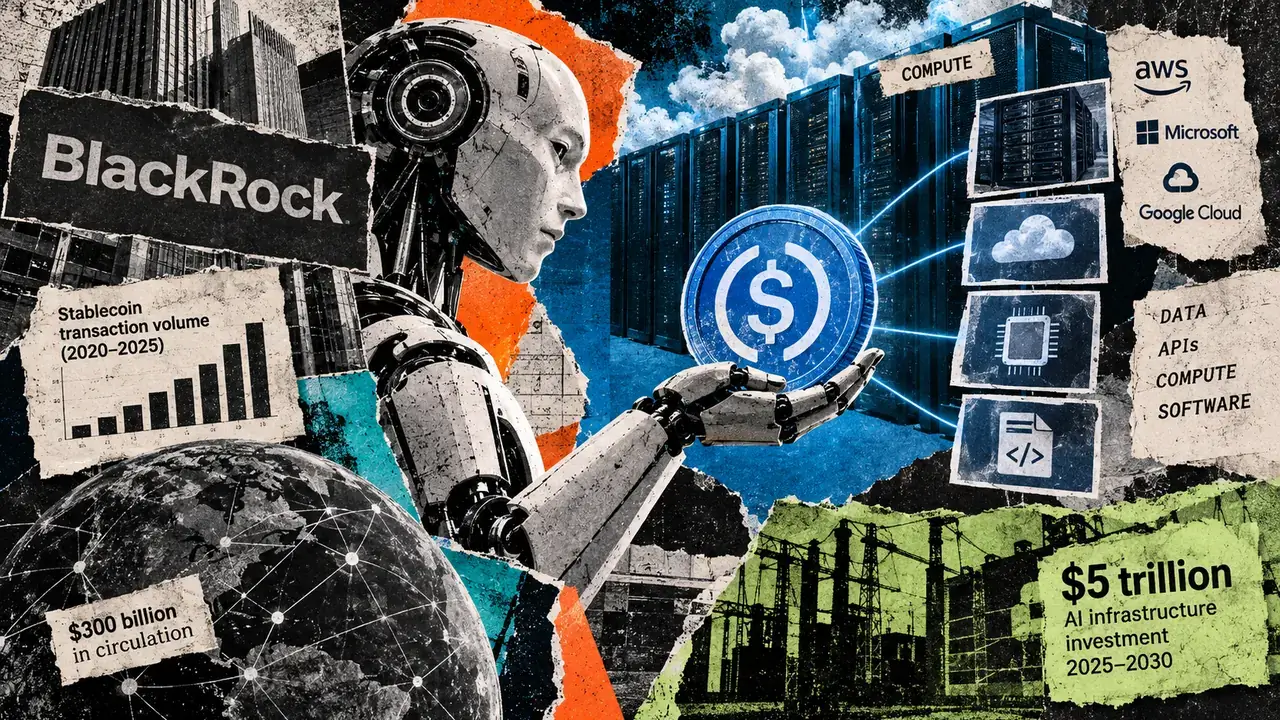
BlackRock, the world’s largest asset manager, envisions a future where artificial intelligence (AI) plays a significant role in economic activity. In a new report titled “The Machine-Native Economy,” BlackRock explores how AI systems could become new customers for stablecoins, continuously making transactions without the need for human approval.
The report highlights the potential for AI agents to autonomously purchase data, access software, and acquire computing resources, leading to a new source of transaction demand in the digital assets space. With stablecoins already circulating over $300 billion and experiencing rapid growth, BlackRock suggests that AI-driven transactions could revolutionize the way economic activity is initiated.
Unlike traditional payment methods like credit cards or bank transfers, AI agents could engage in thousands of small transactions to complete tasks, such as paying for API calls, data feeds, or processing power. These transactions, which may be worth fractions of a cent and occur round the clock, present a unique opportunity for stablecoins to be held in programmable wallets and settle transactions seamlessly without human intervention.
Various payment companies are already exploring ways to facilitate machine-to-machine transactions. Coinbase’s x402 protocol allows services to demand payment before providing data or resources, while Stripe and Tempo are developing the Machine Payments Protocol to enable settlements through stablecoins or traditional payment methods.
The competition among payment protocols complicates the assumption that machine commerce will automatically move onto blockchain networks. While traditional payment networks can adapt to autonomous software, stablecoins have an advantage in scenarios where transactions are small, frequent, or native to software.
As AI systems increasingly rely on computing power, BlackRock predicts a significant market for autonomous agents to navigate computing providers, compare prices, purchase capacity, and settle costs automatically. This could lead to a financial market around standardized claims on computing capacity, trading, and futures markets, with the potential for collateralized assets.
Overall, the rise of AI-driven transactions presents a unique challenge for stablecoin issuers, payment protocols, and blockchain networks. As AI systems gain more authority to spend autonomously, the competition will intensify among infrastructure providers to cater to a customer that values price, settlement speed, and programmability over the underlying financial network.