
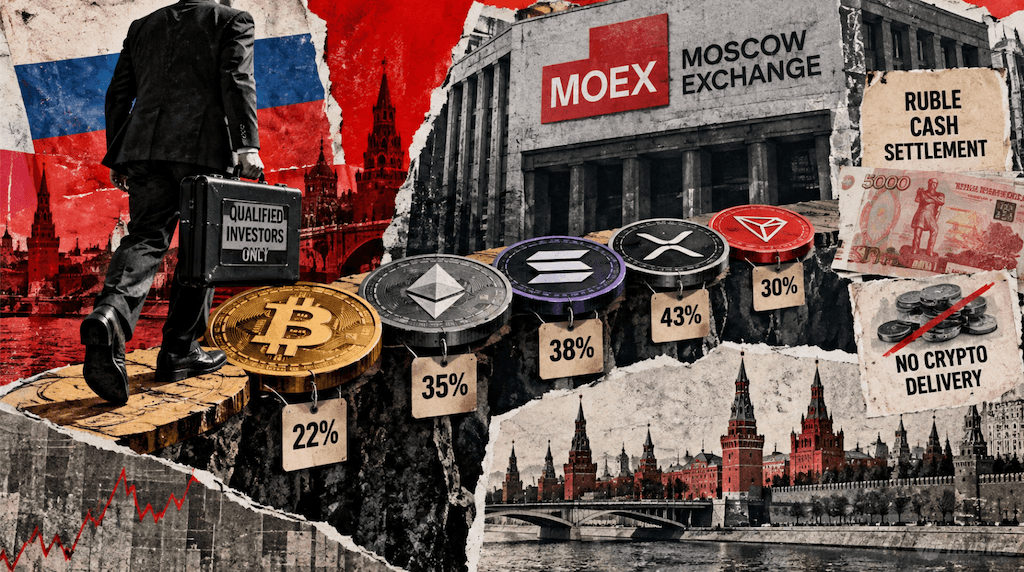
Moscow Exchange is set to introduce perpetual futures contracts tied to five major cryptocurrencies on September 22nd. These contracts, including BTCUSDF, ETHUSDF, SOLUSDF, XRPUSDF, and TRXUSDF, will allow qualified investors to have continuous price exposure to Bitcoin, Ethereum, Solana, XRP, and Tron without the need to own the actual assets.
Unlike traditional spot trading of cryptocurrencies, these futures contracts do not involve the physical delivery of the assets. Instead, they are quoted against US dollar-denominated indexes, with profits and losses settled in Russian rubles. This structure enables investors to benefit from crypto price movements without holding the underlying tokens themselves.
Access to these perpetual futures contracts is limited to qualified investors, as per MOEX regulations. Investors must also provide collateral to trade these contracts, with initial margin rates set at 22% for Bitcoin, 35% for Ether, 38% for Solana, 43% for XRP, and 30% for Tron. The highest initial margin requirement is for XRP among the five contracts.
MOEX has established concentration limits for each contract, ranging from 961 to 4,807 contracts for XRPUSDF. These limits ensure that trading conditions are controlled and prevent excessive exposure for individual investors. Brokers will determine the final trading conditions available to qualified clients based on these limits.
The launch of these perpetual contracts builds upon Moscow Exchange’s existing crypto derivatives offerings. The exchange already provides dated futures tied to crypto indexes, with over 72,000 qualified investors trading its digital-asset futures. Cumulative turnover in these products has surpassed 600 billion rubles, demonstrating strong demand for crypto derivatives trading.
With the introduction of perpetual contracts, investors no longer need to manually roll positions into later-dated futures. Each contract automatically rolls over daily, allowing investors to maintain continuous exposure to crypto prices. Despite the perpetual structure, these products remain cash-settled derivatives, providing regulated exposure to crypto markets without the need to hold the actual cryptocurrencies.