

A recent report by the Wall Street Journal (WSJ) suggested that Coinbase CEO Brian Armstrong was to blame for the failure of the CLARITY Act, a crucial piece of legislation for the crypto industry. However, Armstrong has vehemently denied these claims.
The CLARITY Act faced a setback earlier this week when it did not receive enough votes to move forward to the Senate floor for debate. With no support from Democrats and some Republicans also withholding their approval, the bill fell short of the required votes.
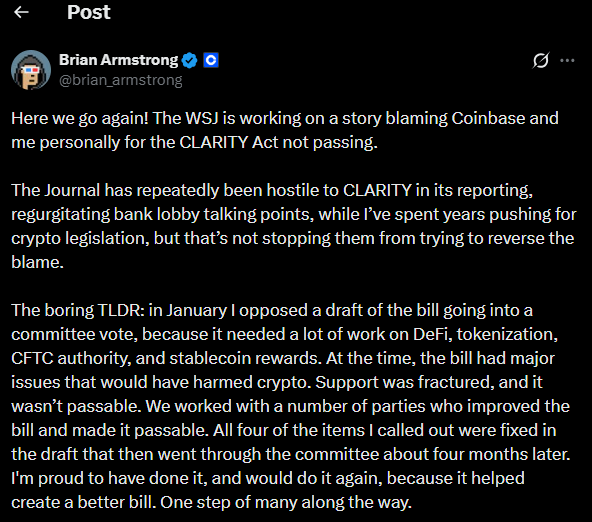
Armstrong clarified his stance on the bill, stating that he initially opposed it in its draft form due to issues related to DeFi, tokenization, CFTC authority, and stablecoin regulations. He believed that the bill needed significant improvements to benefit the crypto industry.
Armstrong defended his opposition, stating that it ultimately led to a better version of the bill. He expressed pride in his decision despite facing criticism from the White House and others in the industry.
After the bill was revised to include a compromise on stablecoin yields, Armstrong threw his support behind it. He criticized the WSJ for allegedly taking direction from bank lobbyists in their coverage of the issue.
Some industry insiders have pointed to former President Trump’s significant crypto profits as a contributing factor to the bill’s failure, citing ethics concerns.
SEC, CFTC Take Steps Towards Crypto Clarity Through Rulemaking
Despite the setback with the CLARITY Act, regulatory bodies such as the SEC and CFTC have begun to address crypto clarity through rulemaking.
The CFTC issued a no-action relief for passive software providers, allowing platforms like self-custodial wallets to offer derivative trading without registering as brokers. Additionally, they have proposed a new market structure framework for crypto platforms seeking approval for leveraged trading.
Similarly, the SEC introduced a tokenization exemption program that allows crypto platforms to facilitate tokenized stock trading without full securities exchange registration.
While these rulemaking efforts provide a temporary pathway for industry growth, there are concerns about potential regulatory risks if a future administration takes a different stance on crypto.

ETF expert Nate Geraci views the rulemaking as a positive development for the industry, but some stakeholders remain cautious about the long-term implications.
Key Takeaways
- Coinbase CEO refutes claims of responsibility for CLARITY Act failure.
- SEC and CFTC’s rulemaking efforts offer potential clarity for the crypto industry.