

Altcoin breadth on Binance has deteriorated sharply, with a large majority of tokens now trading below a commonly viewed long-term trend level, an exhaustion signal that CryptoQuant contributor Darkfost sees as both a liquidity problem and a pricing problem.
In a post on His main claim: “LIQUIDITY CRUNCH PUSHES 83% OF ALTCOINS IN BEAR TREND,” arguing that most investors exposed to non-Bitcoin, non-stablecoin assets “are now in significant distress,” especially those still holding positions.
Altcoin breadth fails on Binance
Darkfost’s chart, titled ‘Altcoins performance (Binance)’, shows the percentage of altcoins below the 50-week moving average returning to historically depressed territory. In his latest reading, 83% of Binance altcoins are below that threshold, a sign that the weakness is not limited to a handful of names but is spreading across the band.
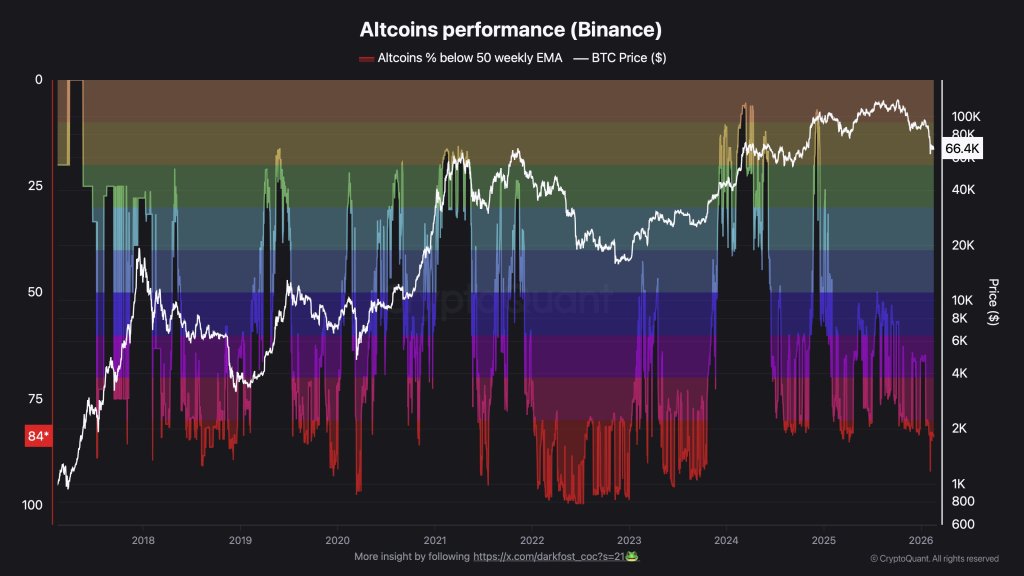
He also pointed to an even more extreme episode earlier this month. “Since the end of the bear market in 2023, a new record was set on February 7, with over 92% of altcoins on Binance below this key technical support,” he wrote, describing it as a post-2023 cycle with a peak in downside participation.
Related reading
This is in stark contrast to conditions during previous upward phases. Darkfost noted that in March 2024, only 6% of Binance altcoins traded below the 50-week mark, and in December 2024 this was 7%. Outside of these multi-month periods, he added, at least half of altcoins remained below the threshold, a behavior he characterized as meaningfully different from the breadth dynamics of the previous cycle.
Darkfost described the altcoin’s decline as inextricably linked to Bitcoin’s trend and macroeconomic backdrop, suggesting that the market’s risk budget has tightened while altcoin supply has increased.
Related reading
“The market is still driven by the movements of BTC, which has been in a downtrend since October 2025 after an ATH of $126,000. At this time, BTC’s momentum remains very uncertain, with the price still hovering around 46% of its all-time high. Rising geopolitical tensions, especially between the US and Iran, in addition to the Fed’s increasingly aggressive projections and tone expressed in the latest FOMC minutes, make the current environment particularly challenging for highly volatile assets like altcoins,” he wrote.
The chart itself marks BTC around the mid-$60,000s, which underlines its broader point: in a regime where Bitcoin’s direction is unclear and macro inputs are hostile to duration and volatility, the breadth of higher beta tokens can quickly deteriorate and then remain compromised.
Why the 50-week line is important
Darkfost highlighted the 50-week moving average as a long-horizon filter used by market participants to separate corrective phases from structurally constructive phases. When a majority of tokens are below it, rallies tend to be narrower, selection pressure increases, and ‘alt season’ narratives become harder to sustain without a decisive shift in liquidity conditions.
He attributed the current setup to “the increase in altcoin supply in the broader crypto market combined with still-constrained liquidity conditions,” a combination that could mechanically dilute marginal flows. In that environment, he argued, outperforming is less about broad beta exposure and more about understanding how the market structure has changed.
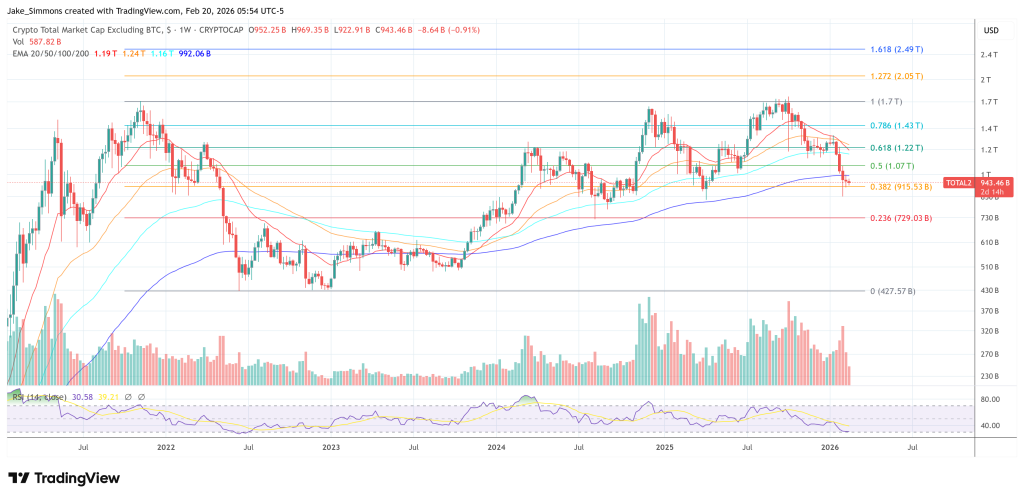
At the time of writing, the total crypto market capitalization excluding Bitcoin was $943.46 billion.
Featured image created with DALL.E, chart from TradingView.com